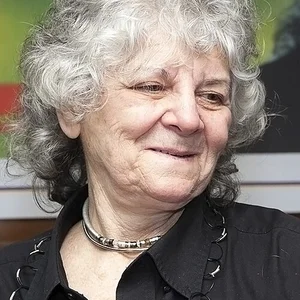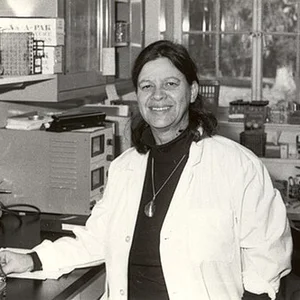

Esther Lederberg (1922-2006) was an American microbiologist who pioneered bacterial genetics. She discovered the lambda bacteriophage and developed the replica plating technique, long overshadowed by her husband Joshua Lederberg.
Esther Lederberg(1922 — 2006)
Esther Lederberg
États-Unis
5 min read
Frequently asked questions
Key Facts
- Born in 1922 in New York into a modest Jewish family.
- Discovered the lambda bacteriophage in 1951, a virus essential to the study of bacterial genetics.
- Developed the replica plating technique around 1952 to grow and identify bacteria.
- Identified the F fertility factor, which explains the transfer of genetic material between bacteria.
- Founded and directed the Plasmid Reference Center at Stanford University from 1976; died in 2006.
Works & Achievements
Identification of a latent virus in E. coli K-12, which became a central tool of molecular biology and genetic engineering.
A simple and revolutionary method for copying bacterial colonies from one dish to another, still used today.
Demonstration that the ability to release a phage is a hereditary trait linked to the bacterial chromosome.
Contributions to understanding the transfer of genetic material between bacteria during conjugation.
Creation of a worldwide reference collection of plasmids at Stanford, standardizing their identification for researchers.
Anecdotes
To quickly compare thousands of bacterial colonies from one dish to another, Esther Lederberg came up with an idea of brilliant simplicity: pressing a piece of sterile velvet onto the colonies, like a stamp, then applying it to fresh dishes. This technique, called “replica plating” (velvet imprinting), is still taught and used in laboratories today.
In 1951, while working on the E. coli K-12 strain, she discovered the bacteriophage lambda: a virus able to hide quietly within the bacterium's genetic material without destroying it, and then to “wake up.” This discovery became a fundamental tool of molecular biology and genetic engineering.
In 1958, her husband Joshua Lederberg received the Nobel Prize in Medicine for work to which Esther had largely contributed. Yet she was neither cited nor rewarded, and would long remain confined to junior researcher positions, without the tenure she deserved.
A lover of early music, Esther played the recorder and was one of the founders of an early-instrument ensemble in the San Francisco area. For her, the rigor of science and the beauty of Renaissance music went perfectly together.
In 1976, she founded and directed the Plasmid Reference Center at Stanford University, a worldwide reference collection allowing researchers across the globe to identify and share bacterial plasmids in a standardized way.
Primary Sources
A piece of sterile velveteen mounted on a cylindrical block is pressed onto the surface of a plate, picking up an impression of the bacterial colonies, which can then be transferred in the same pattern to fresh media.
Cultures of E. coli K-12 carry a latent bacteriophage which can be liberated, indicating that the strain is lysogenic.
The capacity to liberate phage (lysogenicity) behaves as a heritable character associated with a determinant carried by the bacterial chromosome.
Key Places
New York City borough where Esther Lederberg was born in 1922, into a modest family during the interwar years.
Institution where she earned her bachelor's degree in 1942, specializing in biochemistry despite advice steering her toward other paths.
University where she earned her doctorate in 1950 and made her major discoveries on the lambda phage and replica plating.
University she joined in 1959, where she founded the Plasmid Reference Center and worked until her retirement; she died there in 2006.
Typical Objects

A wooden cylinder covered with sterile velvet, pressed onto a culture dish to copy the pattern of all the bacterial colonies onto fresh dishes in a single motion.
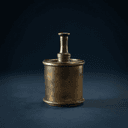
A small circular container made of glass or plastic holding an agar medium, on which the bacterial colonies studied in the laboratory grow.
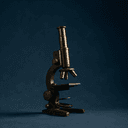
An optical instrument for observing microorganisms and the details of cultures that are invisible to the naked eye.

A source of UV light used to induce mutations or awaken a latent virus such as the lambda phage hidden inside bacteria.
A notebook in which the researcher records each experiment, its conditions and its results, an essential part of the scientific method.
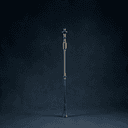
An early music instrument that Esther played passionately within a Renaissance music ensemble.
School Curriculum
Vocabulary & Tags
Key Vocabulary
Tags
Daily Life
Morning
Esther arrived early at the laboratory to prepare her culture media and seed her Petri dishes. The first hours were spent examining the previous day's cultures, spotting interesting colonies, and planning the day's experiments.
Afternoon
Afternoons were spent handling bacteria and phages: inoculations, UV irradiations, and replica plating using velvet. She meticulously recorded every result in her lab notebook and discussed her work with colleagues in the department.
Evening
At the end of the day, she analyzed her results and wrote up papers and scientific correspondence. Several evenings a week, she devoted herself to her passion for early music, practicing the recorder.
Food
Her diet was that of a middle-class American in the mid-twentieth century: simple meals, coffee in the lab, and lunches sometimes eaten on campus between experiments.
Clothing
At work, she wore a white lab coat over plain, practical clothing. Outside the lab, her style remained that of American academics of the era—elegant but understated.
Housing
She lived in university housing and later in homes near the Wisconsin and Stanford campuses, in a typical American residential setting of the second half of the twentieth century.
Historical Timeline
Period Vocabulary
Liens externes & ressources
Références
Œuvres
Découverte du bactériophage lambda
1951
Technique du replica plating (empreinte sur velours)
1952
Études génétiques de la lysogénie chez E. coli
1953
Travaux sur le facteur F de fertilité
1952-1960
Fondation du Plasmid Reference Center
1976