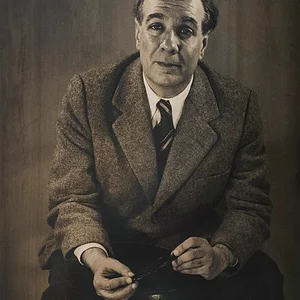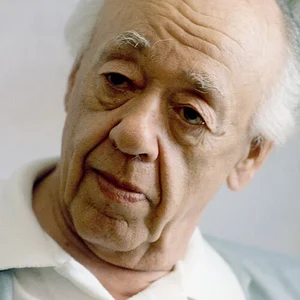

Franco-Romanian playwright (1909–1994), Eugène Ionesco is one of the founders of the Theatre of the Absurd. His plays, marked by humor, absurdity, and a critique of mass society, revolutionized contemporary theatre.
Eugène Ionesco(1909 — 1994)
Eugène Ionesco
Roumanie
8 min read
Frequently asked questions
Famous Quotes
« The real drama is repetition, habit, custom.»
« Modern man has no time to live.»
Key Facts
- 1950: premiere of 'The Bald Soprano', a founding work of the Theatre of the Absurd
- 1959: premiere of 'Rhinoceros', a critique of submission to totalitarianism
- 1970: elected to the Académie française
- Exploration of the emptiness of everyday dialogue and human incommunicability
- Development of a theatre grounded in absurdity and logical nonsense
Works & Achievements
The founding anti-play of the Theatre of the Absurd, it stages characters exchanging meaningless platitudes. Performed without interruption since 1957 at the Théâtre de la Huchette, it remains Ionesco's most iconic work.
A professor and his student clash during a lesson that spirals into pure violence. The play explores the oppressive power of language and authority, recurring themes in Ionesco's work.
An elderly couple multiplies empty chairs to welcome invisible guests who have come to hear a crucial message that will never be delivered. A work about the emptiness of communication and human solitude.
In an ordinary town, the inhabitants transform one by one into rhinoceroses. A powerful metaphor for the rise of totalitarianism and conformism, it is Ionesco's most political play.
A king learns he will die within the hour and refuses to accept it. A personal and universal meditation on death and the refusal to accept it, considered Ionesco's most intimate work.
A collection of essays and reflections on theatre in which Ionesco sets out his vision of dramatic art, defends the Theatre of the Absurd, and responds to his critics. An essential document for understanding his approach.
A fragmentary personal diary in which Ionesco shares his existential anxieties, dreams, and reflections on death, politics, and creativity. A revealing text on the depth of his inner life.
Anecdotes
Ionesco recounts that the idea for The Bald Soprano came to him while learning English with the Assimil method. The absurd phrases in the textbook — 'The ceiling is above, the floor is below' — struck him as so comical and so devoid of meaning that he turned them into the material for an entire play. The premiere, in 1950 at the Théâtre des Noctambules, was performed before an audience of three.
During a rehearsal of Rhinoceros in 1959, Ionesco demanded that the actors physically imitate rhinoceroses on stage. He believed the play had to provoke a visceral unease in the audience confronting the rise of conformism and totalitarianism. Jean-Louis Barrault, who was directing the play, had to negotiate at length to find a balance between the absurd and realistic acting.
Ionesco was elected to the Académie française in 1970, which earned him much mockery from intellectuals such as Sartre, who himself refused such institutions. Ironically, the author who had spent his entire life criticizing hollow speeches and empty social rituals found himself delivering an acceptance speech under the Coupole, dressed in the traditional green coat and sword.
A refugee in France during the Second World War, having fled the fascist Iron Guard regime in Romania, Ionesco lived through the Occupation in Paris in conditions of great hardship. This firsthand experience of totalitarianism profoundly shaped his theatre, most notably Rhinoceros, in which the transformation of men into wild beasts illustrates the contagion of mass ideologies.
Ionesco suffered from a panicked fear of death, which he called 'the great absence'. He wrote about it in his private diaries and in plays such as Exit the King. Toward the end of his life, he turned to painting and drawing, creating works populated by ghostly figures and rhinoceroses, as if to exorcise his deepest anxieties.
Primary Sources
Theatre is not the reproduction of reality. It is not the imitation of life. It is life itself, or rather a certain way of seeing life, of magnifying it, of bringing it to a kind of paroxysm.
I am afraid. I am afraid of dying and I am afraid of living. These two fears are not alike. One is known and the other remains mysterious, and that is perhaps why it is even more terrifying.
In writing this play, I had no intention of writing a comedy, or a satire, or anything else. I simply wanted to put on stage people who had nothing to say to each other.
Rhinoceros is, above all, a play against collective hysterias and epidemics that hide beneath the cover of reason and ideas, but which are nonetheless grave collective illnesses.
Literature is the conscience of a people, it is their living memory. It can also be their critical conscience, lucid, capable of saying no to what is not human.
Key Places
Eugène Ionesco's birthplace, where he was born on November 26, 1909. His Romanian roots and attachment to the French language would fuel a lifelong sense of being a stranger everywhere.
Since 1957, The Bald Soprano and The Lesson have been performed there without interruption, making this Latin Quarter theatre an iconic venue of contemporary drama. It is the longest-running show in the history of French theatre.
Ionesco lived and worked for many years in this Parisian apartment overlooking the Tuileries Gardens, where he wrote a large part of his plays and journals.
The burial place of Eugène Ionesco, who died on March 28, 1994. His simple tombstone stands near those of other great writers and artists of the 20th century.
Ionesco was elected to seat number 6 there in 1970, joining the institution not without irony — he who had built his entire body of work on a critique of social rituals and fossilized language.
Typical Objects

It was while studying English with this language manual that Ionesco discovered the absurdity of didactic phrases, the direct inspiration for The Bald Soprano. This mundane object was the origin of a theatrical revolution.

Ionesco wrote his plays and personal diaries on the typewriter in his Parisian apartment. It symbolizes the daily, solitary work of the writer confronting the language he was deconstructing.

Ionesco kept very rich personal diaries, published in the form of fragmentary journals. These notebooks served as a space to explore his existential anxieties, his dreams, and his reflections on theatre.

From the 1970s onward, Ionesco devoted himself increasingly to painting, creating dreamlike and anguished works populated by rhinoceroses and ghostly figures. Painting was for him another way of expressing the unspeakable.

The central object of the play The Chairs (1952), where empty chairs accumulate on stage to symbolize absence and the emptiness of human discourse. The chair has become one of the best-known symbols of Theatre of the Absurd.

Ionesco was an avid reader of the press and an engaged columnist, notably in Le Figaro, where he defended anti-communist and anti-totalitarian positions that put him at odds with part of the Parisian intelligentsia.
School Curriculum
Vocabulary & Tags
Key Vocabulary
Daily Life
Morning
Ionesco woke up late, around nine or ten o'clock, and began the day with a long period of half-sleep during which he jotted down his dreams in a notebook kept on his bedside table. These dream notes directly fed into his theatrical writing and personal journals.
Afternoon
The afternoon was devoted to writing, often at his typewriter in his Parisian apartment. He sometimes received directors or actors to discuss his plays, and frequented the cafés of the Latin Quarter where the intellectuals and artists of the time would gather.
Evening
Evenings were often spent at the theatre attending rehearsals or performances of his plays. Ionesco enjoyed lively dinners with writer and artist friends, but suffered from chronic insomnia linked to his existential anxieties.
Food
Ionesco appreciated traditional French cuisine, particularly slow-cooked dishes and family meals, a legacy of his Franco-Romanian childhood. He was a great lover of French wines and coffee, beverages that accompanied his long sessions of writing and conversation.
Clothing
Ionesco dressed in a sober, bourgeois manner, jacket and tie being standard in the Parisian intellectual circles of the 1950s–1970s. He often wore thick-framed glasses and had a round, expressive face that caricaturists loved to sketch.
Housing
Ionesco lived in a comfortable apartment in central Paris, overlooking the Tuileries for part of his life. His interior blended bookshelves overflowing with books, canvases painted by his own hand hung on the walls, and a desk cluttered with manuscripts and notebooks.
Historical Timeline
Period Vocabulary
Visual Style
Un style visuel minimaliste et expressionniste, entre le noir et blanc des petits théâtres d'avant-garde parisiens et l'absurde surréaliste des affiches de théâtre des années 1950-1960.
Sound Ambience
L'ambiance sonore des petits théâtres parisiens des années 1950, entre le silence chargé d'angoisse et les ruptures sonores absurdes qui caractérisent les mises en scène de Ionesco.
Liens externes & ressources
Références
Œuvres
La Cantatrice chauve
1950
La Leçon
1951
Les Chaises
1952
Rhinocéros
1959
Le Roi se meurt
1962
Notes et contre-notes
1962
Journal en miettes
1967