
Argentine writer
Jorge Luis Borges(1899 — 1986)
Jorge Luis Borges
Argentine
8 min read
Frequently asked questions
Famous Quotes
« Une bibliothèque peut être interprétée comme un miroir qui révèle, d'une façon ou d'une autre, les traits du monde.»
« Je ne parle pas de la vengeance ni du pardon : l'oubli est la seule vengeance et le seul pardon.»
Key Facts
- Naît à Buenos Aires en 1899 dans une famille bilingue (espagnol et anglais) ; passe son adolescence en Europe.
- Publie Fictions en 1944, recueil fondateur de la littérature fantastique et métafictionnelle.
- Devient directeur de la Bibliothèque nationale d'Argentine en 1955, alors qu'il perd progressivement la vue.
- Candidat régulier au prix Nobel de littérature sans jamais l'obtenir ; reçoit le prix Cervantes en 1979.
- Meurt à Genève en 1986, laissant une œuvre traduite dans le monde entier et influençant des générations d'auteurs.
Works & Achievements
A foundational short story collection containing 'The Library of Babel', 'The Garden of Forking Paths' and 'Pierre Ménard, Author of the Quixote'. This book revolutionized world literature by inventing a narrative form blending the fantastical, philosophy, and fictional erudition.
Borges' second major short story collection, notably containing 'The Aleph' and 'Death and the Compass'. In it he explores themes of infinity, circular time, and labyrinths with unparalleled stylistic mastery.
A collection of literary and philosophical essays in which Borges analyzes authors, ideas, and paradoxes with fascinating erudition. This book reveals Borges as a universal reader and original thinker.
A hybrid work blending prose poems, fables, and short parables. Borges here achieves a form of maximum distillation, condensing entire universes into a few lines.
A short story collection marking a return to more direct and realistic writing, inspired by Kipling. Borges explores themes tied to Argentine identity, violence, and fate.
One of his last major collections, containing the eponymous story about a book with infinite pages. Written after his total blindness and dictated, it bears witness to an imagination intact and as vertiginous as ever.
Anecdotes
Borges suffered from a hereditary eye disease that gradually rendered him blind. Having become almost completely blind around the age of 55, he was appointed director of the National Library of Argentina in 1955 — an irony of fate he never failed to point out with humor: 'God gave me at once the books and the night.'
A bilingual child, Borges learned English before Spanish thanks to his English paternal grandmother. He read Don Quixote in English before reading it in Cervantes's original language, which gave him throughout his life a detached and universal perspective on literature.
In 1938, Borges suffered a serious accident: climbing a staircase in the dark, he struck an open skylight and badly injured his head. Hospitalized, he narrowly escaped septicemia. It was during his convalescence that he wrote 'Pierre Ménard, Author of the Quixote', one of his most celebrated short stories, as if to prove he had retained his mental faculties.
Borges never received the Nobel Prize in Literature, despite numerous nominations. Many writers and critics consider he was unjustly denied it, and this absence remains one of the most debated controversies in the history of the prize. He did, however, receive the prestigious Cervantes Prize in 1979.
A passionate reader of English and American fantastic literature, Borges was one of the first translators into Spanish of authors such as Edgar Allan Poe, Virginia Woolf, and William Faulkner. He thus contributed to bringing Anglo-Saxon literature to Latin America while forging his own style.
Primary Sources
The Library of Babel is total — its shelves record all possible combinations of the twenty-odd orthographic symbols... that is to say, everything that it is possible to express, in all languages.
In the lower part of the step, toward the right, I saw a small iridescent sphere of almost unbearable brilliance. At first I thought it was spinning; then I understood that this movement was an illusion produced by the dizzying spectacles it contained. The Aleph's diameter must have been two or three centimeters, but cosmic space was contained within it, with no reduction in volume.
I must confess that I have often imagined the invention of the mirror and wondered whether it might not have been enough to build an entire mythology. Mirrors and fatherhood are abominable because they multiply mankind.
Together we have invented so many characters, so many plots, that I no longer always know where my imagination ends and yours begins. Perhaps that is how literature ought to work.
Key Places
Borges's birthplace and main place of residence, whose neighbourhoods — notably Palermo where he grew up — deeply permeated his literary imagination. He walked its streets until his complete blindness, retaining in memory every detail of its urban labyrinths.
Borges served as its director from 1955 to 1973 and spent a large part of his professional life there. It is the real library that inspired him to create the metaphor of the 'Library of Babel', a universal labyrinth of all human knowledge.
Borges lived there as a teenager from 1914 to 1919, learned French and German, and discovered Schopenhauer. He chose to end his life there and died in 1986; he is buried in the Kings' Cemetery.
Borges stayed there from 1919 to 1921 and actively participated in the Ultraist movement, the first Spanish literary avant-garde. This experience forged his earliest skills as a writer and poet.
In 1967–1968, Borges delivered the prestigious Charles Eliot Norton Lectures on poetry and literature there. These lectures, published under the title 'Seven Nights', earned him worldwide academic recognition.
Typical Objects

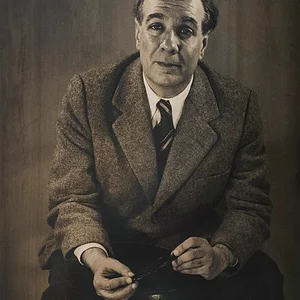
Afflicted with hereditary retinal degeneration, Borges used magnifying glasses and thick-lensed spectacles throughout his life before losing his sight entirely. These objects symbolize the paradoxical tension between his passion for books and his progressive disability.

After becoming nearly completely blind, Borges navigated the streets of Buenos Aires — which he knew by heart — with a white cane. He made it a literary symbol, saying that darkness had forced him to invent a new inner vision.

Director of the National Library of Argentina from 1955 to 1973, Borges was surrounded by hundreds of thousands of books he could no longer read. This library was the direct inspiration for his best-known work, 'The Library of Babel'.

Before losing his sight, Borges typed his texts on a typewriter. After going blind, he dictated his works to his mother and later to secretaries, but the typewriter remained on his desk as a symbol of his craft as a writer.

Borges had both a phobia and an obsessive fascination with mirrors, which appear throughout many of his short stories. He said that mirrors 'populate space' by multiplying images, and saw in them a metaphor for identity and infinity.

In his eponymous short story, Borges invents a book with infinite pages that can never be found twice. This fictional object illustrates his literary obsession with infinity, the labyrinth, and philosophical paradoxes.
School Curriculum
Vocabulary & Tags
Key Vocabulary
Tags
Daily Life
Morning
Borges rose early and devoted his mornings to reading and writing. Before his total blindness, he read alone at his desk using a powerful magnifying glass; afterward, he dictated to his mother Leonor or to a secretary. He worked methodically, revising each sentence aloud.
Afternoon
In the afternoons, Borges often went to the National Library where he managed the staff and received visitors. He also walked the streets of Buenos Aires, guided by his cane and his prodigious memory of the neighborhoods of his childhood, meeting friends in cafés in the city center.
Evening
In the evening, Borges dined simply with family — for a long time with his mother — and devoted himself to literary conversation. A great admirer of English fantastic literature, he often had texts by Poe, Stevenson, or Kipling read aloud to him before bed.
Food
Borges had a modest and unsophisticated diet, typical of the educated Argentine middle class. He enjoyed maté, the Argentine national drink, grilled meats, and simple family meals, with no particular interest in gastronomy.
Clothing
Borges dressed in a classic and understated manner: dark suit, white shirt, plain tie. He wore very thick-lensed glasses and, after losing his sight, never went without his white cane. His sober appearance reflected his disinterest in worldly appearances.
Housing
Borges lived for many years with his mother in a modest apartment in Buenos Aires, first in the Palermo neighborhood and later in a more central area. His study was overrun with books from floor to ceiling. He never sought material luxury, preferring to invest in books and intellectual travels.
Historical Timeline
Period Vocabulary
Visual Style
Esthétique noir et blanc inspirée du Buenos Aires des années 40-50, bibliothèques labyrinthiques et lumière dorée sur les livres anciens, avec une tension entre ombre et lumière.
Sound Ambience
Ambiance sonore de Buenos Aires des années 1940-1960 : tango lointain, bibliothèque silencieuse, rues pavées et tramways électriques du quartier Palermo.
Liens externes & ressources
Références
Œuvres
Fictions (Ficciones)
1944
Enquêtes (Otras inquisiciones)
1952
L'Auteur et autres textes (El hacedor)
1960
Le Rapport de Brodie (El informe de Brodie)
1970
Le Livre de sable (El libro de arena)
1975