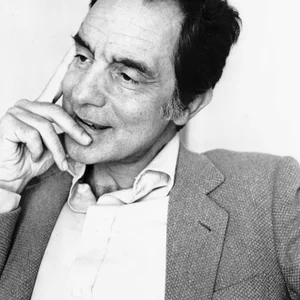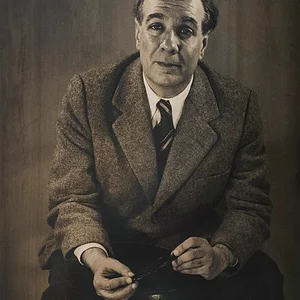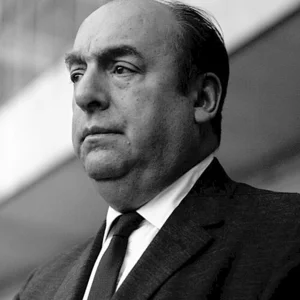

A major Chilean poet of the 20th century (1904–1973), Pablo Neruda is celebrated for his political commitment and wide-ranging poetic work, which earned him the Nobel Prize in Literature in 1971. A Communist activist and diplomat, he embodies the engaged intellectual in Latin America.
Pablo Neruda(1904 — 1973)
Pablo Neruda
Chili
8 min read
Frequently asked questions
Famous Quotes
« I want to do with you what spring does with the cherry trees»
« Tonight I can write the saddest lines»
« Me gusta la vida, caramba, me gusta vivir»
Key Facts
- Published 'Twenty Love Poems and a Song of Despair' in 1924, his first major success
- Wrote 'Residence on Earth' (1933–1947), a landmark work of Hispanic modernism
- Awarded the Nobel Prize in Literature in 1971 for his political commitment and humanist poetry
- Became politically active as a Communist sympathizer from the 1930s and served as Chilean ambassador
- Died on September 23, 1973, just days after the military coup in Chile
Works & Achievements
A collection of love poetry written at the age of twenty, which became one of the most widely read poetry books in the Spanish language. It introduced Neruda to the general public and laid the foundations of his sensual and melancholic lyricism.
Two collections written during his years as a solitary consul in Southeast Asia, marked by existential anguish and a dark surrealism. They bear witness to his evolution toward a more complex and tormented poetry.
A collection of poems in homage to the Spanish people and the Republic, written during the Civil War. This text marks the decisive political turning point in his work and was printed at the Republican front.
A poetic epic of 340 poems tracing the history of Latin America from its origins to the twentieth century. Considered his masterpiece, it was translated into more than thirty languages.
A collection celebrating with humor and tenderness the objects and beings of everyday life (the onion, the artichoke, a pair of socks). This accessible poetry illustrates his desire to reach ordinary people.
An autobiography published after his death, retracing with lyricism and humor his travels, his loves, his political commitments, and his vision of poetry. An essential document for understanding both the man and his work.
Anecdotes
Pablo Neruda was not his real name: he was actually born Ricardo Eliécer Neftalí Reyes Basoalto. He adopted the pen name 'Pablo Neruda' in his teenage years to hide his literary activities from his father, who opposed them. He was inspired by the Czech poet Jan Neruda, whose name he had come across by chance in a magazine.
In 1936, during the Spanish Civil War, Neruda was serving as Chile's consul in Madrid. He was deeply affected by the execution of his friend the poet Federico García Lorca at the hands of Franco's Nationalists. This event radicalized him politically and turned him into a fierce defender of the Spanish Republic.
In 1948, Chilean president González Videla — whom Neruda had once supported — ordered his arrest after the poet denounced him in a speech before the Senate. Neruda was forced to flee clandestinely across the Andes on horseback in the dead of winter, crossing the mountain range under extreme conditions to reach Argentina and exile.
When Neruda received the Nobel Prize in Literature in 1971, he was already gravely ill with cancer. He died on September 23, 1973, just twelve days after the coup led by General Pinochet that overthrew his friend Salvador Allende. His Santiago home, La Chascona, was ransacked by soldiers on the very day of his funeral.
Neruda was a passionate and eccentric collector: he amassed thousands of eclectic objects in his homes — African masks, ship figureheads, giant shoes, rare seashells, bottles of every color. His house at Isla Negra, facing the Pacific Ocean, resembled an imaginary museum that he lived in and proudly showed off to his friends.
Primary Sources
Tonight I can write the saddest lines. / Write, for example: 'The night is starry, / and the stars, blue, shiver in the distance.'
Come up to be born with me, brother. / Give me your hand from the deep / zone of your scattered sorrow.
Poetry is an act of peace. Peace constructs as much as war destroys. […] I have no other trade than that of poet, and I cannot do without it.
I accuse the President of the Republic of having betrayed the people who brought him to power, of having persecuted the workers who supported him, of having handed Chile over to Yankee imperialism.
I have sometimes defined poetry as an attempt at reconciliation between man and nature and between man and his fellow men. […] The poet is not a little god.
Key Places
Neruda's main house, facing the Pacific Ocean, which he had built and expanded throughout his life. He is buried there alongside his third wife Matilde Urrutia; the house is today a museum.
Neruda's house in Santiago, built for his mistress and later wife Matilde. It was ransacked by Pinochet's soldiers during the 1973 coup and is today a museum open to the public.
The city where Neruda served as consul in the 1930s and where he forged deep ties with the poets of the Generation of '27, notably García Lorca. The civil war there permanently transformed his political outlook.
A place of exile and intellectual encounters for Neruda during the years 1948–1952. There he mingled with Picasso, Aragon, and other committed communist artists and intellectuals.
The city where Neruda received the Nobel Prize in Literature in December 1971 at a solemn ceremony, despite his declining health.
Typical Objects

Neruda always wrote by hand, in notebooks and on sheets of paper covered with his fine, regular handwriting. He would often compose his verses in the morning, before any other activity.

An avid collector, Neruda filled his homes with shells, corals, and objects found on beaches. His house at Isla Negra, facing the Pacific, was filled with them from floor to ceiling.

Wine — particularly Carménère and Chilean Cabernet — was a central element of the meals and celebrations Neruda organized for his friends and political comrades.

Passionate about trains since childhood — his father was a railway worker — he collected locomotive models and had a toy train installed in one of his homes.

In his daily life at Isla Negra, Neruda readily wore the traditional Chilean poncho, a symbol of his attachment to the culture and people of his country.

He collected ship figureheads — symbols of travel and adventure — which he displayed throughout his homes like monumental sculptures.

For his diplomatic work and political correspondence, Neruda used a mechanical typewriter, which became an emblematic object of the committed intellectual of the 20th century.
School Curriculum
Vocabulary & Tags
Key Vocabulary
Tags
Mouvement
Daily Life
Morning
Neruda was in the habit of rising early and beginning to write in the morning, always by hand and with green ink, which he considered the color of hope. He composed his verses facing the sea from the window of his study at Isla Negra, before the day's visits and obligations began.
Afternoon
Afternoons were often devoted to visits from friends, artists, and political activists whom he received with great generosity. When in exile or engaged in diplomatic work, the afternoon was reserved for correspondence, reading, and political meetings.
Evening
Evenings at Neruda's were moments of celebration and conviviality: he enjoyed cooking certain dishes himself, uncorking bottles of Chilean wine, and reciting his poems aloud to his guests. He slept little and often extended intellectual and political discussions deep into the night.
Food
Neruda was a passionate gastronome who loved to cook and eat. He was particularly fond of Pacific seafood — sea urchins, grilled conger eel, clams — garden vegetables, and Chilean red wine. He even celebrated several of these foods in his Odas elementales.
Clothing
In his daily life, Neruda dressed simply but carefully: flannel trousers, a thick pullover, or a wool jacket for cool evenings by the ocean. He readily wore the Chilean poncho during his stays at Isla Negra, and sometimes sported a felt hat when traveling in the city.
Housing
Neruda owned three houses in Chile, each a reflection of his exuberant personality: Isla Negra facing the Pacific, La Chascona in Santiago, and La Sebastiana in Valparaíso. These homes, which he designed and decorated himself with objects collected from every corner of the world, were spaces of creation, celebration, and intellectual gatherings.
Historical Timeline
Period Vocabulary
Visual Style
Style visuel ancré dans le Chili des années 1930-1970, mêlant l'intimité chaleureuse des maisons de collectionneurs au blanc des vagues du Pacifique et au rouge des engagements politiques.
Sound Ambience
Ambiance sonore mêlant le roulement de l'Océan Pacifique sur les rochers d'Isla Negra, le crépitement d'un feu de cheminée et les voix animées d'intellectuels réunis autour du poète.
Liens externes & ressources
Références
Œuvres
Veinte poemas de amor y una canción desesperada
1924
Residencia en la Tierra (I et II)
1933-1935
España en el corazón
1937
Canto General
1950
Odas elementales
1954
Confieso que he vivido (mémoires)
1974 (posthume)