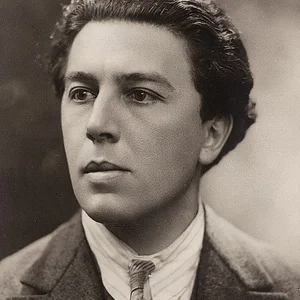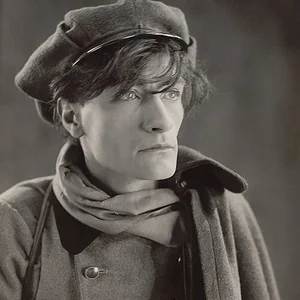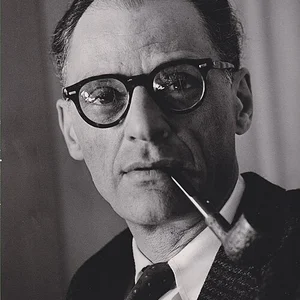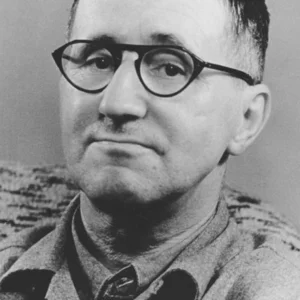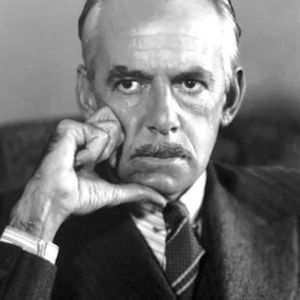

American playwright considered the father of modern theater in the United States. The first American dramatist to receive the Nobel Prize in Literature, in 1936, he brought realism and psychological tragedy to the American stage.
Eugene O'Neill(1888 — 1953)
Eugene O'Neill
États-Unis
6 min read
Frequently asked questions
Key Facts
- Born in 1888 in New York, the son of a touring stage actor
- First successes with the Provincetown Players troupe from 1916 onward
- Won four Pulitzer Prizes for Drama (1920, 1922, 1928, and 1957 posthumously)
- Nobel Prize in Literature in 1936, the first American playwright to be so honored
- Died in 1953; his autobiographical play 'Long Day's Journey Into Night' premiered in 1956
Works & Achievements
O'Neill's first major play staged on Broadway, it earned him his first Pulitzer Prize and established tragic realism on the American stage.
A bold expressionist drama in which an African American man fleeing through the jungle relives the terrors of his people; a landmark role for Black actors.
A portrait of a young woman and her sailor father on the docks; the play won the 1922 Pulitzer Prize.
The expressionist tragedy of an ocean-liner stoker searching for his place in an industrial world that crushes him.
A rural drama inspired by Greek tragedy, depicting passion and greed within a New England farm.
A sweeping trilogy that transposes the Greek legend of the House of Atreus to Civil War-era America.
A closed-room drama set in a seedy bar where life's castoffs cling to their illusions; one of his darkest works.
An autobiographical masterpiece about a family torn apart, published after his death and awarded a posthumous Pulitzer.
Anecdotes
Eugene O'Neill was born on October 16, 1888, in a hotel room overlooking Broadway, at Times Square. His entire childhood unfolded backstage and on trains, for his father James O'Neill was a famous actor who tirelessly performed “The Count of Monte Cristo” on tour across America.
In 1912, at the age of 24, O'Neill fell seriously ill with tuberculosis and spent several months in a Connecticut sanatorium. It was on his sickbed, reading August Strindberg and Henrik Ibsen, that he resolved to devote his life to writing for the theater.
O'Neill won the Pulitzer Prize four times (1920, 1922, 1928, and, posthumously, 1957) and in 1936 became the first American playwright to receive the Nobel Prize in Literature. Too weakened by illness, he was unable to travel to Stockholm to accept his award.
His most personal play, “Long Day's Journey into Night,” portrays the dramas of his own family. O'Neill demanded that it be neither performed nor published until twenty-five years after his death; yet his widow Carlotta overrode his wishes and had it staged as early as 1956, earning him a fourth Pulitzer.
According to his wife's account, O'Neill is said to have murmured on his deathbed, in Boston in 1953: “I knew it! Born in a hotel room and, goddammit, died in a hotel room.” An ending that echoed his birth.
Primary Sources
I give you the original script of this play of old sorrow, written in tears and blood. These twelve years, Beloved One, have been a Journey into Light—into love.
It was reading his plays that, above everything else, first gave me the vision of what modern drama could be; it is from him that I received my inspiration.
The lie of a pipe dream is what gives life to the whole misbegotten mad lot of us, drunk or sober.
None of us can help the things life has done to us. They're done before you realize it, and once they're done they make you do other things until at last everything comes between you and what you'd like to be.
Key Places
Broadway hotel where O'Neill was born in 1888, in the very heart of the theater district. The place already foretold his destiny as a man of the stage.
The O'Neill family home, named after the father's great role. It is the real setting that inspired his autobiographical play *Long Day's Journey Into Night*.
Cape Cod fishing village where the Provincetown Players staged his first one-act plays, as early as 1916. This avant-garde theater launched his career.
Secluded home where O'Neill retreated from 1937 to 1944 and wrote his late masterpieces, including *The Iceman Cometh* and *Long Day's Journey Into Night*. Today it is a national historic site.
City where he was awarded the Nobel Prize in Literature in 1936. Too ill to attend, O'Neill had his speech read aloud in his absence.
City where O'Neill died in 1953, in a hotel room, after years of illness that had prevented him from writing. The tremor in his hands had ultimately robbed him of his working tool.
Typical Objects

O'Neill wrote his plays by hand, in script so small that a magnifying glass was sometimes needed to make it out. His notebooks, covered in crossings-out, bear witness to relentless work.

Refusing the typewriter for the act of creation, O'Neill traced his dialogue with a pen. Writing by hand was an integral part of his thought process.

In plays such as The Great God Brown, O'Neill had his actors wear masks to show the gap between the true face and the social appearance. In this way he revived the spirit of ancient tragedy.

A gold disc awarded to Nobel Prize laureates, engraved with a profile of Alfred Nobel. O'Neill's, in 1936, sealed the worldwide recognition of American theater.

Alcohol haunts O'Neill's life and that of his characters, from the saloon of The Iceman Cometh to family dramas. The bottle becomes the symbol of his heroes' illusions and downfalls.

Before he wrote, the young O'Neill shipped out as a deckhand and sailed as far as Buenos Aires. This experience fed his early plays, peopled with sailors and waterfronts.
School Curriculum
Vocabulary & Tags
Key Vocabulary
Tags
Daily Life
Morning
During his peak creative years at Tao House, O'Neill rose early and shut himself in his study first thing in the morning. He wrote by hand, in absolute silence that no one was allowed to disturb.
Afternoon
His afternoons were devoted to rereading, revisions, and long walks for reflection. A solitary man, he preferred nature and quiet to the social whirl of the theater world.
Evening
In the evening he read a great deal — ancient drama, Strindberg, Nietzsche — and discussed his projects with his wife Carlotta, his first reader. He shunned opening nights and gala soirées.
Food
In his youth as a sailor and a bohemian, alcohol held a large place in his life, until he stopped drinking in order to be able to write. As a settled adult, he led a sober, orderly existence in the countryside.
Clothing
O'Neill wore simple, understated clothes — a dark suit in society but comfortable attire for work. His gaunt face and intense gaze left their mark on all his portraits.
Housing
He lived in isolated houses, far from the bustle, such as the Monte Cristo Cottage of his childhood or the remote Tao House in California. He needed seclusion and tranquility in order to create.
Historical Timeline
Period Vocabulary
Liens externes & ressources
Références
Œuvres
Au-delà de l'horizon (Beyond the Horizon)
1920
L'Empereur Jones (The Emperor Jones)
1920
Anna Christie
1921
Le Singe velu (The Hairy Ape)
1922
Le Désir sous les ormes (Desire Under the Elms)
1924
Le Deuil sied à Électre (Mourning Becomes Electra)
1931
Le Marchand de glace est passé (The Iceman Cometh)
1939