
In Greek mythology, Eurycleia is the faithful nurse of Odysseus, king of Ithaca, whom she raised from his birth. A character in Homer's Odyssey, she is the first to recognize her master on his return, thanks to a scar on his leg.
Eurycleia
Eurycleia
6 min read
Frequently asked questions
Key Facts
- A character in Homer's Odyssey, an epic composed around the 8th century BC
- Nurse of Odysseus, bought by Laertes (Odysseus's father) according to the Homeric account
- Recognizes Odysseus, disguised as a beggar, while washing his feet, thanks to a scar left by a boar on Mount Parnassus
- Keeps the secret of Odysseus's return at his request, despite her joy
- Denounces to Odysseus the unfaithful serving women of the palace before the slaughter of the suitors
Works & Achievements
Eurycleia raises Odysseus from birth as his nurse, establishing the bond of loyalty that shapes her entire character.
She watches over the son of Odysseus throughout the king's twenty-year absence, ensuring the continuity of the royal household.
She secretly prepares the provisions for Telemachus's departure and swears to say nothing to Penelope, protecting the young prince.
A famous scene in which Eurycleia identifies the disguised Odysseus, becoming the first to see through his incognito; the ancient model of “recognition” (anagnorisis).
She points out to Odysseus the maidservants who betrayed him, taking part in the restoration of order within the household.
Eurycleia wakes Penelope to announce the return of Odysseus, the turning point between the vengeance and the reunion of the spouses.
Anecdotes
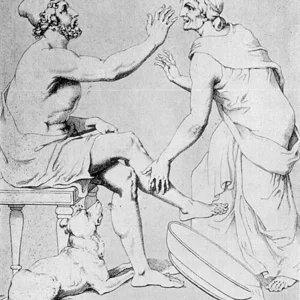
In the Odyssey, Eurycleia is the first to recognize Odysseus after twenty years of absence: while washing his feet, she discovers a scar on his leg, the mark of a boar wound he received in his youth. Odysseus immediately seizes her by the throat to silence her, for he is still disguised as a beggar.
The poet Homer tells us that Eurycleia was bought when very young by Laertes, Odysseus's father, for the considerable price of twenty oxen. Despite her status as a slave, she was honored in the royal household almost like a wife, but Laertes never touched her out of respect for his own wife.
It was Eurycleia who raised Odysseus from birth, and later his son Telemachus: she embodies a lifetime of loyalty in the service of a single family. When Telemachus secretly sets off to seek news of his father, it is to her alone that he confides his plan.
After Odysseus's slaughter of the suitors, it is Eurycleia who goes up to bring the news to the sleeping Penelope. Overcome with joy, she wants to raise the cry of triumph, but Odysseus forbids it: “Rejoice in your heart, but hold back; it is not right to glory over slain men.”
Eurycleia knows the household so well that Odysseus entrusts her with overseeing the maidservants during the vengeance: she points out those who betrayed by sleeping with the suitors, and it is they who must afterward clean the hall of the blood that was spilled.
Primary Sources
She drew near to wash her master, and at once she recognized the scar that a boar had once given him with its white tusk. The old woman felt it as she touched it with her hands, and she let the foot fall.
With him walked Eurycleia, daughter of Ops, son of Peisenor, whom Laertes had once bought with his own wealth, in the days of her youth, for the price of twenty oxen, and whom he honored in his house as the equal of a faithful wife.
“Nurse, pour me sweet wine into amphorae, and say nothing of it to my mother before the twelfth day.” So he spoke, and the old Eurycleia swore by the gods to keep the secret.
The old woman, full of joy, went up to the upper chamber to announce to her mistress that her beloved husband was in the house.
Key Places
The royal household where Eurycleia spends her entire life as nurse and then steward. There she raises Odysseus, then Telemachus, and there she recognizes her master upon his return.
Odysseus's island kingdom in the Ionian Sea, the setting for the whole of Eurycleia's role. The precise identification of the Homeric Ithaca remains debated.
The vaulted, fragrant chamber where the gold, bronze, wine, and oil are stored, and to which Eurycleia keeps the keys. There she secretly prepares Telemachus's provisions.
The upper floor reserved for the women, where Eurycleia serves Penelope; it is there that she climbs to announce Odysseus's return to her sleeping mistress.
Typical Objects

The bronze basin into which Eurycleia pours water to wash the beggar's feet; it is by touching his leg that she recognizes Odysseus's scar. Her emotion makes her spill the water.

Steward of Odysseus's household, Eurycleia holds the keys to the storerooms where the gold, bronze, clothing, and wine are kept. She opens the storeroom to secretly prepare Telemachus's provisions.

Sealed terracotta jars in which Eurycleia stores the old and precious wine. She fills skins with it for Telemachus's voyage to Pylos and Sparta.

Stores of ground barley flour that Eurycleia pours into tightly sewn skins to prepare Telemachus's secret departure, a staple food of Greek seafarers.

Eurycleia oversees the maidservants who spin wool and weave in the women's quarters; she watches over the nightly work by torchlight. The woolwork symbolizes the order of the household.

To light the megaron, the maidservants kindle torches in bronze braziers. Eurycleia orders their upkeep and the cleaning of the hall defiled by the blood of the suitors.
School Curriculum
Vocabulary & Tags
Key Vocabulary
Daily Life
Morning
Up before dawn, Eurycleia wakes the maidservants and assigns the tasks: sweeping the *megaron*, lighting the hearth, grinding the barley. She opens the storerooms and hands out the day's provisions.
Afternoon
The afternoon is spent overseeing the weaving and spinning of wool in the *gynaeceum*, watching over young Telemachus, and preparing the palace meals. As stewardess, she counts the household goods and keeps the keys.
Evening
In the evening, she sets out the seats and hides for the guests, has the wine poured and the torches of the great hall lit. At last she escorts her mistress Penelope to her chamber.
Food
People eat bread and barley cakes, served with roasted beef, mutton, or pork at feasts, along with cheese and fruit. Wine, diluted with water, is served at the table; olive oil flavors the dishes.
Clothing
Eurycleia wears a long woolen tunic (the *peplos* or *chiton*) gathered at the waist, covered with a cloak when going out. As an elderly and respected servant, her clothes are simple but well kept.
Housing
She lives in Odysseus's palace, a vast dwelling organized around the *megaron*, the great hall with its central hearth. The women occupy the upper floor (*gynaeceum*), and the provisions are stored in locked cellars.
Historical Timeline
Period Vocabulary
Liens externes & ressources
Références
Œuvres
Éducation d'Ulysse
génération précédant la guerre de Troie
Éducation de Télémaque
pendant l'absence d'Ulysse
Le serment du secret (chant II)
récit de l'Odyssée
La reconnaissance à la cicatrice (chant XIX)
récit de l'Odyssée
La dénonciation des servantes infidèles (chant XXII)
récit de l'Odyssée
L'annonce à Pénélope (chant XXIII)
récit de l'Odyssée