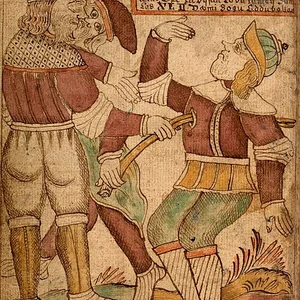

Fafnir is a dwarf from Norse mythology, son of Hreidmar, transformed into a dragon by his own greed after seizing a cursed hoard of gold. He is slain by the hero Sigurd (Siegfried) who drinks his blood to understand the language of birds. His story lies at the heart of the Völsunga saga and the Nibelung cycle.
Fafnir
Fafnir
8 min read
Frequently asked questions
Key Facts
- Son of the dwarf king Hreidmar, he murders his own father to seize Andvari's cursed gold
- Transformed into a dragon by the force of his own greed, he jealously guards his treasure on the Gnitaheid
- Slain by the hero Sigurd (Siegfried in the Germanic tradition) with the sword Gram
- Drinking Fafnir's blood grants Sigurd the ability to understand the language of birds
- His story is central to the Völsunga saga (13th c.) and inspired Richard Wagner's Ring of the Nibelung (1876)
Works & Achievements
An Eddic poem entirely devoted to the dialogue between Sigurd and the dying Fafnir. It is the most direct primary source on the character, preserving his words, his warnings about the cursed treasure, and his prophetic vision.
An Icelandic saga that tells the complete cycle of Sigurd, from his family origins to the deaths of the heroes. It offers the most comprehensive account of Fafnir's transformation and his role in the chain of curses.
A Middle High German epic that transposes the Norse legend into a medieval courtly narrative. Fafnir appears here as a Lindwurm (dragon) slain by Siegfried, whose bath in the creature's blood renders his skin invulnerable.
An Icelandic poetics handbook that references Fafnir's treasure as a poetic metaphor for gold ('the burden of Fafnir's arm'). Snorri thus anchors the myth within the literary language of medieval Scandinavia.
An opera in which Fafner (Wagner's version of Fafnir) is the guardian of the treasure and the all-powerful ring. Wagner transforms him into a symbol of capitalism and corrupting power, giving the myth a modern philosophical dimension.
Anecdotes
Fafnir and his brother Regin murdered their own father Hreidmar to seize a cursed golden treasure that the god Loki had given as a ransom for the accidental death of Otr, their brother. This original crime, driven purely by greed, unleashed the curse that would shadow the entire cycle.
To keep the treasure for himself, Fafnir drove his brother Regin away and gradually transformed into a dragon — a metamorphosis that ancient Scandinavians interpreted as the physical manifestation of a soul corrupted by avarice. He then settled on the Gnita Heath, spewing venom at anyone who approached.
The hero Sigurd, guided by Regin, dug a pit along the path Fafnir took each day to drink. When the dragon passed overhead, Sigurd thrust his sword Gram upward through the soft underbelly, bypassing the tough scales that made the dragon invulnerable from the front.
When Sigurd accidentally brought a finger smeared with Fafnir's blood to his mouth, he instantly gained the ability to understand the language of birds. The chickadees revealed to him that Regin was plotting to betray him and take the treasure — a twist of fate that cost the blacksmith his life.
Before dying, Fafnir warned Sigurd that the gold was cursed and would bring death to all who possessed it. His prophecy proved true: Sigurd, and later the Nibelungs, all perished because of this treasure, embodying the Norse theme of doom bound to ill-gotten wealth.
Primary Sources
Sigurðr mælti: 'Hvat er þat flagð, er liggr á Fáfnis leið, ok hefr þik hér of drepit?' Fáfnir kvað: 'Fáfnir ek heiti, en faðir minn hét Hreiðmarr.'
Fáfnir lagðist á gullið ok varð at ormi, ok lá þar síðan á gullinu. Hann var allra orma mestr ok grimmastr.
Hann drap föður sinn Hreiðmar ok tók allt gullið; en Reginn fór í brott, en Fáfnir tók ormslíki ok lagðist á gullið.
Hér er nú sagt frá þeim hlut Fáfnis er Sigurðr fekk: hjálminn Ægishjálmr ok brynjuna gullna.
Sîvrit der küene der sluoc den lintrachen, er badet sich in dem bluote: sîn hût wart hurnîn.
Key Places
A desolate, poisoned plain where Fafnir settled to guard the treasure after his transformation into a dragon. This mythical place symbolizes the monstrous solitude of a being consumed by greed.
It was in Iceland, during the 13th century, that scribes committed to writing the Völsunga saga and the Poetic Edda — the two main sources of the Fafnir legend — preserving the Viking oral traditions for posterity.
An 11th-century runestone engraved with a scene depicting Sigurd's slaying of Fafnir. It is one of the oldest known iconographic representations of the myth and testifies to its wide geographical spread.
A 12th-century carved wooden panel (now held at the Museum of Cultural History in Oslo) depicting key scenes from the Sigurd cycle, including the slaying of Fafnir. It is evidence of how the myth was woven into Scandinavian medieval Christian art.
Typical Objects

A magical helmet Fafnir wore to terrorize his enemies and paralyze their will. Sigurd seized it after slaying the dragon, inheriting its power to inspire dread.

A vast hoard of cursed gold that Fafnir guarded on the Gnita Heath. Originally stolen from the dwarf Andvari by Loki, the treasure carried a curse that doomed every one of its owners to a violent death.

A magical ring at the heart of the cursed hoard, of which Andvari had prophesied it would bring death. Fafnir wore it as the prized jewel of his hoard, and its possession sealed the dark fate of every hero in the cycle.

Fafnir spewed corrosive venom across the heath, making the ground barren and approachable only by himself. This natural weapon illustrated, in Norse mythology, how moral corruption could be transformed into a physical poison.

A weapon forged by Regin and reforged by Sigurd to be sharp enough to cleave through Fafnir. Gram is the instrument of the dragon's death and symbolizes heroic valor in the face of monstrous greed.

The organ that Regin ordered Sigurd to roast after the slaying. While touching it to check whether it was cooked, Sigurd inadvertently brought some blood to his lips, gaining the gift of understanding the speech of birds.
School Curriculum
Vocabulary & Tags
Key Vocabulary
Tags
Daily Life
Morning
Fafnir spends his mornings patrolling the perimeter of his heath, spitting venom along the edges of his territory to drive away any intruders. He meticulously inspects every gold coin and jewel in the hoard, unable to tear himself away even for a moment.
Afternoon
Each afternoon, the dragon makes the same journey to a nearby river to drink — a routine that Sigurd will use to trap him. This daily trek is the only time Fafnir strays from his treasure, a sign of the inescapable biological need that persists despite his transformation.
Evening
In the evening, Fafnir coils atop the pile of gold, using the Ægishjálmr to amplify his aura of terror and discourage any approach in the night. In the soliloquies preserved in the Fáfnismál, one can sense a tormented consciousness, still capable of prophecy and unsettling clarity about his own monstrous nature.
Food
Fafnir feeds mainly on livestock and game he captures from the surrounding lands, terrorizing the populations of neighboring regions. His venom allows him to kill from a distance, and he swallows his prey whole — the behavior of an apex predator, in stark contrast to his former life as a craftsman dwarf.
Clothing
In dragon form, Fafnir is covered in chitinous scales of a dark greenish-black, naturally armored against ordinary weapons. He bears the Ægishjálmr on his brow like a mark of power — the only visible remnant of his original identity as the son of a dwarf king.
Housing
Fafnir occupies a vast cave at the heart of the Gnita heath, its floor entirely covered by the cursed hoard. The air is thick with venomous vapors emanating from his body, making it unbreathable for any living creature and creating a natural exclusion zone around his lair.
Historical Timeline
Period Vocabulary
Visual Style
Style inspiré des enluminures vikings et des gravures de pierres runiques, associant entrelacs zoomorphes nordiques et atmosphère sombre et pesante d'un repaire de dragon. La palette mêle l'ocre de l'or maudit, le gris du fer et le vert vénéneux de la corruption.
Sound Ambience
Ambiance sombre et caverneuse dominée par la respiration lente d'un dragon, entrecoupée du chant des oiseaux qui révèlent la vérité au héros. Le contraste entre l'obscurité pesante du repaire et la pureté des voix aviaires symbolise l'opposition entre cupidité et sagesse.
Liens externes & ressources
Références
Œuvres
Fáfnismál (Edda poétique)
XIIIe siècle (traditions antérieures)
Völsunga saga
vers 1260-1270
Nibelungenlied
vers 1200-1210
Prose Edda — Skáldskaparmál de Snorri Sturluson
vers 1220