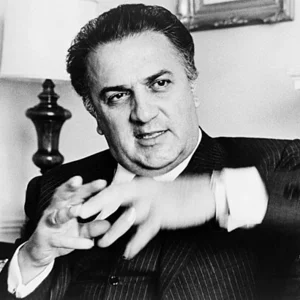

Federico Fellini (1920-1993) was an Italian filmmaker and screenwriter, a major figure in world cinema. A master of a dreamlike, baroque style, he left his mark on the history of the seventh art with films such as La Dolce Vita and La Strada.
Federico Fellini(1920 — 1993)
Federico Fellini
Italie
6 min read
Frequently asked questions
Famous Quotes
« Cinema is the art closest to life.»
« There is no end. There is no beginning. There is only the infinite passion of life.»
Key Facts
- Born on January 20, 1920, in Rimini, Italy
- Directs La Strada in 1954, which wins the Academy Award for Best Foreign Language Film
- Releases La Dolce Vita in 1960, winning the Palme d'Or at the Cannes Film Festival
- Directs 8½ in 1963, regarded as one of his masterpieces
- Receives an Honorary Academy Award for his lifetime achievement in 1993, the year of his death
Works & Achievements
A poignant story of a naïve young woman and a brutal travelling showman. Fellini's first major international success, it won the Oscar for Best Foreign Language Film.
A portrait of a hopeful prostitute, played by Giulietta Masina. It earned another Oscar for Best Foreign Language Film.
A sweeping portrait of Rome's glamorous, disenchanted high society. Winner of the Palme d'Or at Cannes, the film introduced the word "paparazzi" to the entire world.
A film about a filmmaker suffering from creative block, blending dream and reality. A cult work about artistic creation, crowned with an Oscar.
Fellini's first feature film in colour, a dreamlike exploration of the female imagination.
A visual and fantastical declaration of love for the city of Rome, blending memory and invention.
A tender and funny evocation of his childhood in Rimini under fascism. It won the Oscar for Best Foreign Language Film.
A fantastical sea voyage paying tribute to a vanished world, in which Fellini fully embraces the artifice of the film studio.
Anecdotes
Before becoming a filmmaker, the young Fellini earned his living in Rome by drawing caricatures in a little shop called the 'Funny Face Shop': he sketched the faces of American soldiers at the end of the war. This love of drawing never left him, and he would sketch his films' characters in notebooks before shooting.
For 'La Dolce Vita' (1960), Fellini unintentionally coined a word that became universal: the intrusive photographer character is named 'Paparazzo'. In its Italian plural, 'paparazzi', the term today refers worldwide to the photographers who hound celebrities.
Fellini won four Oscars for Best Foreign Language Film, a record for a director. In 1993, shortly before his death, the Academy awarded him an Honorary Oscar for his lifetime achievement; during the ceremony, he simply asked his wife and actress Giulietta Masina, seated in the audience, to stop crying.
The director claimed he wrote down his dreams upon waking in large notebooks illustrated with colorful drawings. This 'Book of Dreams', published after his death, shows just how directly his dreamlike cinema drew from his nocturnal imagination.
To recreate the sea in several of his films, Fellini often preferred an artificial plastic sea filmed in the Cinecittà studios in Rome rather than the real ocean. He said he could better master a reality built entirely from scratch than nature itself.
Primary Sources
Neorealism is not a question of what you show, but of the spirit in which you show it. It is a way of looking at the world without prejudice or convention.
Thank you, and... Giulietta, stop crying.
Handwritten, illustrated notebooks in which Fellini recorded and drew his nighttime dreams, a direct source of inspiration for his films.
I wanted to show Rome not as a postcard, but as a confused and anxious celebration, a sweetness of living that conceals an emptiness.
Key Places
Fellini's birthplace, on the Adriatic coast. His childhood in this seaside resort directly inspired 'Amarcord'.
A vast studio complex where Fellini reconstructed entire worlds, from ancient Rome to a sea made of plastic. His favorite creative playground.
A chic Roman avenue that became the symbol of 1960s 'dolce vita'. Fellini recreated its atmosphere of partying and existential emptiness.
The city where Fellini settled in 1939 and which became the heart of his life and work. He died there in 1993.
The Cannes Film Festival crowned Fellini with the Palme d'Or for 'La Dolce Vita' in 1960. A major international recognition.
Typical Objects

The director's central tool, the camera captures images on photographic film. Fellini made it an extension of his dreamlike vision.

Fellini drew characters, sets and dreams before shooting. His notebooks, including the "Book of Dreams", became genuine graphic artworks.

On the vast sets of Cinecittà, the megaphone made it possible to direct extras and technicians. Fellini thus orchestrated crowds of hundreds of people.

A strip of film onto which images are printed before editing. Editing the film gave Fellini's stories their rhythm.

A written document describing dialogue and scenes, which Fellini reworked constantly. As much a screenwriter as a director, he blended notes and drawings into it.

Recurring elements of his baroque world, inspired by carnival and the circus. They embody Fellini's taste for the grotesque and the dreamlike.
School Curriculum
Vocabulary & Tags
Key Vocabulary
Daily Life
Morning
Fellini often woke up jotting down the previous night's dreams in his illustrated notebooks. The morning might begin with endless phone calls, as he loved to chat and improvise ideas for scenes.
Afternoon
Afternoons were frequently spent at the Cinecittà studios, directing shoots where he orchestrated sets, costumes, and crowds of extras. Meticulous, he personally chose every face from among hundreds of casting photos.
Evening
In the evening, Fellini would meet up with his wife Giulietta Masina or with collaborators over a meal and conversation. He liked to wander and observe Roman nightlife, an inexhaustible source of characters.
Food
Like many Italians of his generation, he enjoyed traditional cuisine: pasta, vegetables, and dishes from Rome and from Romagna, his native region. He readily associated food with reunions and conviviality.
Clothing
At work, Fellini often wore a loose overcoat, a scarf, and a hat — a silhouette instantly recognizable on set. His casual attire contrasted with the baroque elegance of the costumes in his films.
Housing
He lived in Rome, a city he considered his true home from 1939 onward. His life was split between his Roman apartment and the manufactured world of the Cinecittà studios.
Historical Timeline
Period Vocabulary
Liens externes & ressources
Références
Œuvres
Juliette des esprits
1965
Fellini Roma
1972