
Fenrir is a gigantic wolf from Norse mythology, son of the god Loki and the giantess Angrboða. Feared by the gods for his immense power, he was bound by the Aesir using the magical fetter Gleipnir. At Ragnarök, he will break free to devour Odin, before being slain by Víðarr.
Fenrir
Fenrir
9 min read
Frequently asked questions
Key Facts
- Fenrir is the son of Loki and the giantess Angrboða, and the brother of the serpent Jörmungandr and of Hel
- The gods first raise him in Asgard, but his terrifying growth compels them to bind him
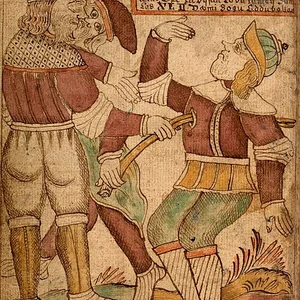
- Only Týr agrees to place his hand in Fenrir's mouth as a pledge during the binding; he loses it when Fenrir realizes the deception
- Fenrir is held by Gleipnir, a magical fetter forged by the dwarves from things that do not exist (the sound of a cat's footstep, a woman's beard, the roots of a mountain…)
- At Ragnarök, Fenrir breaks free, swallows Odin, and is then slain by the god Víðarr, who tears apart his jaws
Works & Achievements
Central poem of Norse mythology describing the world's creation through to Ragnarök. Fenrir appears here as one of the main agents of final destruction, breaking free from his bonds to advance with gaping jaws toward the heavens.
The most complete account of Fenrir: his birth, upbringing in Asgard, the attempts to bind him, and Tyr's sacrifice. This Icelandic text is the primary source for historians and teachers.
Verse dialogue between Odin and the giant Vafþrúðnir concerning cosmic secrets. The giant explicitly predicts that Víðarr will avenge Odin by killing Fenrir at Ragnarök.
Poem of Loki's insults to the gods during a feast. Loki reveals his fatherhood of Fenrir, highlighting the familial ties between the forces of chaos and the agents of cosmic destruction.
Treatise on skaldic poetics listing kennings (poetic periphrases) related to Fenrir: gold is 'Fenrir's chains', the sword is 'the jaw's staff'. Reveals Fenrir's central place in Viking poetic culture.
Swedish carved stone probably depicting the scene where Odin is devoured by a wolf at Ragnarök. One of the few medieval visual representations of Fenrir, attesting to the myth's spread beyond Iceland.
Stone cross combining Christian and Norse motifs, depicting scenes of Ragnarök including a wolf devouring a divine figure. Evidence of the syncretism of Norse myths and Christianity in Viking England.
Anecdotes
The Aesir gods, frightened by Fenrir's prodigious growth, decided to bind him. They forged two colossal chains, Leyding and then Dromi, which the wolf broke effortlessly. So they called upon the dwarves Svartálfar to create Gleipnir, a magical fetter as thin as a silk ribbon but indestructible, woven from six impossible things: the sound of a cat's footsteps, a woman's beard, the roots of a mountain, the sinews of a bear, the breath of a fish, and the spittle of a bird.
Suspicious of Gleipnir, Fenrir agreed to be bound on one condition: that a god place his hand in the wolf's mouth as a pledge of good faith. Only Týr, god of justice and courage, dared to take the challenge. When Fenrir realized he could not break the fetter, he bit off Týr's hand at the wrist. Týr lost his hand, but the gods had won: Fenrir was bound.
Fenrir was exiled to the isolated island of Lyngvi, in the middle of Lake Ámsvartnir. He was tied to a rock with Gleipnir, and a sword was placed in his mouth to keep it open. The Aesir knew they could not kill him without defiling the sacred place, and only Ragnarök, the end of the world, would free the monster.
Norse mythology attributes a terrifying offspring to Fenrir. His sons Sköll and Hati chase the Sun and Moon across the sky every day. At Ragnarök, they will finally catch and devour them, plunging the world into darkness. For the Vikings, this image illustrated the fragility of the cosmic order in the face of chaos.
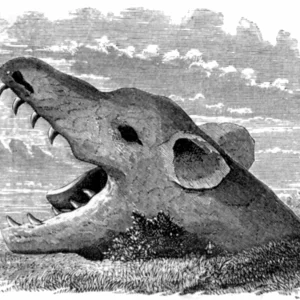
At Ragnarök, Fenrir breaks free from his bonds and rages across the world, his gaping jaws touching both earth and sky. He swallows Odin, the father of the gods, fulfilling the prophecy. But Víðarr, Odin's silent son, avenges his father by stomping on the wolf's lower jaw and piercing his palate with his sword, ending the most feared creature in the Norse cosmos.
Primary Sources
“Fenrir grew so quickly that the gods grew worried. Only Tyr had enough courage to bring him food. When the gods saw how much he grew each day, and that all prophecies foretold he would harm them, they decided to bind him.”
“Hrym comes from the east, holding his shield before him; the great serpent writhes in his sea-fury. The eagle shrieks, tearing at corpses; Naglfar breaks loose. Fenrir advances, jaws agape; fire blazes, flames shoot from his eyes and nostrils.”
“Loki said: You must know, Tyr, that your son was born to me by the she-wolf, and that son will never be declared legitimate.”
“One may also call gold the chains of Fenrir, and the sword the staff of Fenrir’s mouth. Víðarr is called the avenger of Odin, he who pierces Fenrir.”
“Víðarr will avenge his father when Fenrir slays the king of gods: he will split the wolf’s jaw with his sharp sword, straight to the heart.”
Key Places
World of the giants where Fenrir was born, son of Loki and the giantess Angrboða. This hostile and wild realm is the source of the chaotic forces that threaten the order of the Æsir.
Celestial fortress of the Æsir gods where Fenrir was raised under surveillance. It was here that the gods became aware of the threat posed by the growing wolf.
Isolated island in the middle of a dark lake where Fenrir was finally bound with Gleipnir. This place of captivity symbolizes the boundary between the order of the world and the restrained chaos.
Underground world of the dwarf craftsmen who forged Gleipnir at the gods' command. These master smiths created the only object capable of containing Fenrir's power.
Immense plain where the final battle of Ragnarök will take place. It is here that the freed Fenrir will devour Odin, before being killed by Víðarr, fulfilling the prophecy of the Völuspá.
Typical Objects

Magic fetter forged by the svartálfar dwarves, as thin as a silk ribbon but utterly indestructible. Made from six nonexistent ingredients, it is the only object capable of holding Fenrir until Ragnarök.

First iron chain forged by the gods to try to bind Fenrir. The wolf broke it effortlessly, demonstrating his superhuman strength from his early years.

Second chain, twice as strong as Leyding, which the Æsir made after their first failure. Fenrir broke it as well, cementing his reputation as an invincible creature.

Weapon planted vertically in Fenrir's wide-open mouth to prevent him from biting during his imprisonment. It symbolizes the constraint imposed by the gods upon chaos.

Sacrificed by Týr as a pledge of good faith to convince Fenrir to accept Gleipnir. The loss of this hand is the price paid by the gods to bind the wolf and delay Ragnarök.

Stone to which Gleipnir is fastened, driven deep into the earth of the island Lyngvi. It symbolizes Fenrir's anchorage in the world until the end of time.

Fenrir's mouth, wide enough to swallow Odin and touch both sky and earth simultaneously, is a symbol of chaos devouring cosmic order during Ragnarök.
School Curriculum
Vocabulary & Tags
Key Vocabulary
Tags
Daily Life
Morning
Fenrir awakens, bound on the island of Lyngvi, his jaws held open by a divine sword. At dawn, his growls roll across Lake Ámsvartnir like muffled thunder, scattering the birds. His hunger is insatiable, but no god dares approach since the exile.
Afternoon
During the long hours of the Nordic day, Fenrir strains his muscles against Gleipnir, tirelessly searching for a flaw in the magical bond. Each attempt is futile, but he never stops, for the prophecy has promised him freedom at Ragnarök. Meanwhile, his sons Sköll and Hati chase the Sun and Moon across the sky.
Evening
With nightfall, Fenrir howls at the stars—a howl so powerful that it echoes all the way to Asgard and makes the gods tremble in their halls. This cry is at once rage, defiance, and a reminder to the Æsir that chaos can only be contained for so long. Odin himself stirs on his throne Hliðskjálf upon hearing the wolf.
Food
Fenrir is a cosmic wolf with a bottomless hunger, a symbol of chaos devouring order. His food is not described in the texts as ordinary: it is destruction itself that nourishes him. At Ragnarök, he will devour Odin, the greatest of the Æsir, before being killed in turn by Víðarr.
Clothing
As a mythological creature, Fenrir does not wear clothes. His 'garment' is his pelt, deep black like the arctic night, and Gleipnir, the magical ribbon-like fetter that binds his legs—the only adornment imposed by the gods as a symbol of their temporary victory over chaos.
Housing
Fenrir is forcibly confined on the island of Lyngvi, in the middle of the dark lake Ámsvartnir, far from any inhabited world. This place of exile is deliberately isolated so that his growls cannot reach the living. The rock Gjöll to which he is tied is driven so deep into the earth that it almost touches the underworld.
Historical Timeline
Period Vocabulary
Visual Style
Style épique et sombre inspiré des enluminures vikings et des pierres runiques, représentant Fenrir comme une force cosmique colossale enchaînée au bord de la fin du monde, avec des tons froids nordiques et des éclats de feu.
Sound Ambience
Ambiance sonore glaciale et oppressante évoquant l'emprisonnement de Fenrir sur l'île de Lyngvi, mêlant grondements profonds, cliquetis de chaînes et vents arctiques annonciateurs du Ragnarök.
Liens externes & ressources
Références
Œuvres
Völuspá (La Prophétie de la Voyante) — Edda poétique
Xe-XIe siècle (copié vers 1270, Codex Regius)
Gylfaginning — Prose Edda (Snorri Sturluson)
vers 1220
Vafþrúðnismál — Edda poétique
Xe-XIIe siècle
Lokasenna — Edda poétique
Xe-XIIe siècle
Skáldskaparmál — Prose Edda (Snorri Sturluson)
vers 1220
Pierre runique de Ledberg (Ög 181)
vers 1000-1100
Croix de Gosforth (Cumbria, Angleterre)
vers 920-950