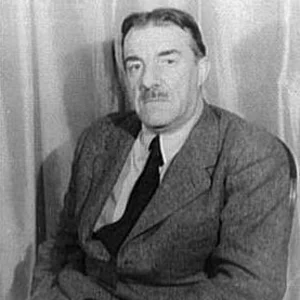

French painter (1881–1955) and major figure of the avant-garde, he developed a unique style blending Cubism with mechanical imagery. His works celebrate the modern world, machinery, and working people.
Fernand Léger(1881 — 1955)
Fernand Léger
France
8 min read
Frequently asked questions
Famous Quotes
« Beauty is everywhere — in the arrangement of your pots and pans on the white walls of your kitchen.»
« A painting must be beautiful before it can be understood.»
Key Facts
- Born in Argentan (Normandy) in 1881
- Developed 'tubism' around 1909–1914, breaking down forms into cylinders and mechanical volumes
- Served in the First World War, an experience that deepened his interest in the working class and machinery
- Created major works such as *The Constructors* (1950), a tribute to manual workers
- Founded the Musée National Fernand Léger in Biot, inaugurated in 1960, five years after his death in 1955
Works & Achievements
A large-format Cubist painting of fragmented, geometric forms, this work introduced the public to Léger's distinctive style. It is considered one of the founding canvases of French Cubism.
An abstract composition of gears and circular forms inspired by the machinery of war, painted after his return from the front. It marks his decisive turn toward an openly industrial aesthetic.
A monumental canvas (2.3 × 3 m) depicting the visual chaos of a modern metropolis — billboards, construction sites, and mechanical silhouettes. It is one of the most celebrated paintings of the interwar period.
The first avant-garde film with no narrative and no actors, made up entirely of the movements of mechanical and everyday objects. A pioneering work of experimental cinema, co-directed with American filmmaker Dudley Murphy.
A large figurative composition showing workers at rest in nature — playing cards or holding a bicycle. It reflects Léger's commitment to a popular, celebratory art in the aftermath of the war.
A masterwork of his mature period, depicting workers assembling a metal framework against a blue sky. It is regarded as the culmination of his lifelong project to dignify working people through painting.
A monumental canvas (4.8 × 6.5 m) and Léger's last major work, depicting acrobats, clowns, and dancers in a colorful popular celebration. It brings together his entire vision of an art that is joyful and accessible to all.
Anecdotes
Mobilized in 1914, Fernand Léger served as a sapper on the front. Amid the trenches, he was struck by the unexpected beauty of the machines of war — cannons, planes, shells — and by the dignity of ordinary soldiers. This traumatic experience radically transformed his art: he abandoned pure abstraction to celebrate the mechanical world and the working class.
In September 1917, Léger was gassed during the Battle of Verdun and nearly died. While hospitalized, he made himself a promise: if he survived, he would paint ordinary people and everyday objects rather than subjects reserved for the elite. That commitment would remain at the heart of his entire body of work until his death.
In 1924, Léger co-directed with Dudley Murphy the experimental film *Ballet mécanique*, with no script and no characters: household objects, machines, and fragments of human bodies dance to a score by George Antheil. The film stands as one of the earliest works of abstract art cinema in history.
A refugee in the United States during the Second World War, Léger taught at Yale and was captivated by America. He recalled being dazzled by the neon signs and illuminated billboards of Broadway at night, which he likened to a gigantic abstract painting. His American canvases are more colorful and exuberant than ever.
On his return to France in 1945, Léger joined the French Communist Party. Convinced that art should be accessible to everyone, he created monumental mosaics for public buildings, including the façade of the Notre-Dame-de-Toute-Grâce church in Assy, Haute-Savoie. He used to say he wanted to “take painting out of museums and put it in the street.”
Primary Sources
Beauty is everywhere; in the arrangement of your pots and pans on the white walls of your kitchen, perhaps more than in your eighteenth-century drawing room or in the official museums.
A locomotive engine, polished and set off to advantage, is more beautiful than the Winged Victory of Samothrace. I believe in the value of the manufactured object, constructed by modern man.
I came out of Verdun completely transformed. When I think back on those men at the front — mechanics, carpenters, miners… they are the ones I want to paint, them and their machines.
For an entire summer, I watched a bicycle chain hanging on a nail. Every morning, the light struck it differently. It was as beautiful as a cathedral.
Key Places
Birthplace of Fernand Léger, born on February 4, 1881, into a Norman farming family. His rural childhood and working-class roots gave him a lasting interest in laborers and ordinary people.
The neighborhood where Léger settled in 1900 and worked for most of his life. Montparnasse was then the world center of the artistic avant-garde, frequented by Picasso, Apollinaire, Cendrars, and Le Corbusier.
Léger's place of exile from 1940 to 1945, fleeing the Nazi occupation. There he taught, met American artists, and was deeply marked by the visual energy of the city — its neon lights and skyscrapers.
The town where Léger settled after the war and where he died on August 17, 1955. It was here that he painted his final major works, including *La Grande Parade*.
Museum inaugurated in 1960 by his widow Nadia Léger, five years after his death. It houses the world's largest collection of his works, and its façade is adorned with an enormous colorful mosaic.
Typical Objects

The central geometric form in Léger's work, the tube symbolizes the machine and the mechanized human body. His figures with cylindrical limbs became an instantly recognizable stylistic signature.

Recurring objects in his still lifes and compositions, the worker's tools embody the dignity of manual labor that Léger sought to celebrate in paint.

Léger spent hours observing the light on a bicycle chain hanging from the wall of his studio, seeing in it a plastic beauty equal to that of an ancient sculpture.

Circular forms ubiquitous in his compositions from 1918–1920, the discs evoke gears, wheels, and propellers — symbols of triumphant industrial modernity.

A traumatic object from the Great War, the gas mask appears in several works after 1917, a discreet testament to the industrial violence of a conflict that nearly cost Léger his life.

Léger frequently incorporated playing cards into his compositions as symbols of leisure and popular culture — sources of identity for him, and a deliberate break from the noble subjects of classical painting.
School Curriculum
Vocabulary & Tags
Key Vocabulary
Daily Life
Morning
Léger rose early and devoted his mornings to studio work, finding the morning light ideal for painting. He would begin by spending a long time observing his subjects — objects arranged on a table, tools hanging on the wall — before picking up his brushes. He worked methodically, carefully preparing his large canvases through numerous studies.
Afternoon
Afternoons were often reserved for meetings and discussions with other avant-garde artists, architects, and writers such as Le Corbusier, Blaise Cendrars, or Guillaume Apollinaire, in the cafés of Montparnasse. He also taught at his academy (the Académie Moderne) and oversaw commissions for murals and mosaics.
Evening
Léger frequented popular entertainment — the circus, music hall, and workers' theatre — drawing constant inspiration from them for his characters of clowns, acrobats, and laborers. After the war, he attended Communist Party meetings and took part in debates about art and society. He came home late, often energized by long political or aesthetic discussions.
Food
A man of peasant origins, Léger kept simple, hearty eating habits close to those of the workers he painted. He was fond of the Norman cooking of his childhood and enjoyed good meals shared among friends rather than fancy restaurants. During his American exile, he discovered American food with curiosity but remained attached to French flavors.
Clothing
Léger cultivated an image of sturdiness and simplicity, dressing more like a craftsman or worker than an artistic dandy. He wore paint-stained work smocks in his studio, and a plain suit for gallery openings. This deliberately working-class appearance matched his political convictions and his rejection of the elitism of the art world.
Housing
Léger lived for many years in spacious studios in Montparnasse, Paris's bohemian quarter. His studio was at once a workplace, exhibition space, and living area, cluttered with canvases, collected mechanical objects, and scale models. After the war, he settled in Gif-sur-Yvette in a house with a garden where he could also work on ceramics and large-scale sculpture.
Historical Timeline
Period Vocabulary
Liens externes & ressources
Références
Œuvres
La Femme en bleu
1912
Les Disques
1918
La Ville
1919
Les Loisirs — Hommage à Louis David
1948-1949
La Grande Parade
1954