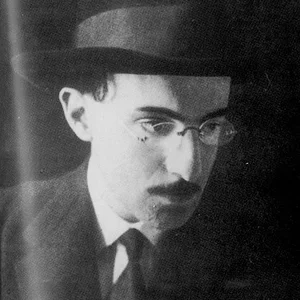

Fernando Pessoa (1888-1935) was a Portuguese writer and poet, a major figure of modernist literature. He is famous for his heteronyms, fictional author identities each endowed with its own style and biography.
Fernando Pessoa(1888 — 1935)
Fernando Pessoa
Portugal, royaume de Portugal
6 min read
Frequently asked questions
Famous Quotes
« The poet is a faker. He fakes it so completely that he even fakes that the pain he truly feels is pain.»
Key Facts
- Born in Lisbon in 1888, he spent part of his childhood in Durban, South Africa, where he was schooled in English.
- From 1914 onward he created his main heteronyms: Alberto Caeiro, Ricardo Reis and Álvaro de Campos.
- He published little during his lifetime; his great patriotic collection 'Message' (Mensagem) appeared in 1934.
- He died in Lisbon in 1935, leaving behind a trunk of unpublished manuscripts.
- 'The Book of Disquiet', signed by the semi-heteronym Bernardo Soares, was only published posthumously in 1982.
Works & Achievements
The only collection of poems in Portuguese published during his lifetime; it revisits the history and myth of Portugal.
A fragmentary journal attributed to the heteronym Bernardo Soares, considered one of the great books of the 20th century.
A modernist magazine co-founded by Pessoa, the founding act of Portuguese literary modernism, which caused a scandal.
A collection signed by the heteronym Alberto Caeiro, the “master” of the other heteronyms, celebrating a simple gaze upon nature.
A long poem by the heteronym Álvaro de Campos, a high point of Portuguese modernism on emptiness and identity.
A satirical tale in which a banker proves through absurd logic that he is the only true anarchist.
A collection of sonnets written directly in English, attesting to his dual literary culture.
Anecdotes
On 8 March 1914, Pessoa claimed to have lived his "triumphant day": standing before a chest of drawers, he wrote in a single burst some thirty poems signed Alberto Caeiro, an imaginary poet he had just invented. This was the birth of his famous heteronyms, those fictional authors each with their own style, life and ideas.
When he died in 1935, Pessoa left behind a large wooden trunk crammed with around 27,000 sheets: poems, letters, projects and fragments in Portuguese, English and French. Nearly a century later, scholars are still deciphering this "trunk" and continue to discover unpublished texts in it.
In 1930, the English occultist Aleister Crowley came to Lisbon. With the help of Pessoa, an astrology enthusiast, he staged his fake disappearance at the Boca do Inferno, near Cascais, making it look like a suicide. The press worked itself into a frenzy before the hoax was exposed.
During his lifetime, Pessoa remained almost unknown and earned his living as a commercial correspondent, translating the mail of Lisbon trading houses. Only one book of poems in Portuguese, *Mensagem*, appeared before his death, in 1934.
The day before his death, on 29 November 1935, Pessoa scribbled one last sentence, in English: "I know not what tomorrow will bring." He died the following day, at the age of 47.
Primary Sources
It was on the 8th of March, 1914, that I found Alberto Caeiro. […] I went over to a chest of drawers and, taking a sheet of paper, began to write, standing up, as I always write whenever I can. And I wrote some thirty poems in a row, in a kind of ecstasy whose nature I am unable to define.
The poet is a feigner. He feigns so completely that he comes to feign as pain the pain he genuinely feels.
Myth is the nothing that is everything. The very sun that opens the skies is a bright and silent myth.
I have never done anything but dream. This, and this alone, has been the meaning of my life. I have never had any real concern other than my inner life.
Key Places
Pessoa's native city, where he spent most of his life, worked and died; it pervades his entire body of work.
The city where the young Pessoa lived with his consul stepfather and received an English education that left a lasting mark on his language and his reading.
A famous café in the Chiado district frequented by Pessoa; a bronze statue depicts him seated at a table on the terrace.
A sea chasm where the fake disappearance of the occultist Aleister Crowley was staged in 1930 with Pessoa's help.
The poet's last home, today a house-museum that preserves his library and manuscripts.
A monastery in Lisbon where Pessoa's remains were transferred in 1985, near those of great Portuguese navigators and writers.
Liens externes & ressources
Références
Œuvres
Mensagem
1934
Le Livre de l'intranquillité (Livro do Desassossego)
publié en 1982
Revue Orpheu
1915
Le Gardeur de troupeaux (O Guardador de Rebanhos)
écrit en 1914
Bureau de tabac (Tabacaria)
1928
Le Banquier anarchiste (O Banqueiro Anarquista)
1922
35 Sonnets
1918