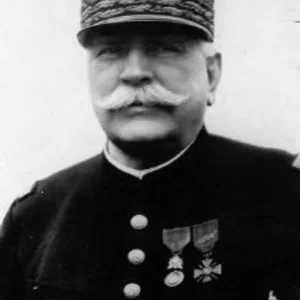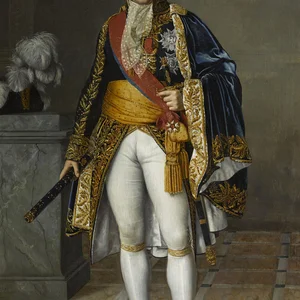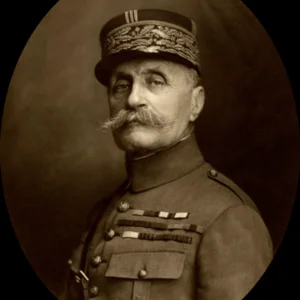

Ferdinand Foch (1851-1929) was a French marshal, military theorist, and strategist. Appointed commander-in-chief of the Allied forces in 1918, he led the coalition to victory in the First World War and received the German surrender.
Foch(1851 — 1929)
Ferdinand Foch
France
6 min read
Frequently asked questions
Famous Quotes
« This is not peace. It is an armistice for twenty years.»
Key Facts
- Born in 1851 in Tarbes, he entered the École Polytechnique and then pursued a career in the artillery
- A professor and later director of the École Supérieure de Guerre, he developed a doctrine of the offensive before 1914
- Played a decisive role in the First Battle of the Marne (1914) and the Battle of the Yser (1914)
- Appointed commander-in-chief of the Allied armies in March-April 1918, he coordinated the response to the German offensives
- Received the signing of the armistice on 11 November 1918 in his railway carriage at Rethondes; made Marshal of France that same year and died in 1929
Works & Achievements
Collection of his lectures at the École supérieure de guerre, setting out his doctrine of will and the offensive. A reference work for officers.
A second theoretical work extending his reflection on strategy and the maneuvering of armies.
His resistance in the Saint-Gond marshes helps halt the German advance and save Paris.
Appointed generalissimo, he coordinates the French, British, and American armies under a unified command for the first time.
He leads the general counter-offensive that pushes back the German army and leads to the armistice.
A posthumous account of his experience of the Great War, an important source for historians.
Anecdotes
Before the war, Foch taught at the École supérieure de guerre, where he developed a doctrine of the offensive and of willpower. He is credited with the maxim: “A battle won is a battle in which one refuses to admit defeat.” His thinking would shape an entire generation of French officers.
During the First Battle of the Marne in 1914, when his army was in dire straits in the marshes of Saint-Gond, Foch is said to have telegraphed: “My center is giving way, my right is falling back, situation excellent, I am attacking.” This phrase, perhaps embellished, became the symbol of his tenacity.
On 11 November 1918, it was in a converted dining car, set up in the clearing of Rethondes in the forest of Compiègne, that Foch received the German plenipotentiaries and had them sign the armistice that ended the fighting. The same carriage would serve as the setting for Hitler's revenge in June 1940.
Foch lost his only son, Germain, and his son-in-law in the very first weeks of the war, in August 1914. Despite this terrible family bereavement, he continued to exercise his command without letting anything show.
Regarding the Treaty of Versailles of 1919, which he considered too lenient toward Germany, Foch is said to have declared: “This is not peace, it is an armistice for twenty years.” History, with the outbreak of the Second World War in 1939, proved him almost exactly right.
Primary Sources
Hostilities will cease on land and in the air six hours after the signing of the armistice.
War is the use of every available means to impose one's will upon the enemy.
The will to conquer is the first condition of victory.
The enemy has launched a tremendous offensive. To hold is to win; we must hold at all costs.
Key Places
Town in the Hautes-Pyrénées where Ferdinand Foch was born in 1851. His birthplace is now a museum dedicated to him.
Institution where Foch taught and then directed the training of officers, and where he developed his strategic doctrine.
Sector of the First Battle of the Marne in 1914 where Foch distinguished himself through his fierce resistance against the Germans.
Place where Foch received the German delegation and had the Armistice of 11 November 1918 signed in his command railway carriage.
Monument where Ferdinand Foch was laid to rest after his death in 1929, not far from Napoleon's tomb.
Typical Objects

Supreme insignia of command, covered in blue velvet strewn with golden stars. Foch received it upon his elevation to the dignity of Marshal of France in 1918.

Military headgear adorned with oak leaves and stars indicating rank. Foch wore it throughout his career as an army commander.

Large, detailed maps of the front on which troop movements are planned. Foch's daily tool for coordinating the Allied armies.

A dining car converted into an office, set up in the clearing at Rethondes, where the armistice of 11 November 1918 was signed. It became a major site of remembrance.

A ceremonial sword presented upon admission to the Académie française and the Académie des sciences. Foch was elected a member of the Académie française in 1918.

An optical instrument used to observe the terrain and enemy positions from a distance. Indispensable for a commander tracking operations.
School Curriculum
Vocabulary & Tags
Key Vocabulary
Daily Life
Morning
An early riser and a deeply devout man, Foch often begins his day with Mass before joining his staff. He then studies the night's reports and the maps of the front to assess the situation.
Afternoon
The afternoon is devoted to conferences with the other Allied commanders and to visits in the field. He travels through the sectors by automobile to meet the officers and judge the state of the troops for himself.
Evening
In the evening, he dictates his orders and his correspondence, then reflects on the next day's operations. A man of faith, he frequently ends the day with prayer.
Food
Like the officers of his time, Foch eats simple meals prepared by the military commissariat. The food at headquarters remains plain, based on soups, meats and bread.
Clothing
He wears the uniform of a general and later a marshal, with the star-adorned kepi and the horizon-blue greatcoat. A thick moustache and his upright bearing are part of his image.
Housing
In the field, Foch lodges in requisitioned châteaux or houses serving as headquarters, often behind the front. His command railway car also serves as a mobile office.
Historical Timeline
Period Vocabulary
Liens externes & ressources
Références
Œuvres
Des principes de la guerre
1903
De la conduite de la guerre
1904
Victoire de la Marne
1914
Commandement unique des forces alliées
1918
Offensive victorieuse de 1918
1918
Mémoires pour servir à l'histoire de la guerre de 1914-1918
1931