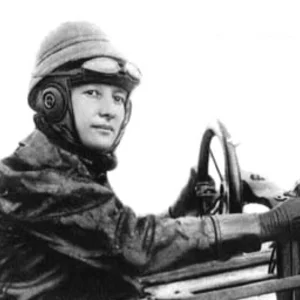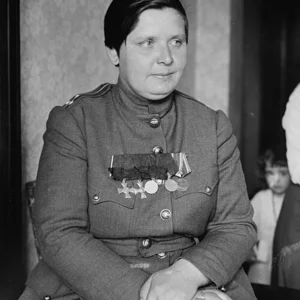

Maria Bochkareva was a Russian soldier of peasant origin who fought during the First World War. In 1917, she founded and commanded the first women's “Battalion of Death” in the Russian army, a unit meant to rally troops demoralized by the revolution.
Maria Bochkareva(1889 — 1920)
Maria Bochkareva
Empire russe
6 min read
Frequently asked questions
Key Facts
- Born in 1889 into a poor peasant family in the Russian Empire
- Volunteered for the imperial army in 1914 by personal authorization of Tsar Nicholas II, a rare thing for a woman
- Founded the first women's “Battalion of Death” in 1917, with the backing of Kerensky's Provisional Government
- Her battalion took part in the summer 1917 offensive at the front and defended the Winter Palace in October 1917
- Executed by the Bolsheviks in Krasnoyarsk in 1920 after opposing Soviet power
Works & Achievements
An extremely rare feat, she served as a regular combatant in an army where military service was reserved for men.
The first all-female combat unit of the Russian army, designed to boost troop morale amid the revolutionary collapse.
Her battalion took part in the fighting of the summer of 1917, an example of direct female engagement on the front lines.
Received by President Wilson and King George V, she pleaded the Russian cause and became an international figure.
A life story dictated to a journalist, which became a major testimony on the war and the Russian revolutions seen through the eyes of a woman of the people.
Anecdotes
Born into a family of poor Siberian peasants, Maria Bochkareva could barely read or write. To enlist in the army in 1914, at a time when the law forbade it to women, she sent a telegram directly to Tsar Nicholas II asking for his permission — and obtained it.
In the trenches, her fellow soldiers nicknamed her “Yashka.” At first, many mocked her, but after several assaults in which she rescued the wounded under fire and fought in hand-to-hand combat, she earned their respect and was decorated with the Cross of Saint George.
In 1917, with the approval of Kerensky's Provisional Government, she created the first “Battalion of Death,” made up entirely of women. She enforced iron discipline: the volunteers had to shave their heads and obey without question, and she dismissed hundreds of recruits she judged undisciplined.
During the October Revolution of 1917, women soldiers from her battalion were among the last troops to defend the Winter Palace in Petrograd against the Bolsheviks.
Having become famous, she traveled to the United States and the United Kingdom in 1918, where she was received by President Woodrow Wilson and King George V. It was at this time that she dictated her memoirs, since she could not write them herself.
Primary Sources
I resolved to offer my life to my country and to serve, as far as my strength would allow, on the field of battle.
She petitioned for imperial permission to join the regular army as a common soldier, an exceptional favor that was granted to her.
The “Russian Joan of Arc” was received at the White House, where she pleaded the cause of continuing the war against Germany.
Key Places
Region in northwestern Russia where Maria Bochkareva was born into a family of poor peasants in 1889.
Siberian city where her family emigrated and where she spent part of her youth; the starting point of her activism.
Imperial capital where she formed the Women's Battalion of Death in 1917; the Winter Palace was defended here during the October Revolution.
Front line where she fought from 1914, was wounded several times, and earned her decorations.
Siberian city where she was arrested by the Cheka and then executed in 1920.
Typical Objects

Standard-issue rifle of the Russian Imperial Army, the basic infantry weapon in the trenches of the First World War.

Russian military decoration awarded for soldiers' bravery in combat, which was bestowed upon her for her conduct on the front lines.

Military dress (gymnastyorka and boots) worn identically by the volunteers of the Battalion of Death, with no distinction of gender.

Emblem worn by the “death” units, a symbol of the oath to fight to the bitter end and never retreat.

Explosive device thrown at short range, widely used during assaults and trench fighting.

Autobiographical account dictated by Bochkareva, the main source on her life since she was nearly illiterate.
School Curriculum
Vocabulary & Tags
Key Vocabulary
Daily Life
Morning
At the front, a soldier's day begins before dawn with roll call and weapons inspection. Maria Bochkareva, as commander of the battalion, enforced discipline and had the rifles and trenches cleaned at first light.
Afternoon
Afternoons were divided between training, fatigue duties and the anxious wait for assault orders. During periods of combat, troops charged the enemy across no man's land under artillery and machine-gun fire.
Evening
In the evening, the soldiers gathered around meager fires to eat and warm themselves. Bochkareva imposed silence and rest, but often had to manage the political tensions that stirred the regiments in 1917.
Food
The Russian soldier's ordinary fare rested on black bread, kasha (buckwheat porridge), cabbage soup (shchi) and tea. In times of shortage, rations were scant and irregular, especially toward the end of the war.
Clothing
She wore the army's regulation uniform: tunic (gymnastyorka), trousers, woolen greatcoat, boots and a cap or fur hat. The volunteers in her battalion had their heads shaved and dressed exactly like the men.
Housing
Life unfolded in the trenches, the underground dugouts and the barracks. Comfort was nonexistent: cold, mud, lice and overcrowding were the daily lot of the fighters on the Eastern Front.
Historical Timeline
Period Vocabulary
Liens externes & ressources
Références
Œuvres
Engagement comme femme soldat dans l'armée impériale
1914
Création du 1er Bataillon féminin de la mort
1917
Participation à l'offensive Kerenski
1917
Tournée diplomatique aux États-Unis et au Royaume-Uni
1918
Mémoires « Yashka: My Life as Peasant, Officer, and Exile »
1919