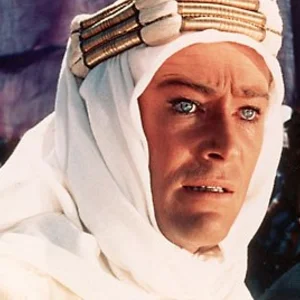

British officer, archaeologist and writer, famous for his role as a liaison with the Arab tribes during the Arab Revolt against the Ottoman Empire (1916-1918). His autobiographical account “Seven Pillars of Wisdom” forged his legend.
Lawrence of Arabia
Lawrence of Arabia
6 min read
Frequently asked questions
Famous Quotes
« All men dream, but not equally.»
Key Facts
- Born in 1888 in Wales, he led archaeological excavations in the Near East before 1914
- Joined the Arab Revolt in 1916 alongside Emir Faisal against the Ottoman Empire
- Took part in the capture of Aqaba in 1917 through a surprise overland attack
- Present at the Paris Peace Conference (1919) to defend the Arab cause
- Published “Seven Pillars of Wisdom” (1926) and died in 1935 in a motorcycle accident
Works & Achievements
An autobiographical account of the Arab Revolt — at once a war chronicle, a moral reflection, and a great literary work that forged his legend.
An abridged, popular version of the “Seven Pillars,” which became an enormous bestseller.
A journal of his service as an ordinary enlisted man in the Royal Air Force, published after his death, bearing witness to barracks life.
A major feat of arms: the seizure of the strategic port through an unexpected overland attack, which opened the way for the Allied advance.
A series of raids and railway demolitions that lastingly disrupted the Ottoman army in Arabia.
A highly regarded English version of the Greek epic poem, displaying Lawrence's erudition and literary talent.
A practical guide for British officers on how to work with the Arabs, which became a reference text.
Anecdotes
Thomas Edward Lawrence was very short (about 1.66 m / 5'5"), which did not stop him from crossing the desert on camelback over hundreds of kilometres. He impressed the Arab chiefs with his endurance and his ability to bear heat, hunger and thirst as well as his Bedouin companions.
In July 1917, Lawrence and the Arab forces captured the port of Aqaba by attacking from inland, on the desert side, where the Ottomans expected no offensive because their guns were turned toward the sea. This boldness made the capture of Aqaba one of his greatest feats of arms.
Lawrence lost the almost complete manuscript of *Seven Pillars of Wisdom* in 1919, leaving it in a briefcase at a railway station in Reading, England. He had to rewrite most of this book of several hundred pages from memory, a colossal effort.
Having become a worldwide celebrity after the war, Lawrence sought to escape his own legend. He enlisted under false names (“John Hume Ross”, then “T. E. Shaw”) as an ordinary soldier in the Royal Air Force, preferring anonymity to glory.
A speed enthusiast, Lawrence died in May 1935 in a motorcycle accident near his cottage in Dorset, swerving to avoid two young cyclists. The neurosurgeon who treated him, Hugh Cairns, later launched research that led to the adoption of the helmet for motorcyclists.
Primary Sources
All men dream, but not equally. Those who dream by night in the dusty recesses of their minds wake in the day to find that it was vanity; but the dreamers of the day are dangerous men, for they may act their dream with open eyes, to make it possible.
The work here is a strange mixture: I live with the Arabs, I wear their clothes, I share their food and their marches through the desert.
Better that the Arabs do the thing tolerably than that you do it perfectly. It is their war, and you are there to help them, not to win it for them.
Key Places
Welsh village where Thomas Edward Lawrence was born in 1888.
British intelligence headquarters where Lawrence worked from 1914 and from which the Arab Revolt was coordinated.
Red Sea port captured in 1917 by a surprise attack from the desert, one of Lawrence's greatest successes.
Capital taken in 1918 by Arab and Allied forces, marking the end of Ottoman rule in the Near East.
Vast desert valley of sandstone that served as a base and a passageway for Arab forces during the revolt.
Secluded cottage where Lawrence spent his final years and near which he met his death in 1935.
Typical Objects

Long white tunic and traditional headdress that Lawrence adopted to blend in among the Bedouin tribes. This garment, given by Emir Faisal, became the iconic image of “Lawrence of Arabia.”

Curved dagger worn at the belt, a sign of prestige and manhood among Arab chiefs. Lawrence received a golden one, a symbol of his honorary rank among them.

Bolt-action rifle of the British army, distributed to Arab fighters by the Allies. It armed the guerrillas during attacks on the Ottoman railways.

Charges of dynamite used by Lawrence to blow up rails, bridges, and locomotives of the Hejaz Railway. These acts of sabotage paralyzed Ottoman reinforcements.

An indispensable mount for crossing the immense desert expanses of Arabia. Mastery of the camel allowed the Arab forces to carry out swift and unpredictable raids.

Lawrence recorded observations, sketches, and field surveys, continuing his work as an archaeologist. These notes later fed into the writing of “Seven Pillars of Wisdom.”
School Curriculum
Vocabulary & Tags
Key Vocabulary
Tags
Daily Life
Morning
In the field, Lawrence rose before dawn, in the cool hour when one prays and loads the camels. The morning was used to push forward across the desert before the heat became crushing, often after a tea shared around the fire.
Afternoon
The afternoon was spent riding for hours on end, scouting the terrain or planning the next sabotage of the railway lines. He also wrote intelligence reports and negotiated with the tribal chiefs.
Evening
In the evening, the troop pitched camp and gathered around the fire for the meal and long conversations in Arabic. Lawrence would then jot down the observations that would later feed his books.
Food
In the desert, he ate like the Bedouins: flatbread, dates, rice and, on feast days, boiled mutton shared by hand from a large communal dish. Water, scarce and precious, was rationed between the watering points.
Clothing
He most often wore the Arab white tunic and keffiyeh, sometimes set off by garments offered by Emir Faisal. This choice of dress made it easier for him to travel and to blend in among the tribes.
Housing
On operations, he lived under the Bedouin tent of goat hair or slept out under the stars in the desert. At other times, he stayed in the intelligence offices in Cairo, then, after the war, in his modest English cottage at Clouds Hill.
Historical Timeline
Period Vocabulary
Liens externes & ressources
Références
Œuvres
Les Sept Piliers de la sagesse (Seven Pillars of Wisdom)
1926
Le Mécréant (Revolt in the Desert)
1927
La Matrice (The Mint)
1955
Prise d'Aqaba
1917
Campagne de sabotage du chemin de fer du Hedjaz
1916-1918
Traduction de l'Odyssée d'Homère
1932
Vingt-sept articles (Twenty-Seven Articles)
1917