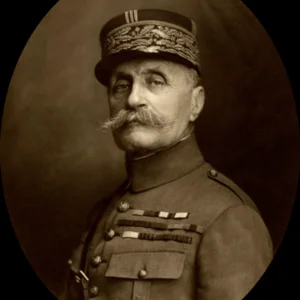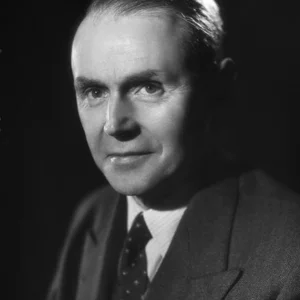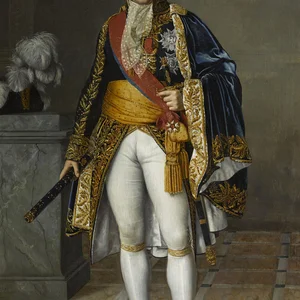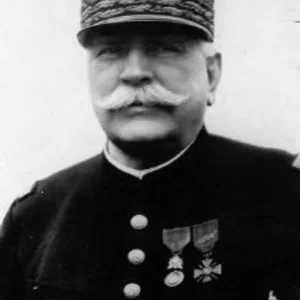

Joseph Joffre (1852-1931) was a French general, commander-in-chief of the French army at the start of the First World War. Victor of the Battle of the Marne in September 1914, he became a Marshal of France in 1916.
Joffre(1852 — 1931)
Joseph Joffre
France
6 min read
Frequently asked questions
Key Facts
- Born on 12 January 1852 in Rivesaltes (Pyrénées-Orientales)
- Appointed commander-in-chief of the French armies in 1911
- Won the First Battle of the Marne (6-12 September 1914), halting the German advance
- Raised to the dignity of Marshal of France on 26 December 1916
- Died on 3 January 1931 in Paris
Works & Achievements
A colonial expedition that established his reputation as an engineering officer capable of leading and fortifying a position in hostile terrain.
The French army's concentration and offensive plan adopted under his leadership; its failure in August 1914 forced the defense to be improvised.
His greatest achievement: the counter-offensive that halted the German invasion and saved Paris, making him a national hero.
Through the “limogeages” (dismissals), he removed the failing generals and rebuilt an effective chain of command.
Having become a diplomatic figure, he was sent on missions to strengthen the ties between France and its allies.
A posthumous account of his career and his conduct of the war, an important source for understanding the decisions of 1914-1916.
Anecdotes
Nicknamed “Grandpa” by his soldiers, Joffre was famous for his unshakeable calm and his appetite: even during the worst hours of 1914, he stopped to eat lunch at a fixed time and slept full nights, convinced that a tired commander makes bad decisions.
In September 1914, as the German armies were rushing toward Paris, Joffre ordered a general counterattack on the Marne. To bring reinforcements to the front, the military governor of Paris, Gallieni, requisitioned around 600 Parisian taxis: these “taxis of the Marne” carried soldiers to the battle, an episode that became legendary.
Joffre was an engineer by training, a graduate of the École Polytechnique. Before the Great War, he had served in the colonies, notably in Sudan where he led the Timbuktu expedition in 1894, and in Madagascar: he was a builder of fortifications as much as a leader of troops.
During the Battle of the Marne, Joffre mercilessly dismissed dozens of generals deemed inadequate — this was called “les limogeages” (after the city of Limoges, where they were sent). This firmness allowed him to quickly reshape his command.
Having become very popular after the Marne, Joffre was the first general to receive the baton of Marshal of France under the Third Republic, in December 1916, shortly after being removed from the supreme command.
Primary Sources
At the moment when a battle is beginning on which the safety of the country depends, it is essential to remind everyone that the time for looking back is over; every effort must be devoted to attacking and driving back the enemy. A unit that can no longer advance must, at all costs, hold the ground it has won and let itself be killed where it stands rather than retreat.
I was convinced that victory depended on our ability to restore freedom of maneuver and to resume the offensive at a moment of our own choosing.
The battle that has been raging for five days is ending in an unquestionable victory. The retreat of the German First, Second, and Third Armies is becoming more pronounced before our left wing and our center.
Key Places
Small town in Roussillon (Pyrénées-Orientales) where Joffre was born in 1852 into a modest family of coopers.
Region east of Paris where the Battle of the Marne took place in September 1914, a victory that saved the capital and made Joffre famous.
City in French Sudan (present-day Mali) that Joffre occupied in 1894 during a colonial expedition, where he distinguished himself as an engineering officer.
Established at Chantilly from late 1914, the GHQ was the command center from which Joffre directed the French army during the war of position.
The capital that the victory at the Marne spared from occupation, and where Joffre died in 1931 before a state funeral.
Prestigious engineering school where Joffre was admitted in 1869, steering his career toward military engineering and the construction of fortifications.
Typical Objects

A cylindrical baton covered in blue velvet sprinkled with stars, the supreme insignia of French military command, presented to **Joffre** in **1916**. It symbolizes the army's highest distinction.

A rigid headdress adorned with braid and gilded oak leaves indicating rank. **Joffre**, with his stocky silhouette and his kepi, was instantly recognizable.

A large, detailed topographic map of the front, spread out at headquarters to plan troop movements. A central tool of **Joffre**'s strategy during the **Battle of the Marne**.

A portable device connecting general headquarters to the armies by wire, allowing orders to be transmitted quickly. The **Marne** was one of the first major battles coordinated by telephone.

A car that allowed **Joffre** to travel across the front and inspect his troops. Motorized transport transformed command during the **Great War**, as illustrated by the famous taxis of the Marne.

Brightly colored trousers worn by the French infantry in **1914**, inherited from the 19th century. Too conspicuous against machine guns, they were soon replaced by the horizon-blue uniform, symbolizing the brutal entry into modern warfare.
School Curriculum
Vocabulary & Tags
Key Vocabulary
Daily Life
Morning
At General Headquarters, Joffre rose early but without haste. He reviewed the night's reports and the maps of the front with his staff officers, listening to the briefings before calmly making his decisions.
Afternoon
The afternoon was devoted to conferences with the army commanders, telephone communications with the front, and sometimes to inspections by automobile. He settled strategic questions without ever letting himself be swept up in agitation.
Evening
In the evening, Joffre insisted on dining properly and going to bed early. Renowned for his regular sleep, he refused to be woken for minor news, believing that a well-rested commander commands better.
Food
A bon vivant from the Roussillon region, Joffre enjoyed good food and insisted on meals taken at fixed hours. This almost ritual regularity was part of his legend as a commander who stayed serene in the midst of the storm.
Clothing
He wore the uniform of a general and later of a marshal: a dark tunic, a kepi trimmed with oak leaves, and, from 1916 onward, the insignia of his rank. His round figure and simple uniform reinforced his image as “Grandpa.”
Housing
During the war, he lived at General Headquarters, first at Vitry-le-François and then settled in a requisitioned château at Chantilly, surrounded by his staff offices and communications equipment.
Historical Timeline
Period Vocabulary
Liens externes & ressources
Références
Œuvres
Occupation de Tombouctou
1894
Plan XVII
1913
Victoire de la Marne
septembre 1914
Réorganisation du haut commandement
1914-1915
Mission militaire aux États-Unis et au Japon
1917 et 1922
Mémoires du maréchal Joffre
1932