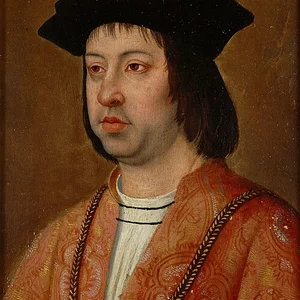

A Florentine merchant and magistrate of the Renaissance, Francesco del Giocondo is best known for having commissioned Leonardo da Vinci to paint the portrait of his wife Lisa Gherardini, known as the Mona Lisa. Born in 1465 in Florence, he was a prosperous silk merchant.
Francesco del Giocondo(1460 — 1542)
Francesco del Giocondo
8 min read
Frequently asked questions
Key Facts
- Born in 1465 in Florence into a merchant family
- Married Lisa Gherardini in 1495, who would become the model for the Mona Lisa
- Commissioned the portrait of his wife from Leonardo da Vinci around 1503
- A prosperous merchant of silk and cloth in Florence
- Held official positions in the Florentine administration
Works & Achievements
Francesco commissioned Leonardo da Vinci to paint a portrait of his wife, most likely to celebrate the birth of their second son and the acquisition of a new home. This commission gave birth to the Mona Lisa, the most famous work of art in the world — though Francesco himself never received it.
For fifty years, Francesco ran a thriving trade in silks and precious fabrics in Florence, operating within the powerful silk merchants' guild. His business contributed to the economic influence of the Florentine Renaissance across European markets.
This notarial deed, preserved in the State Archives of Florence, documents the union between the del Giocondo and Gherardini families. It illustrates the matrimonial practices of the merchant bourgeoisie, in which economic interests and social alliances were closely intertwined.
Francesco del Giocondo held several civic positions within the Florentine Republic, attesting to his standing among the political and merchant elite. These roles show that commercial success could open the door to city governance in Renaissance Florence.
Anecdotes
In 1503, Francesco del Giocondo commissioned Leonardo da Vinci to paint a portrait of his wife, Lisa Gherardini. It is believed this commission was intended to celebrate the birth of their second son, Andrea, and the acquisition of a new family home. The painting would go down in history as the Mona Lisa — known in Italian as *La Gioconda*, derived from 'del Giocondo'.
Unlike almost all artistic commissions of the era, Francesco del Giocondo never received his painting. Leonardo da Vinci kept it with him, reworking it over the years, and finally took it to France in 1516 at the invitation of Francis I. Francesco died in 1542 without ever having recovered the portrait of his own wife.
An exceptional document discovered in 2005 in the library of Heidelberg University definitively confirms that the subject of the Mona Lisa is indeed Lisa del Giocondo. It is a marginal note written in 1503 by Agostino Vespucci, Machiavelli's secretary, which explicitly states that Leonardo was then working on a portrait of “Lisa del Giocondo.”
Lisa Gherardini, Francesco's wife, was about fifteen years younger than him when they married in 1495. Their union was typical of the matrimonial arrangements of the Florentine merchant bourgeoisie: young women from noble but impoverished families married prosperous merchants in exchange for financial security, thereby cementing social and economic alliances.
Francesco del Giocondo was not merely a merchant: he held positions as a magistrate in Florence's republican institutions, sitting on municipal councils. His career perfectly embodies the figure of the merchant-citizen of the Italian Renaissance — at once an economic actor and a pillar of civic life.
Primary Sources
Apelles pictor. Ita Leonardus Vincius facit in omnibus suis picturis, ut enim caput Lise del Giocondo et Anne matris virginis. ('So does Leonardo da Vinci in all his paintings, as with the face of Lisa del Giocondo and Anne, mother of the Virgin.')
Prese Lionardo a fare per Francesco del Giocondo il ritratto di mona Lisa sua moglie, e quattro anni penatovi, lo lasciò imperfetto. ('Leonardo undertook to paint for Francesco del Giocondo the portrait of mona Lisa his wife, and having labored at it for four years, left it unfinished.')
The notarial records held at the State Archives of Florence register the marriage between Francesco di Bartolomeo di Zanobi del Giocondo and Lisa di Antonmaria Gherardini, setting out the terms of the dowry and the obligations of both families.
The registers of the catasto (tax register) of Florence document the assets, silk trade, and properties of the del Giocondo family, confirming the prosperity of Francesco as an established merchant in the Santa Croce district.
Key Places
Birthplace and lifelong home of Francesco del Giocondo, Florence was at the dawn of the 16th century the world center of finance and luxury textile trade. His entire career as a merchant and magistrate unfolded within this city.
Francesco del Giocondo lived and conducted his trade in this Florentine district, traditionally associated with merchant families. The Gherardini family, from which his wife Lisa descended, was also established in this part of the city.
The seat of the Florentine republican government, this palace was where Francesco carried out his duties as a magistrate. He took part in the deliberations of the councils that governed the city-state.
One of the most revered churches in Florence, frequented by bourgeois families for important devotions, memorial masses, and services tied to major family occasions such as births or weddings.
It was in the library of this university that the 2005 discovery of Agostino Vespucci's marginal note (1503) definitively confirmed that Leonardo da Vinci was indeed painting the portrait of Lisa del Giocondo, wife of Francesco.
Typical Objects

Florentine merchants kept double-entry accounting ledgers, a method that originated in Italy in the 13th century. Francesco recorded his silk transactions, outstanding credits, and debts with other guild merchants.

The heart of Francesco's trade: luxurious silk fabrics, often woven with gold threads, sold to the great Florentine families and exported throughout Europe. The reputation of Florentine silks made this one of the most lucrative trades of the Renaissance.

A financial instrument invented by medieval Italian merchants, the bill of exchange allowed Francesco to settle transactions at a distance without physically moving currency, reducing the risks inherent in long-distance trade.

Having one's wife's portrait painted by a renowned artist was a mark of social standing for a prosperous Florentine merchant. The tavola commissioned by Francesco from Leonardo was painted on poplar wood, the standard support of the period.

Used to authenticate commercial contracts and official documents, the wax seal bearing the del Giocondo family arms accompanied all of Francesco's important correspondence and transactions.

As a wealthy Florentine merchant, Francesco wore long robes (giornea) of fine cloth lined with fur, along with elaborate hoods. These outfits reflected both his place among the prosperous merchant class and his profession as a dealer in precious fabrics.
School Curriculum
Vocabulary & Tags
Key Vocabulary
Daily Life
Morning
Francesco rose early to attend morning Mass at his neighborhood church, a common practice among Florentine merchants eager to maintain their reputation for piety. He would then head to his shop to receive suppliers and associates, examine new shipments of silk fabrics, and dictate his business correspondence to a clerk.
Afternoon
In the afternoons, Francesco frequented the loggias (covered galleries) and markets where Florentine merchants gathered to discuss commodity prices, news from trade routes, and city affairs. He might also sit on municipal councils or pay visits to his business partners and creditors.
Evening
Evenings were devoted to family life in the del Giocondo household. Meals brought the family together, sometimes with invited associates or notable guests. Francesco would review the day's accounts, plan the following day's transactions, and might attend guild meetings or religious services.
Food
Like the prosperous merchants of his circle, Francesco enjoyed a varied diet: roasted meats, fish on days of abstinence, seasonal vegetables, and fresh or candied fruits. Good-quality bread, Tuscan wine, and olive oil formed the daily staples, supplemented on festive occasions by more elaborate dishes and sweet confections.
Clothing
Francesco wore the characteristic dress of a prosperous Florentine merchant: a long robe (giornea) of fine cloth, sometimes fur-lined in winter, and a carefully arranged chaperon. His clothes were tailored from quality fabrics — silk, velvet, or brocade — reflecting his success in the textile trade and his social standing.
Housing
The del Giocondo family lived in an urban townhouse (palazzo) in the Santa Croce district, typical of prosperous Florentine bourgeois families. Organized around an interior courtyard, the house included reception rooms on the first floor for receiving associates and notables, private living quarters on the upper floors, and several rooms decorated with paintings and solid furniture.
Historical Timeline
Period Vocabulary
Liens externes & ressources
Références
Œuvres
Commande du portrait de Lisa Gherardini à Léonard de Vinci
vers 1503
Négoce de soieries florentines au sein de l'Arte della Seta
vers 1490-1540
Mariage avec Lisa Gherardini — contrat notarié
1495
Fonctions de magistrat dans les institutions florentines
1499-1528