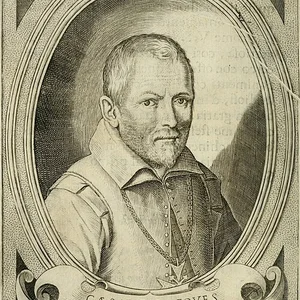

Cesare Ripa (c. 1555–1622) was an Italian scholar and iconographer, author of the *Iconologia* (1593), an encyclopedic treatise that codified the allegorical representation of virtues, vices, and abstract concepts. His work became the essential reference for European artists and decorators from the 17th to the 18th century.
Cesare Ripa(1555 — 1622)
Cesare Ripa
Italie
8 min read
Frequently asked questions
Key Facts
- Born around 1555 in Perugia (Umbria), Italy
- Publication of the *Iconologia* in 1593 in Rome, initially without illustrations
- Illustrated edition of the *Iconologia* in 1603, featuring more than 150 engravings
- The *Iconologia* was translated throughout Europe and reprinted more than 40 times through the 18th century
- Died around 1622 in Perugia
Works & Achievements
The first work of systematic codification of visual allegories in Europe, describing in words how to represent hundreds of abstract concepts. Without engravings, it nonetheless laid the foundations of the iconographic system that would become the reference for European artists.
An expanded and illustrated version of the Iconologia, featuring around 400 intaglio-engraved figures. This edition was an immediate success and was adopted in painting, sculpture, and interior decoration workshops throughout Italy and beyond the Alps.
A newly enriched edition published in Padua, extending the corpus of allegories to nearly 500 entries. It testifies to the commercial and intellectual success of the work and served as the basis for numerous European translations.
Published after Ripa's death, this edition brought the number of entries to more than 700 allegories. It secured the Iconologia's lasting status as an encyclopedic reference throughout the 17th and 18th centuries, across Baroque Europe.
Anecdotes
Cesare Ripa was neither a painter nor a sculptor, but a household steward (maestro di casa) in the service of Cardinal Anton Maria Salviati in Rome. It was precisely this position — giving him access to vast art collections and rich libraries — that allowed him to write his encyclopedia of allegories. A man of the household who became the definitive reference for the greatest European artists.
The first edition of the Iconologia, published in Rome in 1593, contained no illustrations whatsoever: Ripa described in words alone how to represent each abstract concept. It was not until 1603, with the second Roman edition, that engravings came to illustrate the roughly 400 allegorical figures, making the work even more accessible to artists who did not always read Latin.
The Iconologia describes Truth, for example, as a naked woman holding a sun in one hand and a book in the other, standing atop a globe. These precise descriptions served as a guide to painters such as Rubens, Poussin, and later Tiepolo, who consulted the work much as one might today turn to a standard iconographic reference manual.
Ripa was a member of the Accademia degli Insensati in Perugia, a learned society that brought together the intellectuals of his native region. His membership in this humanist network gave him the intellectual credibility needed to publish a work as ambitious as the Iconologia.
The Iconologia achieved spectacular success across Europe: translated into Dutch as early as 1644, then into French, German, and English, it was reprinted more than thirty times through the eighteenth century. Born from the pen of a provincial scholar, it became one of the most widely consulted books in artists' studios throughout Baroque Europe.
Primary Sources
Nella presente opera si descrivono diverse Imagini di Virtù, Vitij, Affetti, Passioni humane, Arti, Discipline, Humori, Elementi, Corpi Celesti... La Verità è una donna ignuda, perché la verità è semplice e aperta, et non ha bisogno di ornamenti.
Con l'aggiunta di molte figure d'Imagini quasi in ogni pagina, per maggiore commodità de' Pittori, Scultori, et altri. The edition specifies for each allegory the attributes, clothing, colors, and associated animals, along with the corresponding ancient sources.
To his patron, Ripa asserts that allegorical images allow one to teach morality and virtues more effectively than simple discourse, for 'gli occhi toccano l'anima più presto che le orecchie' — the eyes touch the soul more swiftly than the ears.
An expanded edition bringing the number of allegories to nearly 500 entries, with numerous references to Virgil, Ovid, and Pliny the Elder to legitimize each symbolic representation through the authority of the Ancients.
The posthumous edition enriched by Castellini brings the number of allegories to more than 700 entries, attesting to the vitality of Ripa's encyclopedic project and the persistent demand among artists for this type of iconographic reference work.
Key Places
The birthplace of Cesare Ripa, Perugia was an active intellectual hub with its learned academies. Ripa was a member of the Accademia degli Insensati there and received his humanist education in the city.
Ripa spent most of his working life in Rome in the service of Cardinal Anton Maria Salviati, whose palace he managed as steward. It was in this environment, rich in art collections and libraries, that he wrote and published the *Iconologia*.
The first editions of the *Iconologia* were printed in Rome, a major center of Italian Counter-Reformation publishing. The illustrated edition of 1603 came off the presses of Lepido Faci, in this district densely packed with printing workshops.
One of the richest libraries in Europe, accessible to Roman scholars of good standing. It was likely an essential resource for Ripa's research into ancient, medieval, and humanist iconography.
Typical Objects

The primary tools of the humanist scholar, the trimmed goose-quill and the metal or ceramic inkwell were Ripa's daily instruments for drafting his meticulous allegorical descriptions. As a cardinal's steward, he had access to quality materials.

Emblem collections — most notably Alciato's *Emblematum liber* (1531) and Bocchi's *Symbolicae Quaestiones* — directly preceded and inspired the *Iconologia*. Ripa consulted them extensively as he built his own symbolic system.

Roman medals engraved with allegorical figures were a major source of inspiration for Ripa. He drew on Antiquity to lend authority to his descriptions of virtues and vices, frequently citing the reverses of ancient coins in the *Iconologia*.

Ripa collected and studied prints depicting allegories — particularly the Flemish and Italian engravings circulating in Roman artistic circles. These images formed the visual corpus from which he constructed and verified his descriptions.

A Baroque symbol of mastery over the world, the globe appears frequently in the allegories of the *Iconologia* — as an attribute of Fortune, Truth, or Fame. It was also a prestige object found in the libraries of Roman prelates.

Candlelight shaped the scholar's nocturnal work. As a cardinal's steward, Ripa no doubt had quality candelabras at hand for his long reading and writing sessions after the day's domestic duties were done.
School Curriculum
Vocabulary & Tags
Key Vocabulary
Daily Life
Morning
Cesare Ripa began his day very early, as any steward of a great Roman palace would: overseeing the kitchens, organizing meals and receptions, managing the domestic staff. These administrative duties occupied the first part of his morning before he could turn to his intellectual work.
Afternoon
In the afternoon, freed from his most pressing obligations, Ripa would retire to the palace library to read classical texts, leaf through emblem books, and study medals and engravings. He drafted his allegorical descriptions with a quill pen, comparing sources and verifying the symbolic attributes of each figure.
Evening
Evenings in the service of a Roman cardinal could be enlivened by banquets or receptions for distinguished guests — humanists, artists, and prelates. Ripa, in his capacity as steward, oversaw these events and made the most of the learned conversations around him. He would then return to his quarters for a few hours of reading by candlelight.
Food
A Roman cardinal's table was abundant and varied: roasted meats, fish (especially on the lean days of the Catholic calendar), vegetables from the Lazio region, cheeses, white bread, and local wines. As steward, Ripa supervised these meals but most likely ate a more modest version of this fare, typical of a man of letters of middling station.
Clothing
Ripa wore the dress of a man of letters in the service of a prelate: a dark doublet, breeches, a cape, and a carefully kept white linen collar. Neither the ecclesiastical robes of a cardinal nor the working clothes of a craftsman, but the distinguished civilian attire of a court humanist — plain and practical.
Housing
As a cardinal's steward, Ripa most likely lodged in the Palazzo Salviati or in its immediate vicinity, in comfortable apartments without excessive luxury. He had access to the palace library and art collections — an ideal setting for his iconographic research.
Historical Timeline
Period Vocabulary
Liens externes & ressources
Références
Œuvres
Iconologia overo Descrittione dell'Imagini Universali (1re édition, sans illustrations)
1593
Iconologia, édition augmentée de Padoue (P. P. Tozzi)
1611
Iconologia, édition posthume augmentée par Giovanni Zaratino Castellini
1630