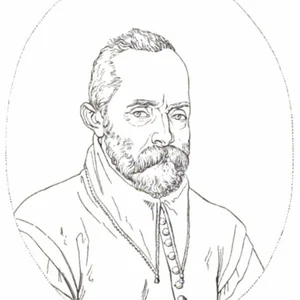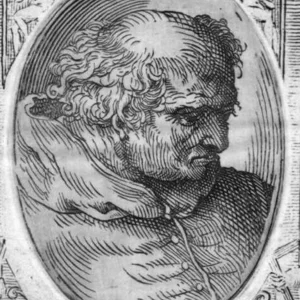

Francesco Melzi (1491-1570) was Leonardo da Vinci's favorite pupil and faithful companion. An Italian painter of the Lombard Renaissance, he inherited Leonardo's manuscripts and works upon his death and helped preserve his legacy.
Francesco Melzi(1492 — 1570)
Francesco Virgolini
9 min read
Frequently asked questions
Key Facts
- Born around 1491 in Vaprio d'Adda, near Milan, into a noble Lombard family
- Joined Leonardo da Vinci's workshop around 1506–1508, at approximately 15 years of age
- Accompanied Leonardo during his stay in France at the court of Francis I (1516–1519)
- Upon Leonardo's death (1519), inherited all of his manuscripts, drawings, and works
- Compiled the Libro di pittura from Leonardo's notes, helping to spread his artistic theories
Works & Achievements
Considered his masterpiece, this painting depicts the Roman goddess Pomona and the god Vertumnus disguised as an old woman, drawn from Ovid's *Metamorphoses*. Held at the Gemäldegalerie in Berlin, it demonstrates his mastery of Leonardesque sfumato in the rendering of faces and drapery.
A compilation of Leonardo da Vinci's theoretical notes on painting, light, proportion, and perspective, assembled by Melzi from thousands of original sheets. Published in Paris in 1651, this work was the first codification of Leonardo's pictorial theories and had a lasting influence on European art theory.
A painting depicting a young woman holding flowers, attributed to Melzi and held at the Hermitage in Saint Petersburg. It showcases his skill in rendering female faces in the Leonardesque style, with the subtle treatment of light characteristic of the Lombard school.
A copy made by Melzi after a now-lost composition by Leonardo depicting Leda and Zeus transformed into a swan. This work is valuable to art historians as it allows for a faithful reconstruction of the master's lost original.
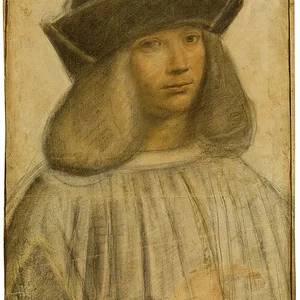
Several portraits of young men are attributed to Melzi, revealing his training within the great Lombard tradition of court portraiture. These works demonstrate his ability to capture the psychology of his subjects in direct lineage with Leonardo's teaching.
Anecdotes
Around 1506, the young Francesco Melzi, son of a noble Lombard family, was only about fifteen years old when he met Leonardo da Vinci in Milan. Captivated by the master's genius, he gave up the privileges of his station to enter his workshop, quickly becoming his closest assistant and faithful companion until the artist's death.
In 1519, when Leonardo died at Amboise, it was Francesco Melzi who broke the news to the master's family. In a moving letter addressed to Leonardo's brothers, he wrote that the loss had been as painful to him as the death of a father, bearing witness to the depth of the bond between them.
After Leonardo's death, Melzi single-handedly organized the repatriation of all the manuscripts and works from France to Italy, transporting thousands of pages of scientific, artistic, and philosophical notes. This perilous mission helped preserve one of the greatest intellectual legacies of the Renaissance.
Melzi spent several decades attempting to organize Leonardo's scattered notes into a Treatise on Painting. Despite his total dedication, this colossal work was not published until 1651 — more than eighty years after his own death — in Paris. His compilation effort nonetheless remains one of the founding acts of art theory in the Western world.
After returning to Italy, Melzi lived in seclusion at the Villa Melzi in Vaprio d'Adda, surrounded by the thousands of pages he had inherited from his master. His heirs, largely unaware of the priceless value of this treasure, scattered the manuscripts after his death in 1570, leading to their dispersal to the four corners of Europe.
Primary Sources
I believe you have learned of the death of Master Leonardo, your brother, and for me the best of fathers. It is impossible for me to express the grief I felt at his death; and as long as my limbs sustain me, I shall feel a perpetual sorrow.
Francesco Melzi, a Milanese gentleman, was greatly loved by Leonardo during his lifetime; and today, an old man, he lovingly preserves the memory of Leonardo and his paintings.
We saw at Amboise an old man of more than seventy years, Leonardo da Vinci, accompanied by a very gracious young Milanese whom the old master cherished tenderly.
This treatise gathers the master's theories on light, proportions, drapery, and perspective, constituting the first systematic codification of his pictorial thought as passed down by his most faithful disciple.
Key Places
The birthplace and main residence of Francesco Melzi, this Lombard family villa became, after 1519, the sanctuary of Leonardo da Vinci's manuscripts. It was here that Melzi spent decades compiling the *Trattato della Pittura*, surrounded by the precious intellectual legacy of the master, until his own death.
It was in Milan that Melzi met Leonardo da Vinci around 1506, at a time when the city was under French rule. There he received his artistic training in the master's workshop, at the heart of a metropolis that was then one of Europe's most vibrant cultural and intellectual centers.
The residence granted by Francis I to Leonardo da Vinci in 1516, the Clos Lucé was the master's final home, where Melzi assisted him until his death in 1519. It was in this château that Melzi solemnly received Leonardo's artistic and intellectual legacy.
Between 1513 and 1516, Melzi accompanied Leonardo to Rome, where the latter stayed under the patronage of Giuliano de' Medici. This period allowed Melzi to study ancient works and mingle with the great contemporary masters, including Michelangelo and Raphael.
Liens externes & ressources
Références
Œuvres
Léda et le Cygne (copie d'après Léonard de Vinci)
c. 1508-1515
Portrait de jeune homme
c. 1510-1520