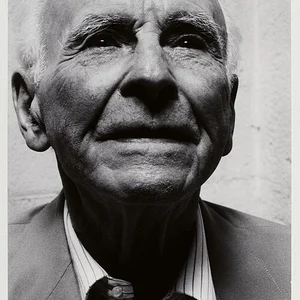

French writer (1899-1988) and founder of an innovative poetics devoted to everyday objects. Ponge liberates poetry from traditional rhetoric by celebrating simple, material things, inventing a 'rage of expression' to explore the sensory world.
Frequently asked questions
Famous Quotes
« Things do not interest us. We are interested only in conversation and love.»
« I propose, on the contrary, to speak to you of things, and again of things.»
Key Facts
- Publication of 'Le Parti pris des choses' (Taking the Side of Things) in 1942, the founding work of his poetics
- Political involvement with the French Communist Party between 1937 and 1946
- Development of a poetic method based on the meticulous observation of everyday objects (pebble, oyster, soap, etc.)
- Publication of 'Proêmes' in 1948, a theoretical collection explicating his literary approach
- Gradual recognition as a major figure of modern French poetry in the second half of the 20th century
Works & Achievements
Ponge's first published collection, these short prose texts already announce his meticulous attention to objects and his pursuit of concise writing.
Ponge's major founding work, this collection of prose poems devoted to everyday objects (pebble, oyster, candle, crate) revolutionizes French poetry. A text studied in school curricula.
A collection blending prose and poetry whose title fuses "prose" and "poem". Ponge develops his reflection on language and writing.
A collection showing poetic work in progress, with its drafts and revisions. Ponge exposes the creative process itself as literary material.
A monumental essay in which Ponge studies the classical poet Malherbe to define his own conception of poetry as artisanal work on language.
A text developed over more than twenty years around a simple bar of soap, now a classic of contemporary literature blending description, humor, and philosophy of language.
A work presenting simultaneously the final text and all preparatory drafts of a poem about a meadow, illustrating Ponge's unique working method.
A late text emblematic of Ponge's approach, in which the fig becomes a pretext for a jubilant unfolding of language between description and wordplay.
Anecdotes
Francis Ponge recounted that his poetic awakening came from a feeling of inadequacy with words: he felt unable to express himself properly in speech, which drove him to seek absolute precision in writing. This difficulty in speaking became the driving force behind his entire literary work.
During the oral philosophy examination for the École normale supérieure entrance exam in 1919, Ponge fell completely silent, paralysed by stage fright. This humiliating failure left a deep mark on him and reinforced his conviction that only writing could allow him to express himself with accuracy.
Ponge worked for nearly twenty years at Gallimard publishers, then at Messageries Hachette, as a simple employee. He wrote his poems in the evenings and on weekends, leading a double life between the world of salaried work and literary creation.
Jean-Paul Sartre devoted a lengthy and laudatory essay to Ponge in 1944, entitled 'L'Homme et les choses' ('Man and Things'), published in the journal Poésie 44. This recognition by the most celebrated philosopher of the time helped bring Ponge out of relative obscurity after years of quiet writing.
Ponge was a committed resistance fighter: he joined the Communist Party in 1937 and actively participated in the Resistance in the south of France during the Occupation. He notably contributed to clandestine publications before leaving the Party in 1947.
Primary Sources
The oyster, the size of an average pebble, has a rougher appearance, a less uniform color, brilliantly whitish. It is a stubbornly closed world.
The bias of things equals the account taken of words. My work must be such that each term used is not a sign but a thing.
If I rub my hands with it, the soap foams, jubilates... The more it makes them compliant, supple, binding, ductile, the more it froths, the more its froth is airy, pearly.
My aim is not to write poems, but to advance in the knowledge and expression of the sensible world.
Key Places
Ponge's birthplace, where he spends his childhood and adolescence in a Protestant family from southern France. The Mediterranean landscape leaves a lasting imprint on his sensibility.
The city where Ponge lives and works for most of his active life, first as an employee at Messageries Hachette and then at Gallimard. It is in Paris that he moves in literary circles and publishes his major works.
A Provençal village where Ponge settles at the end of his life and where he dies in 1988. This peaceful retreat in the hinterland behind Nice reflects his love of nature and simple things.
The town where Ponge spends part of the war years and participates in the Resistance. He leads the local committee of the Front national de lutte pour la libération there from 1943 onwards.
Ponge spends part of his youth in Caen, where his father is posted. The Norman landscape and provincial life nurture his earliest observations of the world.
Typical Objects

An emblematic object from The Nature of Things, the pebble represents raw matter that Ponge attempts to grasp through words. It embodies the resistance of things to language.

Ponge dedicated an entire book to soap, an everyday object that becomes a pretext for meditation on language and matter. Soap accompanied his work for more than twenty years.

Ponge worked on his texts through successive revisions in notebooks, accumulating drafts and crossings-out. The writing process mattered as much to him as the final result.

The crate is one of the most celebrated objects sung by Ponge, a symbol of the humility of ordinary things elevated to the rank of poetic subject.

The oyster from The Nature of Things illustrates Ponge's method: meticulously describing an object to reveal its unsuspected richness, like the pearl one discovers inside it.

Ponge constantly consulted dictionaries, particularly the Littré, to explore the etymology and multiple meanings of words. The dictionary was his primary working tool.
School Curriculum
Vocabulary & Tags
Key Vocabulary
Daily Life
Morning
Ponge rose early and devoted his mornings to writing, the time when his concentration was sharpest. He would settle at his desk with his notebooks and dictionaries, tirelessly reworking his texts. A cup of coffee accompanied this morning ritual of creation.
Afternoon
In the afternoon, during his years as an employee, Ponge worked at Messageries Hachette or at Gallimard, in a world far removed from poetry. Later, freed from these constraints, he dedicated his afternoons to reading, corresponding with other writers, and taking long observational walks.
Evening
Ponge's evenings were often devoted to rereading his drafts and to intellectual exchanges. He frequented Parisian literary circles and maintained friendships with painters such as Braque and Fautrier, whose attention to materials echoed his own.
Food
Ponge appreciated simple, southern French cooking, faithful to his Montpellier roots. In Provence, he enjoyed local produce: olive oil, garden vegetables, and regional cheeses. His table reflected his taste for authentic, unpretentious things.
Clothing
Ponge dressed in a sober and classic manner, like the discreet man of letters he was in the mid-twentieth century. Simple suit, shirt, and sometimes a pullover, he sought neither ostentatious elegance nor eccentricity. His appearance reflected his reserved and studious personality.
Housing
In Paris, Ponge lived in modest apartments, those of an employee and later of a writer with limited income. In his final decades, he settled in Bar-sur-Loup, in a Provençal house surrounded by vegetation — a peaceful setting conducive to observing the nature he loved to describe.
Historical Timeline
Period Vocabulary
Visual Style
Un style visuel épuré et lumineux qui magnifie les objets du quotidien avec une précision quasi scientifique. L'esthétique mêle la lumière méditerranéenne aux textures naturelles, dans l'esprit des natures mortes classiques revisitées par la modernité.
Sound Ambience
L'univers sonore de Ponge est celui d'un bureau d'écriture calme, entre le grattement de la plume sur le papier et les bruits discrets de la Provence. Un silence studieux ponctué par les sons simples du quotidien qu'il aimait tant observer.
Liens externes & ressources
Références
Œuvres
Douze petits écrits
1926
Le Parti pris des choses
1942
La Rage de l'expression
1952
Pour un Malherbe
1965
Le Savon
1967
La Fabrique du pré
1971