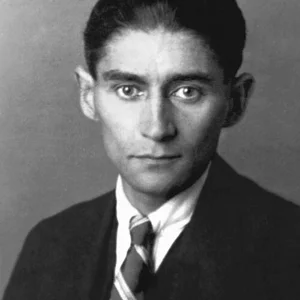

A German-language writer from Prague, a major figure of 20th-century literature. His work, marked by the absurd and by anguish in the face of oppressive systems, gave rise to the adjective “Kafkaesque.”
Franz Kafka(1883 — 1924)
Franz Kafka
Tchécoslovaquie, Cisleithanie
7 min read
Frequently asked questions
Famous Quotes
« A book must be the axe for the frozen sea within us.»
« The railway, the telephone, and wireless telegraphy bring people closer together; but the anguish remains.»
Key Facts
- Born on 3 July 1883 in Prague into a German-speaking Jewish family.
- Published the novella The Metamorphosis in 1915.
- Died of tuberculosis on 3 June 1924 near Vienna, at the age of 40.
- His major novels (The Trial, The Castle, Amerika) were published posthumously by his friend Max Brod, against his wish to have them destroyed.
- Worked as a lawyer at a workers' accident insurance company.
Works & Achievements
A short story written in a single night, which Kafka regarded as his literary breakthrough. A son is condemned by his father in an oppressive confrontation.
Kafka's most famous tale: a man wakes up transformed into a giant insect and becomes a burden to his family. A symbol of modern alienation.
A posthumous novel in which Josef K. is arrested and put on trial without ever learning his crime. A founding work of the “Kafkaesque” imagination.
A short story describing a torture machine that engraves the sentence into the condemned man's flesh. A chilling meditation on justice and cruelty.
A long autobiographical letter, never delivered, in which Kafka analyzes the fear instilled in him by his authoritarian father. A key to reading his entire body of work.
An unfinished novel: the land surveyor K. tries in vain to be recognized by the authorities of an unreachable castle. An allegory of bureaucracy and exclusion.
An unfinished first novel following a young emigrant through an imagined America. It blends social satire with dreamlike strangeness.
Anecdotes
Before he died, Kafka asked his friend Max Brod to burn all his unpublished manuscripts, including the novels "The Trial" and "The Castle." Brod refused to obey and published the texts after 1924: without this betrayal, Kafka's most famous work would have gone up in smoke.
Kafka was a writer only at night. By day, he was a salaried lawyer at the Workers' Accident Insurance Institute in Prague, where he drafted technical reports on machine safety. He called his office job his "bread and butter" and saved his nighttime energy for literature.
During his lifetime, Kafka published almost nothing and was virtually unknown to the general public. He released only a few stories such as "The Metamorphosis
(1915)
and worldwide fame came only years after his death — to the point that his name gave rise to the adjective
Kafkaesque.
Kafka got engaged twice to the same woman, Felice Bauer, and broke it off twice. He wrote her hundreds of letters, sometimes daily, but the idea of marriage terrified him because he feared it would rob him of the time and solitude he needed to write.
Stricken with tuberculosis, Kafka spent his final years in sanatoriums. Toward the end, the disease attacked his larynx, preventing him from speaking and even swallowing: he communicated through small written notes and died of starvation at the age of 40, in 1924, in a facility near Vienna.
Primary Sources
As Gregor Samsa awoke one morning from uneasy dreams, he found himself transformed in his bed into a monstrous insect.
You asked me recently why I claim to be afraid of you. As usual, I was unable to think of any answer, partly for the very reason that I am afraid of you.
September 23. This story, “The Judgment,” I wrote in a single sitting during the night of the 22nd to the 23rd, from ten o'clock at night to six o'clock in the morning.
Someone must have slandered Josef K., for one morning, without having done anything wrong, he was arrested.
Key Places
Kafka's birthplace, where he spent nearly his entire life. Its maze of narrow streets, its German-speaking Jewish community, and the looming outline of the Castle form the backdrop of his work.
Kafka studied law here and earned his doctorate in 1906. It was here that he met Max Brod, his loyal friend and future posthumous editor.
Kafka worked here as a lawyer from 1908 to 1922, writing reports on industrial hazards. This administrative world fed his vision of absurd bureaucracy.
In 1916-1917, Kafka rented a tiny house on this picturesque lane to write there in peace. The Castle towering above it would provide the title and the motif of his last novel.
Kafka died of tuberculosis here on 3 June 1924, at the age of 40. The disease in his larynx prevented him from speaking and eating in his final days.
Kafka rests here in the family vault, beneath a stone that also bears the names of his parents. His grave has become a place of literary pilgrimage.
Typical Objects

From 1910 onward, Kafka kept private notebooks in which he recorded dreams, literary fragments, and anxieties. These diaries are at once a writing laboratory and a confession.

Kafka wrote hundreds of letters, sometimes several a day, to his fiancées and women friends. These letters form an essential part of his work and of his emotional life.

In his work as an insurance officer, Kafka used the tools of modern administration, including the typewriter, to produce reports and forms. This bureaucratic world fed his fiction.

Kafka drafted reports on workplace accidents and the hazards of industrial machines. This omnipresent paperwork inspired the absurd procedures of “The Trial” and “The Castle.”

Like every office clerk of his day, Kafka wore a strict suit, a stiff collar, and a hat to go to the Insurance Office. An outfit that embodied the seriousness of Prague's bourgeoisie.

Kafka crossed Prague daily on foot or by electric tram, a city whose alleys, bridges, and the silhouette of the Castle pervade his imagination.
School Curriculum
Vocabulary & Tags
Key Vocabulary
Daily Life
Morning
Kafka rose early to get to his office at the Workers' Accident Insurance Institute, where he spent the morning studying workplace-accident files. A conscientious lawyer, he was valued there despite the low regard he held for this job he took only to earn a living.
Afternoon
His workday as a civil servant ended around 2 p.m., which left him the afternoon to sleep, stroll through Prague, or exercise. He practiced swimming, gymnastics, and long walks to care for his frail body.
Evening
It was at night that Kafka wrote, sometimes until dawn, in the silence of the family apartment. He regarded this nocturnal solitude as the indispensable condition of his literary creation.
Food
Kafka adopted a vegetarian lifestyle and took an interest in the natural diets and slow chewing then in fashion. At the end of his life, tuberculosis of the larynx almost completely prevented him from eating.
Clothing
Like every employee of bourgeois Prague, he wore the dark suit, the stiff collar, and the hat of the office man. Elegant and well-groomed, he liked a proper, understated appearance.
Housing
Kafka lived for a long time in his parents' apartment, in the heart of the Old Town, which weighed on his need for independence. He sometimes rented rooms or small houses, as on the *Golden Lane*, to write in peace.
Historical Timeline
Period Vocabulary
Liens externes & ressources
Références
Œuvres
Le Verdict (Das Urteil)
1912
La Métamorphose (Die Verwandlung)
1915
Le Procès (Der Process)
1914-1915, publié en 1925
La Colonie pénitentiaire (In der Strafkolonie)
1919
Lettre au père (Brief an den Vater)
1919
Le Château (Das Schloss)
1922, publié en 1926
L'Amérique / Le Disparu (Der Verschollene)
écrit dès 1912, publié en 1927