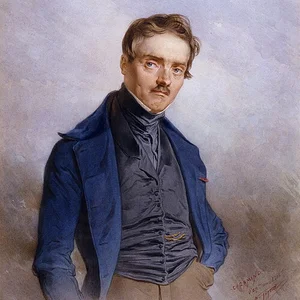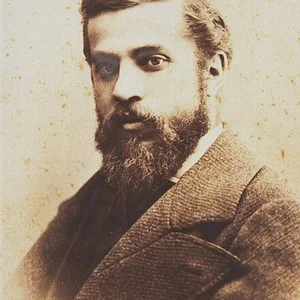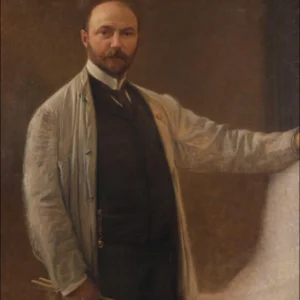

Franz Matsch (1861–1942) was an Austrian painter and sculptor, and a classmate of Gustav Klimt at the Vienna School of Applied Arts. He collaborated closely with Klimt and Ernst Klimt within the Künstler-Compagnie, creating large-scale decorative works for theaters and museums.
Franz Matsch(1861 — 1942)
Franz Matsch
Autriche
8 min read
Frequently asked questions
Key Facts
- 1861: born in Vienna
- Around 1880: trained at the Vienna School of Applied Arts alongside Gustav Klimt
- 1880–1894: collaborated with Gustav and Ernst Klimt within the Künstler-Compagnie on monumental decorative commissions (Burgtheater, Kunsthistorisches Museum in Vienna)
- 1892: artistic split with Klimt — Matsch remained committed to academicism while Klimt moved toward the Secession
- 1942: died in Vienna
Works & Achievements
Monumental paintings adorning the ceilings of the lateral staircases of the new Burgtheater, created together with Gustav and Ernst Klimt. *The Apotheosis of Theatre*, Matsch's principal work in this ensemble, earned him the Imperial Golden Cross of Merit.
Allegorical and historical compositions adorning the grand staircase of the imperial museum. These works in the Historicist style demonstrate the Künstler-Compagnie's ability to handle complex subjects on a very large scale.
Allegorical painting commissioned for the Aula Magna of the University of Vienna, produced alongside Klimt's controversial Faculty Paintings. Matsch's work, more conventional in approach, was warmly received — in stark contrast to those of his former partner.
One of the Künstler-Compagnie's first major commissions outside Vienna, attesting to the wide reach of the collaboration between Matsch and the Klimts across the Austro-Hungarian Empire.
A series of society portraits produced throughout his career following the dissolution of the Compagnie. These works attest to his talent as a psychological portraitist and his enduring place within Vienna's conservative circles.
Anecdotes
Franz Matsch makes the most decisive encounter of his life at the Vienna School of Applied Arts, where he shares a classroom with Gustav Klimt and his brother Ernst. The three young artists found the Künstler-Compagnie around 1879: they take on commissions together, divide up the work, and share the income. This partnership allows them to quickly secure monumental commissions that would have been beyond the reach of any one of them alone.
For the decoration of the new Burgtheater in Vienna, inaugurated in 1888, Matsch and the Klimt brothers receive an exceptional commission: to paint the ceilings of the two lateral staircases with scenes illustrating the history of theatre. Matsch's work, the *Apotheosis of Theatre*, impresses Emperor Franz Joseph I so greatly that he awards all three the Golden Cross of Merit, a high imperial distinction recognizing their artistic services.
When Gustav Klimt founds the Vienna Secession in 1897 and commits to a Symbolist and avant-garde style of painting, Matsch chooses a different path. He remains faithful to an academic and classical style, which gradually opens an artistic rift between the two former friends. This divergence illustrates one of the major debates in Viennese art at the turn of the century: tradition versus modernity.
During the commission of paintings for the University of Vienna around 1900, Matsch and Klimt are each asked to create allegorical works representing the university's Faculties. While Matsch delivers a conventional piece that is well received, Klimt's paintings cause a resounding scandal for their symbolism, deemed obscene, and their nude figures. This episode marks the definitive break between their artistic trajectories.
After the dissolution of the Künstler-Compagnie, Franz Matsch builds a highly regarded career as a society portraitist. He paints the likenesses of numerous figures from the Viennese aristocracy and upper bourgeoisie, becoming an indispensable presence in the salons of the Ringstrasse. His longevity — he dies in 1942 at the age of 81 — allows him to witness the collapse of the empire that had made his fame.
Primary Sources
The Hofburg commissions the Künstler-Compagnie to execute the ceiling paintings of the new Burgtheater building, based on the sketches previously approved by the imperial artistic committee.
His Majesty Emperor Franz Joseph I has graciously seen fit to award the Golden Cross of Merit to painters Franz Matsch, Gustav Klimt, and Ernst Klimt for their exceptional contribution to the decoration of the Vienna Burgtheater.
The university committee confirms the commission awarded to Messrs. Klimt and Matsch for the creation of the allegories intended for the Aula Magna, in accordance with the iconographic programme established jointly with the academic authorities.
Franz Matsch exhibits several portraits and decorative compositions that demonstrate his mastery of academic techniques and his fidelity to the traditions of great Viennese painting.
Key Places
The institution where Matsch studied and met Gustav and Ernst Klimt, forming the Künstler-Compagnie with them. This school was the cradle of his artistic training and the starting point of his entire career.
The imperial theater where Matsch and the Klimt brothers decorated the ceilings of the side staircases (1886–1888). This was his most iconic commission, earning him official recognition from the Emperor.
The grand imperial museum for which the Künstler-Compagnie created decorative paintings in the main staircase. These works in the Historicist style bear witness to the period of collaboration between Matsch and the Klimts.
Capital of the Austro-Hungarian Empire and birthplace of Franz Matsch, where he spent virtually his entire life and career. The Ringstrasse and its monuments formed the main stage for his artistic activity.
One of the regional theaters of the Austro-Hungarian Empire for which the Künstler-Compagnie created decorations, extending Matsch's reputation well beyond the imperial capital.
Typical Objects

For the monumental frescoes and wall paintings commissioned by imperial institutions, Matsch worked on very large-format stretcher frames, sometimes several meters in height, requiring special scaffolding erected inside the theaters and museums being decorated.

Before each major mural composition, Matsch produced cartoons — full-scale drawings on paper — used to transfer the composition onto the final surface and to secure the approval of imperial patrons before beginning the definitive painting.

Matsch used a palette typical of late nineteenth-century academic painting, with ochres, siennas, and muted blues, contrasting sharply with the brighter, more symbolic colors later adopted by Klimt in his Secessionist works.

Commissions from the Imperial Court were governed by detailed contracts specifying the iconographic program, deadlines, materials, and fees. These documents mark the milestones of Matsch's career and attest to his integration into Vienna's highest institutional circles.

Like all academic painters trained at the School of Applied Arts, Matsch relied on reference books for the poses, anatomy, and drapery of the allegorical figures adorning his large decorative compositions destined for public buildings.

For historical scenes evoking ancient or Renaissance theater, Matsch used engravings and, from the 1890s onward, photographs of costumes and sculptures — a common practice in the academic workshops of Viennese *Belle Époque*.
School Curriculum
Vocabulary & Tags
Key Vocabulary
Daily Life
Morning
Franz Matsch began his day early, making his way to his Viennese studio at dawn to take advantage of the natural morning light, which was indispensable for the precision work demanded by his large compositions. He prepared his pigments and brushes before settling into working sessions on his canvases or preparatory cartoons.
Afternoon
Afternoons were often devoted to receiving patrons or models for his society portraits. During major decorative projects such as the Burgtheater, Matsch and his associates worked directly on site from scaffolding, painting architectural surfaces under the supervision of imperial project managers.
Evening
Evenings were frequently spent in Viennese salons and artistic circles, where Matsch cultivated the network of relationships essential to securing institutional commissions. Vienna offered an intense cultural life — opera, concerts, exhibitions — of which he was a regular as an established figure in academic circles.
Food
Like the Viennese bourgeoisie of his era, Matsch enjoyed a rich and varied diet typical of Austro-Hungarian cuisine — roasts, sauerkraut, Wiener Schnitzel, and pastries. Midday and evening meals were important social occasions, sometimes taken in Vienna's famous Kaffeehäuser, essential meeting places for artists and intellectuals.
Clothing
As a society painter who moved in aristocratic circles, Matsch paid particular attention to his appearance. He adopted the conventional attire of the Viennese gentleman — dark jacket, tie, and top hat — for receptions at his patrons' homes, while in the studio he wore a work smock to protect his clothes.
Housing
Matsch lived and worked in Vienna in a bourgeois studio-apartment, in the manner of established artists of his time. Proximity to the great cultural institutions of the Ringstrasse — the Burgtheater, the Kunsthistorisches Museum, the Academy of Fine Arts — represented a practical and symbolic advantage for a painter whose career was closely bound to these landmarks.
Historical Timeline
Period Vocabulary
Liens externes & ressources
Références
Œuvres
Peintures décoratives du Kunsthistorisches Museum de Vienne
1890-1891
Décorations du Théâtre municipal de Fiume (Rijeka)
1883-1885
Portraits de l'aristocratie et de la haute bourgeoisie viennoises
1890-1920