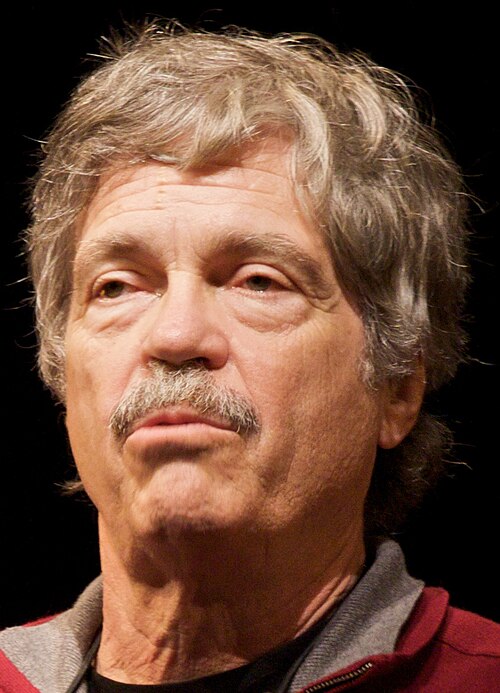
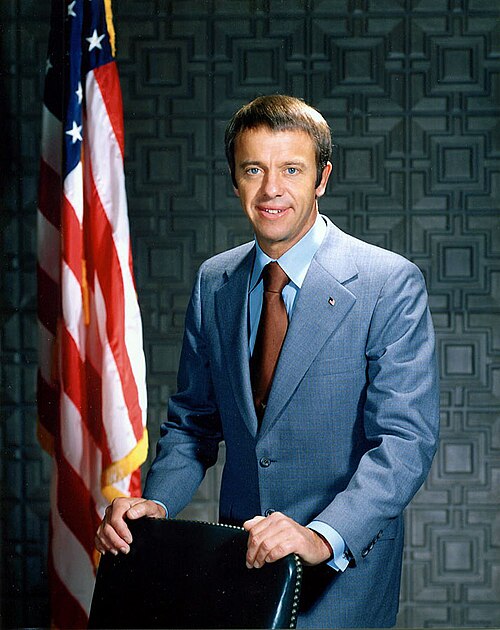
Fred Hoyle(1915 — 2001)
Fred Hoyle
Royaume-Uni
8 min read
British astrophysicist (1915–2001), Fred Hoyle is famous for his work on stellar nucleosynthesis and for ironically coining the term "Big Bang" for the theory he rejected. He championed the steady-state theory of the Universe.
Frequently asked questions
Famous Quotes
« The Universe is like a puzzle whose box we do not have.»
« Space isn't remote at all. It's only an hour's drive away if your car could go straight upwards.»
Key Facts
- 1915: born in Bingley, Yorkshire, England
- 1957: publication of the landmark B²FH paper on stellar nucleosynthesis
- 1949: coined the term "Big Bang" during a BBC radio broadcast
- 1967: founded the Institute of Astronomy in Cambridge
- 2001: died in Bournemouth
Works & Achievements
Landmark article published in Reviews of Modern Physics with Burbidge, Burbidge, and Fowler, explaining how nearly all chemical elements were forged inside stars through nuclear reactions. It is one of the most cited publications in the history of astrophysics.
Article in which Hoyle set out his steady-state theory of the Universe, proposing that matter is continuously created to compensate for expansion. This theory stood in opposition to the Big Bang model for decades.
A science-fiction novel in which an intelligent interstellar cloud threatens the Earth. An international bestseller, it illustrates how Hoyle used fiction to explore bold scientific ideas about life in the Universe.
A series of public lectures in which Hoyle reflects on the philosophical implications of modern astronomy and humanity's place in an expanding Universe.
The first major work developing the theory of cosmic panspermia — the hypothesis that the seeds of life travel through space on interstellar dust grains.
Hoyle's scientific and personal memoirs, tracing his journey from rural Yorkshire to the heights of world cosmology. A valuable account of British science in the twentieth century.
Anecdotes
In March 1949, during a broadcast on BBC Radio, Fred Hoyle used the phrase “big bang” ironically and dismissively to describe the theory of the explosive origin of the Universe, which he found absurd. Unwittingly, he gave the most important cosmological theory of the twentieth century its definitive name — the very theory he would spend his whole life fighting.
In 1953, Hoyle made an extraordinary prediction: for stars to produce enough carbon to allow life to exist, the carbon-12 atom had to possess a precise energy level at around 7.65 MeV. No physicist believed in this “resonant state,” but it was experimentally confirmed a few months later by William Fowler’s team at Caltech. This “Hoyle state” is today considered one of the most remarkable theoretical predictions in astrophysics.
In 1983, William Fowler received the Nobel Prize in Physics for his work on stellar nucleosynthesis — work carried out largely in collaboration with Hoyle. The Nobel Committee’s decision to exclude Hoyle was met with astonishment by the scientific community, and Fowler himself publicly acknowledged that his colleague deserved the prize as much as he did.
Alongside his scientific career, Fred Hoyle was a prolific science-fiction author. His novel *The Black Cloud* (1957) features an intelligent interstellar cloud approaching Earth — a story that some colleagues considered too plausible to be mere fiction, revealing how Hoyle constantly blended creative imagination with scientific rigour.
Towards the end of his career, Hoyle developed with Chandra Wickramasinghe the theory of cosmic panspermia: the idea that the seeds of life travel through space and seed planets. This highly controversial hypothesis led to him being marginalised within the scientific community, but it continues to fuel debates about the origin of life.
Primary Sources
It is the purpose of this paper to show that the synthesis of nearly all the elements can be explained by nuclear processes taking place inside stars, during their normal evolution or during supernova explosions.
The steady-state theory postulates that the Universe, although expanding, presents an overall appearance unchanged over time, with new matter being continuously created to maintain a constant mean density.
Nuclear fusion reactions inside stars enable the progressive production of heavier elements from hydrogen, providing an astrophysical explanation for the observed abundance of elements in the Universe.
Complex organic molecules detected in interstellar clouds suggest that the chemical precursors of life are widespread throughout the galaxy, and that the Earth benefited from them during its formation.
I could never accept the idea that the Universe had a beginning. The notion of an initial singularity struck me as philosophically unacceptable — an act of creation ex nihilo dressed up as physics.
Key Places
Fred Hoyle's hometown, nestled in the hills of West Yorkshire. His childhood in this rural landscape fostered an early interest in observing the night sky.
Hoyle studied mathematics here from 1933, and spent virtually his entire scientific career at Cambridge. In the 1940s–1960s, Cambridge was the world centre of theoretical cosmology.
Hoyle founded this institute in 1966 and served as its director until 1972, establishing it as a leading centre for theoretical astrophysics and cosmology.
Hoyle collaborated regularly here with William Fowler during the 1950s and 1960s, most notably on the work that led to the landmark B²FH paper on stellar nucleosynthesis.
The town where Fred Hoyle settled after his retirement and where he died on 20 August 2001, at the age of 86.