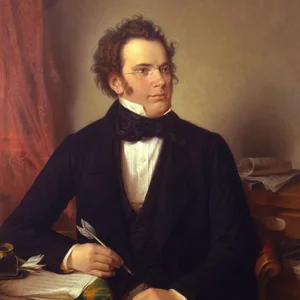

Franz Schubert (1797-1828) was an Austrian composer of the early Romantic period, who wrote more than 600 lieder, symphonies, and chamber music. Despite his short life, he left behind a body of work of exceptional richness, distinguished by its melodic gift and emotional depth.
Franz Schubert(1797 — 1828)
Franz Schubert
empire d'Autriche, archiduché d'Autriche
8 min read
Frequently asked questions
Key Facts
- Born on January 31, 1797, in Vienna, into a modest family
- Composed more than 600 lieder, including the famous song cycle Die schöne Müllerin (1823)
- Wrote his Symphony No. 8 'Unfinished' around 1822, which remained mysteriously incomplete
- Died on November 19, 1828, in Vienna, at just 31 years old, from typhoid fever
- Much of his work was recognized and published only after his death
Works & Achievements
A lied for voice and piano set to a poem by Goethe, considered one of the pinnacles of the genre. The voice alternately portrays the father, the child, and the Erl-King in a breathtaking dramatic crescendo.
A symphony mysteriously abandoned after two movements, only discovered and premiered in 1865. Its deeply Romantic harmonic language makes it a pioneering work in the genre.
A cycle of 20 lieder set to poems by Wilhelm Müller, telling the story of a young miller's unrequited love. The first great song cycle in the history of music.
A joyful quintet whose fourth movement draws on the theme of the lied 'The Trout'. A radiant and beloved work, emblematic of Schubert's summer stay in Upper Austria.
A cycle of 24 lieder set to poems by Wilhelm Müller, a testament work of profound and devastating darkness. Considered one of the pinnacles of all Western vocal music.
A quartet of extreme dramatic intensity, whose second movement draws on the theme of his lied of the same name. A poignant testament to Schubert's struggle against illness.
Schubert's final symphony, of monumental scope, premiered by Schumann and Mendelssohn in 1839. Robert Schumann famously described it as possessing 'heavenly length'.
Anecdotes
Schubert composed at a breathtaking speed: he could write several lieder in a single day. Legend has it that he wrote 'Erlkönig', one of his most celebrated works, in a single afternoon, reading Goethe's poem for the very first time. His friend Josef von Spaun recalls finding him at the piano, eyes shining, the manuscript still wet with ink.
Unable to afford a piano, the young Schubert would sometimes use blank sheet music as an imaginary keyboard, laid flat on a table to compose. His family was of modest means, and his father, a schoolteacher, saw no future in music. Franz spent his entire life juggling composition with the need to earn a living as a teacher.
'Schubertiades' were musical evenings hosted by wealthy Viennese friends, where Schubert would play and sing his own compositions. These intimate gatherings, highly sought after in Viennese intellectual circles, gave Schubert a way to share his music in a world where only a small fraction of his work was ever published. They were marked by a spirit of camaraderie and artistic passion.
Schubert died at 31, most likely from typhoid fever, though his health had been weakened since he contracted syphilis in 1822. He asked to be buried near Beethoven, whom he deeply admired and whose funeral procession he had followed just a year before. His wish was granted: the two composers now rest side by side in Vienna's Central Cemetery.
At his death, Schubert left behind hundreds of unpublished manuscripts. His Symphony No. 8, known as the 'Unfinished', was not discovered and performed until 1865 — 37 years after his death. Why Schubert stopped after two movements remains unknown: illness, forgetfulness, or a deliberate choice? The mystery endures and has fascinated musicologists for two centuries.
Primary Sources
I work constantly, so that I do not become a stranger to the art that has made me so happy, even though my means are modest.
My existence is nothing but composition. I compose in the morning, and when I have finished one piece, I immediately begin another.
We found Schubert in a state of great excitement, reading Goethe's Erlkönig. He read through the poem several times, then sat down at the table, and in a very short time the magnificent ballad was set down on paper.
I feel myself to be the most unhappy, the most wretched of men. Picture a man whose health will never recover, and who in despair makes things worse rather than better.
The evening at Schober's was of rare musical beauty. Schubert played without pause, and each lied seemed to touch the audience to the very depths of their souls.
Key Places
Schubert was born on January 31, 1797, at 54 Nussdorferstrasse in Lichtental, then a suburb of Vienna. The house is now a museum dedicated to his memory.
The imperial boarding school where Schubert studied from 1808 to 1813, receiving an outstanding musical education under the direction of Antonio Salieri. It was here that he discovered the symphonies of Haydn and Mozart.
The Schubertiades were held in various apartments in central Vienna, notably at the homes of Franz von Schober and the Sonnleithner brothers. These evening gatherings were the primary means by which Schubert's work was shared during his lifetime.
Schubert spent several summers in Upper Austria with the singer Vogl, finding renewal in the Alpine landscapes that inspired, among other works, the 'Trout' Quintet in 1819.
Schubert has rested here since 1888, transferred to be buried alongside Beethoven in the grove of distinguished musicians. His grave is a place of pilgrimage for music lovers from around the world.
Typical Objects

Schubert constantly wore his characteristic round glasses, which became his defining feature in all his portraits. His friends affectionately nicknamed him 'Schwammerl' (little mushroom), a reference to his round figure and his glasses.

Schubert composed at a prodigious speed, filling sheets of staff paper with ink. He bought his own ruled paper and often worked from early morning, either in bed or at a small table.

The defining instrument of the Romantic era, the fortepiano accompanied all of his lieder and was central to the Schubertiades. Schubert composed and accompanied singers on this type of instrument, which had a lighter touch than the modern piano.

Schubert often composed at night or in the early morning hours by candlelight, in the dim surroundings of his Viennese room. It is said that he kept his glasses on even while sleeping so he could immediately jot down his musical ideas.

The typical bourgeois attire of Viennese Biedermeier society, which Schubert wore at musical gatherings. His understated appearance contrasted sharply with the emotional exuberance of his music.

Schubert drew most of his lied texts from the great tradition of German poetry. Goethe's works inspired more than 70 of his lieder, including 'Erlkönig' and 'Gretchen am Spinnrade'.
School Curriculum
Vocabulary & Tags
Key Vocabulary
Daily Life
Morning
Schubert rose early, often before dawn, and composed immediately — sometimes still in his nightshirt. He kept his glasses on the bedside table so he could jot down any musical idea the moment he woke. This morning discipline allowed him to produce a colossal body of work despite a short life.
Afternoon
Afternoons were devoted to teaching — his main source of income — followed by walks through the Viennese suburbs with his poet and painter friends. He frequented Viennese coffeehouses, notably the Café Bogner, where a circle of Romantic artists would gather.
Evening
Evenings were often spent at Schubertiades hosted by bourgeois friends, where Schubert would accompany singers and present his latest compositions. He came home late, sometimes after midnight, and would occasionally pick up his pen again before bed, driven by a constant creative fever.
Food
Schubert lived modestly and ate cheaply at inns and at friends' homes. His diet was that of an ordinary Viennese: soups, boiled meats, dark bread, potatoes, and vegetables. On Schubertiade evenings, he shared buffets and wines with the middle-class families who welcomed him.
Clothing
Schubert wore the dark, understated attire of the Viennese bourgeoisie: a black or dark frock coat, waistcoat, plainly knotted white cravat, and light-colored trousers. His round metal-framed glasses were his most distinctive accessory. Unlike some Romantic artists of his time, he made no effort to stand out through his appearance.
Housing
Schubert never owned his own apartment and often lived with friends or in modest furnished rooms. He stayed notably with Franz von Schober and in various lodgings in central Vienna. In the last year of his life, he moved in with his brother Ferdinand to receive care.
Historical Timeline
Period Vocabulary
Visual Style
Intérieur bourgeois viennois de l'époque Biedermeier, lumière dorée et chaude des bougies, tons sobres et intimistes, style portrait réaliste du début du romantisme.
Sound Ambience
Ambiance d'une Schubertiade viennoise : pianoforte délicat, voix chantant des lieder, bruissement de manuscrits, fiacres sur les pavés et chaleur d'un poêle en faïence.