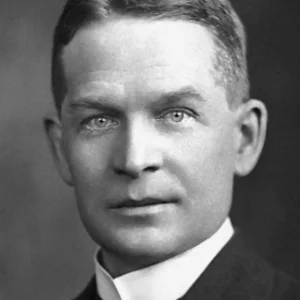

Frederick Soddy (1877-1956) was a British radiochemist and a pioneer in the study of radioactivity. He formulated the concept of the isotope and studied radioactive decay with Ernest Rutherford. He was awarded the Nobel Prize in Chemistry in 1921.
Frederick Soddy(1877 — 1956)
Frederick Soddy
Royaume-Uni
6 min read
Frequently asked questions
Key Facts
- With Ernest Rutherford, formulated the theory of radioactive decay (the transmutation of elements) in 1902-1903.
- Introduced the concept of the “isotope” in 1913 (elements that are chemically identical but have different atomic masses).
- Stated the law of radioactive displacement in 1913 (the Fajans-Soddy rules).
- Received the Nobel Prize in Chemistry in 1921 for his work on radioactive substances and isotopes.
- Turned in the 1920s and 1930s to economics, criticizing the monetary system (a forerunner of ecological economics).
Works & Achievements
Demonstration that radioactivity is the spontaneous transformation of one element into another, a revolutionary idea that founded nuclear physics.
Rule explaining how an element shifts its position in the periodic table during an alpha or beta emission.
Discovery that atoms of the same element can have different masses, a fundamental notion of modern chemistry.
Experimental proof that one radioactive element gives rise to another, confirming natural transmutation.
A work in which Soddy explains the energy of the atom to the general public and imagines its future uses, notably inspiring H. G. Wells.
Award for his contribution to the chemistry of radioactive substances and to the origin and nature of isotopes.
A restatement in verse of a geometric result on mutually tangent circles, published in Nature.
Pioneering reflection linking energy, money and ecology, sometimes seen as an anticipation of ecological economics.
Anecdotes
In 1913, Frederick Soddy coined the word “isotope” to describe atoms of the same element that occupy the same square in the periodic table but do not have the same mass. It was his mother-in-law, the novelist Margaret Todd, who suggested this term drawn from the Greek “isos topos” (“same place”) during a family dinner.
As a young chemist at McGill University in Montreal, Soddy worked with Ernest Rutherford on radioactive thorium. One evening during an experiment, he exclaimed at his result: “Rutherford, this is transmutation!” Rutherford immediately replied: “For heaven's sake, Soddy, don't call it transmutation, they'll have our heads off as alchemists!”
Soddy established the “law of radioactive displacement”: when an atom emits an alpha particle, it moves back two squares in the periodic table, and when it emits a beta particle, it moves forward one square. This simple rule brought order to the bewildering profusion of new radioactive elements.
Passionate about the social consequences of science, Soddy partly abandoned chemistry after his Nobel Prize to devote himself to economics. As early as the 1920s, he predicted that the energy locked within the atom might one day be used to build terrible weapons, long before the atomic bomb.
In 1936, Soddy rediscovered and proved in verse an old geometry formula about tangent circles. He published this poem, “The Kiss Precise,” in the journal Nature: the circles touching one another are described as kissing, and the theorem is now known as the “Soddy circles.”
Primary Sources
“The same algebraic sum of the positive and negative charges in the nucleus, when the arithmetical sum is different, gives what I call isotopes or isotopic elements, because they occupy the same place in the periodic table.”
“Radioactivity is at once an atomic phenomenon and one accompanied by chemical changes in which new kinds of matter are produced.”
“Isotopes are elements that are chemically identical but have different atomic masses; they occupy one and the same square of the periodic table.”
“Four circles to the kissing come. / The smaller are the benter. / The bend is just the inverse of / The distance from the center.”
Key Places
Coastal town in Sussex where Frederick Soddy was born in 1877 into a family of merchants. He received his early schooling there.
Soddy studied chemistry here and graduated with honours in 1898. He would later return as a professor of chemistry from 1919 to 1936.
It was here, between 1900 and 1902, that Soddy collaborated with Ernest Rutherford and developed the theory of radioactive decay.
Soddy worked here with William Ramsay and demonstrated that the decay of radium produces helium.
A professor of physical chemistry and radioactivity from 1904 to 1914, Soddy formulated his radioactive displacement law and the concept of the isotope here.
Town on the south coast where Frederick Soddy died in 1956.
Typical Objects

An instrument that detects the ionization of air caused by radiation: the gold leaves draw together as the charge drains away. Soddy and Rutherford used it to measure the intensity of radioactivity.

A radioactive compound that Soddy studied at McGill to understand disintegration. It was by observing its “emanation” that he established the nature of radioactivity.

A classification of the elements where Soddy showed that different isotopes occupy one and the same cell. His concept of the isotope profoundly enriched this table.

A small device in which one observes, through a magnifying lens, the tiny flashes produced by alpha particles striking a fluorescent screen. It made atomic disintegrations visible one by one.

Together with William Ramsay, Soddy demonstrated that radium produces helium by collecting the gas in a sealed tube and analyzing it by spectroscopy. The balance was used for meticulous chemical weighings.

Awarded to Soddy in 1921 for his contribution to the chemistry of radioactive substances and the theory of isotopes. It marks the worldwide recognition of his work.
School Curriculum
Vocabulary & Tags
Key Vocabulary
Tags
Daily Life
Morning
Soddy reaches the university laboratory early, where flasks, electroscopes and carefully labelled radioactive samples await him. The morning is spent making precise measurements of the ionisation of the air and recording meticulous notes in his notebooks.
Afternoon
The afternoon is devoted to chemistry experiments: purifying rare salts, weighing substances on a precision balance and carrying out spectroscopic analyses. He discusses the results with his collaborators and corrects the proofs of his articles destined for journals such as *Nature*.
Evening
In the evening, Soddy reads, writes lectures and reflects on the social consequences of science. A keen debater, he is happy to exchange views on politics, economics and the future of atomic energy.
Food
Like a British academic of his time, he eats a hearty breakfast (eggs, toast, tea), a light lunch and a more formal dinner in the evening. Afternoon tea sets the rhythm of the day at the laboratory.
Clothing
Soddy wears the dark three-piece suit of the Edwardian man of science: jacket, waistcoat, stiff collar and tie. In the laboratory, he slips on a lab coat to protect his clothes from the chemicals.
Housing
He lives in comfortable houses in university towns such as Glasgow and Oxford, close to his laboratory. His home, shared with his wife Winifred, is that of a comfortably well-off middle-class academic.
Historical Timeline
Period Vocabulary
Liens externes & ressources
Références
Œuvres
Théorie de la désintégration radioactive (avec Rutherford)
1902-1903
Loi de déplacement radioactif
1913
Concept d'isotope
1913
Démonstration de la production d'hélium par le radium (avec Ramsay)
1903
The Interpretation of Radium (livre de vulgarisation)
1909
Prix Nobel de chimie
1921
Théorème des cercles de Soddy (« The Kiss Precise »)
1936