
Inventors of the cinematograph, pioneers of cinema
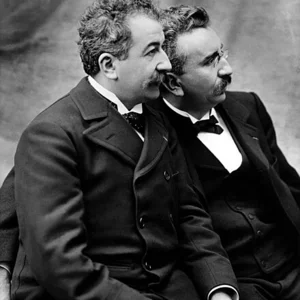
Lumière Brothers(1862/1864 — 1954/1948)
Lumière Brothers
France
7 min read
Frequently asked questions
Key Facts
- Auguste (1862-1954) et Louis (1864-1948) Lumière naissent à Besançon et grandissent à Lyon dans une famille de photographes
- En 1881, leur père Antoine fonde une usine de plaques photographiques à Lyon où les frères travaillent et innovent
- En 1895, ils déposent le brevet du cinématographe, appareil capable de filmer, développer et projeter des images animées
- Le 28 décembre 1895, ils organisent la première projection publique payante de l'histoire du cinéma au Grand Café de Paris
- Entre 1895 et 1905, leurs opérateurs tournent plus de 1 400 films dans le monde entier, constituant une archive visuelle unique de l'époque
Works & Achievements
First film shot by the Lumière brothers, showing female workers leaving their factory. Considered the birth certificate of cinematic documentary.
A view famous for the terror it provoked in early audiences. It illustrates the immersive power of cinema and remains a universal symbol of the birth of the seventh art.
The first comic fiction film in the history of cinema, featuring a simple but effective visual gag. It proves that cinema can tell stories and not merely document reality.
An intimate film showing Auguste Lumière feeding his child. The first example of a home movie, ancestor of the family video.
Official filing of the patent protecting the Lumière brothers' invention. This founding document establishes their authorship of the invention of cinema as we know it.
The first practical and accessible colour photography technique, based on tinted starch grains. It revolutionized photography for several decades before the arrival of modern colour film.
Anecdotes
On December 28, 1895, during the first public paid screening at the Grand Café in Paris, spectators were so terrified by the arrival of the train at La Ciotat station that they leapt from their seats. This reaction illustrates the shock caused by the very first cinematic projection in history.
Louis Lumière, when later asked about the future of cinema, reportedly declared that the cinematograph was 'an invention with no future.' Ironically, this technology would go on to revolutionize entertainment and global culture for generations.
The Lumière brothers were not only filmmakers: their father Antoine had put them to work as teenagers in his photographic plate factory in Lyon. It was this mastery of chemistry and optics that enabled them to develop the cinematograph in just a matter of months.
During the filming of 'L'Arroseur arrosé' (1895), the Lumières created what is considered the first comic fiction film in history. The plot, extremely simple — a gardener gets sprayed by a mischievous boy — proves that popular comedy is timeless.
Auguste and Louis worked as a complementary duo: Louis was more the inventor and technician, while Auguste was more the manager and businessman. Together, they filed over 170 patents throughout their lives, far beyond the cinematograph alone.
Primary Sources
Apparatus for obtaining and viewing chronophotographic prints. We have devised an apparatus in which a film strip is intermittently driven past a lens.
Lumière Cinematograph. This new apparatus, owing to the genius of Messrs. Auguste and Louis Lumière, reproduces the movement of all beings and all things with perfect clarity and precision.
Our father had asked us to find a way to reproduce photographed motion. Louis came up with the claw mechanism idea in a single night, and by the very next day we were able to test our first prototype.
The cinematograph is merely a means of recording scientific facts and scenes of life. We do not claim to have invented an art, but an instrument of observation and documentation.
Key Places
Manufacturing site for photographic plates and birthplace of the cinematograph. It was in this factory that the Lumière brothers developed and tested their invention in 1895.
Site of the first public paid screening of the cinematograph on December 28, 1895. This date is considered the official birth of cinema.
Birthplace of the Lumière brothers, where Auguste (1862) and Louis (1864) were born before the family moved to Lyon for their father Antoine's work.
Filming location of the famous short film 'Arrival of a Train at La Ciotat Station' (1895), shot during the Lumière family's holidays. This town is also associated with screenings held at the Eden Théâtre.
Museum housed in the Lumière family villa in Lyon-Monplaisir. It preserves archives, original equipment, and perpetuates the memory of the inventors of cinema.
Typical Objects

A device serving simultaneously as camera, film printer, and projector, patented in 1895. Its compact design and claw mechanism made it possible to film and project moving images with a single machine.

The preferred medium manufactured at the Lumière factory in Lyon. Louis improved its sensitivity, which first allowed the family business to flourish before the birth of cinema.

The Lumière brothers adopted and standardized the 35 mm format with a single perforation on each side. This format remains the basis of professional film cinema to this day.

The forerunner of the projector, used since the 17th century to project still images onto a screen. The Lumières were well acquainted with its use, and the Cinematograph represents its ultimate evolution through the addition of motion.

Invented by Louis Lumière in 1903 and commercially released in 1907, it was the first color photography technique accessible to the general public, using dyed potato starch granules.

An indispensable tool for Lumière operators during their travels around the world. The camera's stability gave Lumière films their characteristic documentary quality.
School Curriculum
Vocabulary & Tags
Key Vocabulary
Daily Life
Morning
Auguste and Louis would rise early to head to the Lumière factory in Monplaisir, Lyon. Mornings were devoted to overseeing the production of photographic plates and corresponding with clients across Europe. Louis often spent several hours in his laboratory experimenting with new chemical emulsions.
Afternoon
In the afternoons, the brothers would meet to work on their invention projects. In 1894–1895, afternoons were entirely dedicated to perfecting the cinematograph: adjusting the claw mechanism, testing film stock, and shooting the first footage in the factory courtyard.
Evening
Evenings were spent with family at their bourgeois villa in Monplaisir. The brothers read scientific journals, corresponded with other European inventors, and prepared their papers. During major screenings, they personally supervised the setup of the equipment.
Food
Traditional Lyonnaise bourgeois cuisine of the Belle Époque: poultry, charcuterie, and cheeses from the Rhône-Alps region. Family meals were an important occasion, as evidenced by their own film 'Baby's Lunch'. Regional wine accompanied family dinners.
Clothing
Typical bourgeois attire of the late 19th century: dark wool suit, buttoned waistcoat, white shirt with a stiff collar, black tie or lavallière. In the workshop and laboratory, a white or light grey work coat to protect their clothing from chemicals.
Housing
The Lumière family lived in a well-appointed villa in Lyon-Monplaisir, immediately adjacent to their factory. A typical bourgeois home of prosperous Lyonnaise industry: well-furnished reception rooms, a garden, and a fully equipped kitchen. It was in this domestic setting that several of their earliest films were shot.
Historical Timeline
Period Vocabulary
Visual Style
L'esthétique des Lumière est celle de la Belle Époque industrielle : sépia photographique, ateliers lyonnais éclairés à la lumière naturelle, bourgeoisie en redingote face à l'écran blanc.
Sound Ambience
L'univers sonore des Lumière mêle le bruit mécanique de l'atelier industriel lyonnais et le silence stupéfait des premières salles de projection parisiennes.