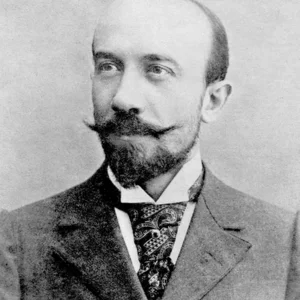

French filmmaker, actor, producer, director, conjurer and illusionist, pioneer and inventor of cinematic spectacle (1861–1938)
Georges Méliès(1861 — 1938)
Georges Méliès
France
8 min read
Frequently asked questions
Key Facts
- Georges Méliès (1861–1938) est un prestidigitateur français qui découvre le cinématographe des frères Lumière en 1895 et comprend immédiatement son potentiel de spectacle.
- En 1896, il fonde le Star Film Studio à Montreuil, premier studio de cinéma construit en Europe, doté d'une verrière pour utiliser la lumière naturelle.
- Il invente de nombreux trucages cinématographiques (arrêt caméra, surimpressions, fondus) qui font de lui le père des effets spéciaux.
- Son film 'Le Voyage dans la Lune' (1902), adapté de Jules Verne et H.G. Wells, est considéré comme l'un des premiers chefs-d'œuvre du cinéma de fiction avec ses 14 minutes.
- Ruiné après la Première Guerre mondiale, ses films détruits ou vendus, il est redécouvert en 1929 et reçoit la Légion d'honneur en 1931.
Works & Achievements
One of Méliès's earliest films exploiting the camera stop trick to make a woman disappear. This two-minute short lays the groundwork for trick cinematography and filmed illusionism.
A reenactment in 11 scenes of the Dreyfus trial, one of the first films to address current political events. A committed work shot from the Dreyfusard perspective, it was banned in several cities.
An adaptation in 20 scenes of Perrault's fairy tale, remarkable for its fantastical sets and special effects. The film showcases Méliès's genius for transposing literary enchantment into moving images.
Méliès's absolute masterpiece and the first science-fiction film in history, inspired by Jules Verne and H.G. Wells. Its 14 minutes of fantastical voyage and the iconic image of the Moon with a rocket in its eye make it a monument of world culture.
An ambitious follow-up to A Trip to the Moon, running 24 minutes. The film multiplies futuristic modes of transport (train, automobile, balloon, submarine) in a wildly inventive adventure story.
A burlesque anticipation of a railway tunnel linking France and England. Méliès masterfully employs his trick techniques to depict a technical feat that was still purely imaginary.
One of Méliès's last major films, depicting an expedition to the North Pole featuring a monumental snow giant. The film marks the swan song of an artist whose style was beginning to be overtaken by modern narrative cinema.
Anecdotes
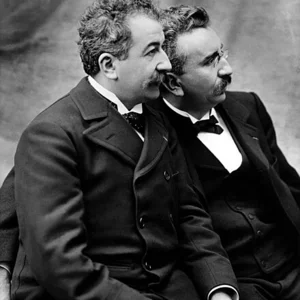
On December 28, 1895, Georges Méliès attended the first screening by the Lumière brothers at the Grand Café in Paris. Fascinated, he immediately attempted to purchase their cinematograph, but Louis Lumière refused to sell, convinced the invention had no commercial future. Méliès would then build his own camera, drawing inspiration from Edison's kinetoscope.
Méliès discovered the principle of the stop-trick by accident, on the rue de l'Opéra in Paris: while he was filming traffic, his camera jammed for a few seconds. When developing the footage, he noticed that an omnibus appeared to transform into a hearse. This technical mishap would become the foundation of special effects in cinema.
To produce 'A Trip to the Moon' in 1902, Méliès spent the equivalent of 10,000 gold francs — a colossal sum for the time. He personally built the sets, costumes, and mechanical rigs in his studio in Montreuil. The film was immediately copied and illegally distributed in the United States by Thomas Edison, ruining Méliès without him receiving a single centime.
After the First World War, bankrupt and forgotten, Méliès was forced to burn hundreds of his film negatives to recover the silver nitrate from the reels. In this way, more than 400 of his 500 films vanished forever. Rediscovered in 1929 during a retrospective, he spent the rest of his life managing a toy shop inside the Gare Montparnasse.
Méliès was above all a professional conjurer and director of the Théâtre Robert-Houdin in Paris. It was this training in illusion and stage magic that gave him the intuition to 'trick' filmed images. He thus invented dozens of techniques still used today: the dissolve, double exposure, fast motion, slow motion, and cinematic makeup.
Primary Sources
It was upon seeing the Lumière brothers' Cinematograph that I had the idea of transforming this machine for reproducing life into an instrument of fantasy and imagination. I wanted to make people dream, not merely to show.
The cinematograph is essentially an optical device whose purpose is to reproduce the movement of people or objects by projecting their successive images onto a screen. But it can equally become an instrument of fantastic composition.
The secret of my 'tricks' lies less in the mechanics than in the rigour of the scenic preparation. Each illusion must be choreographed like a ballet, with every actor knowing their mark to the exact second.
I have made more than five hundred films and I regret nothing, except for not having known how to defend my rights against those who plundered me. Art is not enough — one must also know how to fight in business.
Key Places
Located on the Boulevard des Italiens, this magic theatre was purchased by Méliès in 1888. There he developed his art of illusionism and presented his first films starting in 1896.
The first glass film studio built in France (1897), entirely designed by Méliès. This giant greenhouse measuring 17 x 7 metres allowed him to film using natural light and to install his trick machinery.
It was in the basement of this establishment that Méliès attended, on 28 December 1895, the first paid screening by the Lumière brothers — the founding event that changed the course of his life.
Ruined and forgotten, Méliès ran a toy and confectionery stall at this station for many years. It was there that he was rediscovered by film enthusiasts in 1929, offering a melancholic epilogue to his extraordinary life.
Méliès spent the last years of his life in this residence for cinema artists and technicians, supported by the solidarity of the industry he had helped to found.
Typical Objects

Méliès built his own camera inspired by British inventor Paul's Theatrograph. This improvised and refined instrument became the central tool of all his creations and visual experiments.

Méliès painted giant backdrops himself depicting fantastical landscapes. These forced-perspective sets, inherited from theatrical tradition, gave his films their characteristic fairytale atmosphere.

Before cinema, Méliès used the magic lantern for his shows at the Théâtre Robert-Houdin. This ancestor of the projector taught him the principles of image projection and visual storytelling.

Inherited from magic theatre, trap doors hidden in the studio floor allowed Méliès to make actors appear or disappear instantly, creating illusions impossible to explain.

Méliès often acted in his own films, wearing extravagant costumes as a magician, mad scientist, or alien. He developed specific cinematic makeup techniques, distinct from stage makeup.

Silver nitrate film was the medium for all his movies. Highly flammable and fragile, it was this film that Méliès was forced to burn during his financial ruin, irreversibly destroying a large part of his body of work.

Méliès designed rail and counterweight systems to move the camera or sets in a precise and repeatable manner. These handcrafted devices were the technical secret behind his most spectacular visual effects.
School Curriculum
Vocabulary & Tags
Key Vocabulary
Daily Life
Morning
Méliès arrived at his Montreuil studio by 8 in the morning, taking advantage of the early light streaming through the glass structure. He would begin by inspecting the sets under construction and discussing with his painters and carpenters the adjustments needed for the day's shoot.
Afternoon
Afternoons were devoted to actual filming, between 11am and 4pm when natural light was at its best. Méliès directed, acted, and personally checked every camera position, often in costume. Stops were frequent to adjust trapdoors, change sets, or prepare pyrotechnic effects.
Evening
In the evenings, Méliès returned to Paris to run the shows at the Théâtre Robert-Houdin, where he performed as an illusionist several times a week. He also devoted his evenings to designing new scripts and making preparatory drawings for his sets and storyboards.
Food
As a Parisian bourgeois of the Belle Époque, Méliès enjoyed traditional French cuisine: a hearty lunch at a restaurant near the studio, with colleagues and actors. Coffee was omnipresent, consumed throughout the day to keep up with the sustained pace of production.
Clothing
In the studio, Méliès wore practical work clothes, often covered in paint and sawdust. For his conjuring shows, he sported the impeccable black tailcoat and top hat of the stage magician. In his films, he donned fantastical costumes of his own design.
Housing
Méliès lived in a bourgeois Parisian apartment with his family. His prosperity in the 1900s allowed him to acquire a fine property in Montreuil, close to his studio. After his financial ruin, he was forced to move into much more modest lodgings, before ending his life in a retirement home for cinema artists.
Historical Timeline
Period Vocabulary
Visual Style
Esthétique du film muet colorié au pochoir : fonds peints théâtraux, palette sépia et bleu nuit, costumes extravagants et grain caractéristique de la pellicule nitrate d'époque.
Sound Ambience
L'atmosphère sonore du studio de Méliès à Montreuil : mécanique de caméra artisanale, machineries de théâtre, bruits de chantier créatif et effets pyrotechniques dans un vaste atelier de verre.
Liens externes & ressources
Références
Œuvres
Le Tunnel sous la Manche ou Le Cauchemar franco-anglais
1907