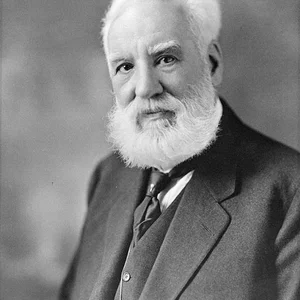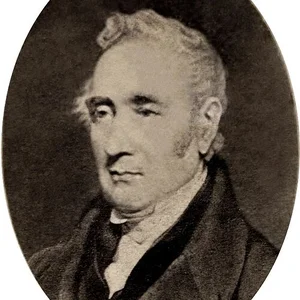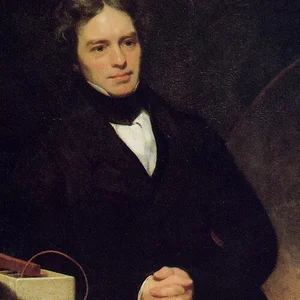

A self-taught British physicist and chemist (1791–1867), Faraday discovered electromagnetic induction and laid the foundations of modern electrical engineering. His work on electric and magnetic fields inspired Maxwell's theories.
Michael Faraday(1791 — 1867)
Michael Faraday
royaume de Grande-Bretagne, Royaume-Uni de Grande-Bretagne et d'Irlande
8 min read
Frequently asked questions
Famous Quotes
« Nothing is too wonderful to be true, if it be consistent with the laws of nature.»
« Work, finish, publish.»
Key Facts
- 1821: invention of the first primitive electric motor
- 1831: discovery of electromagnetic induction
- 1833: formulation of the laws of electrolysis
- 1836: invention of the Faraday cage
- 1845: discovery of the Faraday effect (rotation of the plane of polarization of light by a magnetic field)
Works & Achievements
By varying a magnetic flux through a coil, Faraday demonstrated that an electric current could be generated by a changing magnetic field. This principle underpins all modern generators, alternators, and electrical transformers.
Faraday built the first device to convert electrical energy into continuous mechanical motion, by rotating a conducting wire around a fixed magnet. This foundational demonstration opened the door to industrial electromechanics.
Faraday formulated two quantitative laws linking the mass of substance deposited during electrolysis to the amount of electric charge used. These laws are still taught in chemistry today and form the foundation of electrochemistry.
Faraday demonstrated that a magnetic field could rotate the plane of polarization of light passing through a material, establishing for the first time an experimental link between light and magnetism. This discovery profoundly influenced Maxwell.
A compilation of his scientific papers published in the Philosophical Transactions, tracing twenty years of research on electricity and magnetism. This work stands as one of the most important scientific publications of the 19th century.
A collection of six lectures delivered for young audiences at the Royal Institution, explaining chemistry and physics through the combustion of a candle. Translated into many languages, this book remains a masterpiece of popular science writing.
Anecdotes
Michael Faraday was the son of a poor blacksmith and had received only a basic education. At 14, he became an apprentice bookbinder at a London bookseller, which allowed him to read the books he bound — including the article on 'Electricity' in the Encyclopædia Britannica. This self-taught hunger for knowledge would transform a simple craftsman into one of the greatest scientists of the 19th century.
In 1812, Faraday attended lectures by the renowned chemist Humphry Davy at the Royal Institution. He took meticulous notes, carefully bound them into a volume, and sent it to Davy along with a request for a position. Davy, impressed, hired him as a laboratory assistant. Years later, Davy would reportedly confide that his greatest discovery was not a chemical element, but Michael Faraday himself.
On October 17, 1831, Faraday carried out one of the most important experiments in the history of science: he threaded an iron ring through a coil of wire and observed that moving a magnet toward or away from a coil produced an electric current. This phenomenon — electromagnetic induction — is the founding principle behind every modern electrical generator and transformer.
Faraday twice declined the presidency of the Royal Society, the highest scientific honor in Britain. He also refused a knighthood from Queen Victoria, preferring to remain 'plain Mr. Faraday.' A deeply devout man and member of a small Protestant sect called the Sandemanians, he believed that worldly glory was incompatible with his religious convictions.
In his later years, Faraday suffered from severe memory loss, likely caused by prolonged exposure to mercury vapors during his experiments. Prince Albert offered him a house at Hampton Court, where he spent his final years. He died in 1867 in his armchair, eyes open — never having lost awareness of the magnitude of his discoveries.
Primary Sources
I have been desirous of discovering whether a current of electricity in one wire could induce a current in another wire. The results I have obtained are such as to give me reason to believe that this effect is producible.
I desire to lay before you a few thoughts on the subject of magnetic lines of force, their probable nature, and the part they appear to me to play in various phenomena.
There is no better, there is no more open door by which you can enter into the study of natural philosophy than by considering the physical phenomena of a candle.
Made the ring. Wound 24 feet of copper wire round one half. Connected the ends of the wire with a galvanometer. On passing a current through the other coil, the galvanometer was affected.
Key Places
Institution founded in 1799 where Faraday worked for more than fifty years, first as an assistant and later as director of the laboratory. It was here that he made all his great discoveries and delivered his famous public lectures.
A working-class district south of London where Faraday was born in 1791 into a very modest family. His humble social origins stand in striking contrast to the extraordinary importance of his scientific discoveries.
A residence offered to Faraday by Prince Albert in 1858, where he spent his final years suffering from memory loss. He died peacefully there in 1867, in the house known as 'Grace and Favour'.
A Victorian cemetery where Faraday is buried in his family's tomb, in keeping with his wishes for a modest burial. He declined to be interred at Westminster Abbey despite the offers that were made to him.
Typical Objects

A device consisting of an iron toroid wrapped with two coils of copper wire, with which Faraday demonstrated electromagnetic induction in 1831. This object is the direct ancestor of all electrical transformers.

An instrument for measuring electric current that Faraday routinely used in his experiments to detect induced currents. It allowed him to prove the existence of momentary currents during his induction experiments.

A metallic enclosure invented by Faraday in 1836 to demonstrate that electric charges distribute themselves only on the surface of a conductor. It is used today to shield electronic equipment from interference.

An essential tool in laboratories of the era, which Faraday used in his research on the interactions between magnets and conducting wires. His experiments with magnets helped establish the fundamental concept of the magnetic field.

A source of electrical energy made up of stacked zinc and copper discs separated by acid-soaked discs, inherited from the work of Volta. Faraday used it to power his experimental circuits and study the phenomena of electrolysis.

Faraday kept a meticulous experimental journal for forty years, recording every observation, result, and hypothesis. These 'Diaries' are a valuable historical source, now preserved at the Royal Institution in London.
School Curriculum
Vocabulary & Tags
Key Vocabulary
Tags
Daily Life
Morning
Faraday rose early, in keeping with the Sandemanian discipline that structured his life deeply. He attended his community's religious services on Sunday mornings and devoted his weekday mornings to reading and writing up his experimental notes before heading to the Royal Institution.
Afternoon
His afternoons were devoted entirely to laboratory experiments, which he conducted with extraordinary methodical rigor. He recorded every observation in his journal with meticulous precision, repeating the same experiments tirelessly to validate his results.
Evening
In the evenings, Faraday wrote up his scientific memoirs and maintained an extensive correspondence with scientists from around the world. He also prepared his famous Friday Evening Discourses at the Royal Institution, to which he attached great educational importance.
Food
Faraday led a simple and frugal life, in keeping with his religious convictions and modest origins. He ate plainly, with a typically Victorian British diet — braised meats, boiled vegetables, bread, and tea — without seeking any culinary refinement.
Clothing
Faraday typically wore a strict black coat, both sober and neat, reflecting both his Sandemanian religious convictions and the dress code of the Victorian gentleman scientist. He avoided all superfluous ornamentation and declined honorary distinctions that might have altered his appearance.
Housing
Faraday lived for twenty-six years in a service apartment located at the very top of the Royal Institution on Albemarle Street. This modest but functional apartment allowed him to be available at any hour for his research, and there he received the greatest scientific minds of his time.
Historical Timeline
Period Vocabulary
Visual Style
Style peinture à l'huile victorienne avec éclairage dramatique au gaz et à la bougie, laboratoire encombré d'instruments en laiton et cuivre, atmosphère d'intense concentration scientifique.
Sound Ambience
Ambiance sonore d'un laboratoire victorien londonien : craquements électriques, cliquetis d'instruments de mesure, plume sur papier et bruits de rue du XIXe siècle.
Liens externes & ressources
Références
Œuvres
Découverte de l'induction électromagnétique
1831
Invention du premier moteur électrique
1821
Lois de l'électrolyse (lois de Faraday)
1833
Découverte de l'effet Faraday (magnéto-optique)
1845
Experimental Researches in Electricity (3 volumes)
1839-1855
The Chemical History of a Candle
1861