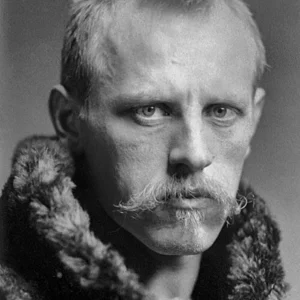

Norwegian polar explorer who crossed Greenland on skis in 1888 and attempted to reach the North Pole in 1893–1896 aboard the Fram. Nobel Peace Prize laureate in 1922, he created the Nansen passport for stateless refugees.
Fridtjof Nansen(1861 — 1930)
Fridtjof Nansen
Norvège
9 min read
Frequently asked questions
Famous Quotes
« The first duty of man is to advance.»
« The impossible is only that which has not yet been attempted.»
Key Facts
- 1888: first crossing of Greenland on skis, from east to west
- 1893–1896: Fram expedition, reached 86°14' N, record northern latitude
- 1906: first Norwegian ambassador to the United Kingdom after independence
- 1921–1922: High Commissioner for Refugees of the League of Nations, created the Nansen passport
- 1922: Nobel Peace Prize for his humanitarian work on behalf of refugees
Works & Achievements
A full account of the first crossing of Greenland on skis, translated into multiple languages and an immediate worldwide bestseller. The book established Nansen's international reputation and sparked a wave of enthusiasm for polar exploration.
An account of the *Fram* expedition (1893–1896), considered one of the great classics of exploration literature. Nansen describes the drift through the ice, his attempt to reach the pole, and the winter camp on Franz Josef Land, with remarkable scientific and literary precision.
A travel document for stateless refugees created at Nansen's initiative under the auspices of the League of Nations. Recognized by more than 52 states, it allowed approximately 450,000 refugees — Russians, Armenians, and Greeks — to travel and settle legally.
Nansen organized and coordinated one of the first major international humanitarian relief operations, aiding the millions of victims of the famine in the Volga region. It is estimated that he helped save between 7 and 22 million lives.
A major scientific work based on data collected during the *Fram* expedition. Nansen describes deep-ocean currents, the layering of Arctic waters, and lays the foundations of modern polar oceanography.
A report and advocacy piece on the situation of Armenian refugees and displaced populations in the Near East, bearing witness to Nansen's humanitarian commitment until the end of his life.
Anecdotes
In 1888, Nansen and five companions undertook the first ski crossing of Greenland, from east to west — roughly 500 kilometres through one of the most inhospitable regions on Earth. The expedition lasted 49 days under extreme conditions, with blizzards and freezing temperatures. Nansen had himself designed the lightweight equipment that made the adventure possible.
In his bid to reach the North Pole, Nansen had the Fram built — a revolutionary vessel with a rounded hull designed so that the pressure of the ice would lift it rather than crush it. In 1893, he deliberately allowed his ship to become locked in the Arctic pack ice and drift toward the Pole, a strategy his contemporaries considered madness, but which proved brilliantly effective.
In April 1895, Nansen and his companion Hjalmar Johansen left the Fram on foot and by dogsled to make a dash for the Pole. They reached 86°14' North — an absolute world record. Trapped by the drifting ice, they were forced to spend the following winter in a hut built from stones and animal skins on Franz Josef Land, surviving by hunting polar bears and walruses.
Returning to Norway as a hero in 1896, Nansen put his worldwide fame to work in diplomacy: in 1905, he played a key role in the peaceful negotiation of Norwegian independence from Sweden, and then served as Norway's first ambassador to London. His international reputation opened the doors of high politics to him.
In 1922, Nansen created a groundbreaking travel document for stateless refugees — in particular Russians fleeing the Bolshevik Revolution — known as the Nansen passport, recognised by more than 50 countries. That same year, he was awarded the Nobel Peace Prize. Before his death in 1930, he had helped more than 450,000 refugees rebuild their lives, leaving a permanent mark on the history of international humanitarian law.
Primary Sources
We pressed on over the hard snow, carrying our skis from east to west across the ice cap, not knowing what lay ahead. But the certainty of moving forward — of having no way back — was our greatest strength.
On April 8, 1895, we planted our flag at the northernmost point ever reached by man, at 86°14' North latitude. Before us stretched an endless sea of ice, silent and indifferent to our presence.
Hundreds of thousands of human beings are wandering across Europe without homes, without papers, without a country. Helping them is not charity — it is an elementary duty of civilized humanity toward itself.
The situation in Russia is catastrophic. Millions of men, women, and children are dying of hunger in the Volga regions. Europe has the resources to save them; the question is whether it has the will.
Key Places
Nansen's birthplace in 1861, on a family estate on the outskirts of Christiania. It was in the forests and snow-covered hills of this region that he developed his passion for skiing and the wilderness from an early age.
Nansen and his five companions crossed this vast frozen wilderness from east to west in 1888, a world first. The expedition made him famous and proved that Greenland's interior ice sheet could be traversed.
Nansen and Johansen spent the winter of 1895–1896 here in a shelter built from stones and animal skins, following their record-breaking attempt to reach the North Pole. They survived by hunting polar bears and walruses, before being rescued by chance by a British expedition.
The estate Nansen had built in 1901, where he lived until his death in 1930. This villa surrounded by forests was the centre of his intellectual and family life, and today houses the Nansen Institute for global affairs.
Headquarters of the League of Nations, where Nansen served as High Commissioner for Refugees from 1920 to 1930. It was from Geneva that he coordinated humanitarian relief operations and negotiated international recognition of the Nansen passport.
Typical Objects

Nansen was an exceptional skier from childhood and refined his techniques for long Arctic crossings. His skis, designed for speed and durability on ice and hard-packed snow, were the central tool of the Greenland traverse.

Built to Nansen's specifications, the Fram ("Forward" in Norwegian) had a specially rounded triple-thickness hull designed to withstand the pressure of pack ice. It remains the wooden vessel to have sailed both furthest north and furthest south in history.

Nansen designed a type of lightweight sledge in ash wood — flexible yet tough — optimized for Arctic travel. This design, known as the "Nansen sledge," was subsequently adopted by major polar expeditions, including Amundsen's journey to the South Pole.

An international travel document created in 1922 under the League of Nations at Nansen's initiative, intended for stateless refugees. It was recognized by more than 50 states and allowed hundreds of thousands of stateless people to travel legally.

An oceanographic instrument designed by Nansen to collect seawater samples at precise depths. Used worldwide until the late twentieth century, it still bears his name in the scientific community.

Nansen was also an oceanographer and brought barometers, thermometers, compasses, and astronomical navigation instruments on his expeditions. The data he gathered in the Arctic helped lay the foundations of modern oceanography.
School Curriculum
Vocabulary & Tags
Key Vocabulary
Daily Life
Morning
Nansen rose early and often began his days with physical activity — skiing in winter through the forests around Polhøgda, swimming or taking long walks in summer. A lifelong athlete, he considered morning exercise essential to his mental and physical well-being. He would then sit at his desk from dawn, making the most of the quiet morning hours to write or analyze his scientific data.
Afternoon
His afternoons varied considerably depending on the period of his life: during expeditions, they were entirely devoted to making progress, navigating, or taking scientific measurements in sometimes extreme conditions. At Polhøgda or in Geneva, he received delegates, drafted reports for the League of Nations, or delivered lectures. He also made time for his children, passing on to them his love of nature and outdoor sports.
Evening
Nansen's evenings were often spent reading — he was a polyglot, fluent in Norwegian, German, English, and French — and writing his books and memoirs. A natural host, he also regularly entertained intellectuals, scientists, and diplomats at Polhøgda. After the death of his first wife Eva in 1907, he went through years of intense grief and threw himself even more deeply into humanitarian work.
Food
On expeditions, Nansen had himself worked out the optimal food ration for polar explorers: pemmican (dried, fatty meat), biscuits, chocolate, and powdered milk, calculated to the gram to maximize calories while minimizing weight. In daily life in Oslo, he followed a classic Norwegian diet based on fish, wholegrain bread, and dairy products, but ate frugally, convinced that dietary restraint built endurance.
Clothing
On Arctic expeditions, Nansen wore and refined Inuit garments made from bear and seal fur, far more effective than the European clothing of the time. He also adopted fine Norwegian wool for mid-layers, a choice that lastingly influenced the equipment of polar explorers. In civilian life, he wore the respectable suit of his era — understated and elegant — with a preference for sporting attire on his many hikes.
Housing
Nansen had Polhøgda ("The Polar Heights") built in 1901, an Art Nouveau villa overlooking the Oslo Fjord, surrounded by forests of pine and birch. The house reflected his dual personality: a large library-study for the scholar and writer, and wide spaces open to nature for the athlete and explorer. After his death, the property became the home of the Nansen Institute, a think-tank devoted to environmental and global governance issues.
Historical Timeline
Period Vocabulary
Liens externes & ressources
Références
Œuvres
Paa ski over Grønland (À ski à travers le Groenland)
1890
Farthest North (Vers le Nord !)
1897
Le passeport Nansen
1922
The Oceanography of the North Polar Basin
1902
Armenia and the Near East
1928