 flip
flipFiskesuppe, the Fish Soup of Middag in Oslo
Fiskesuppe, the Fish Soup of Middag in Oslo
Why this dish? At Store Frøen and later at Polhøgda, Nansen ate frugally the classic Norwegian diet: fish, whole-grain bread, dairy. Fish soup, economical and nourishing, is the archetype of the bourgeois Norwegian *middag* of his time — sober, as he liked it.
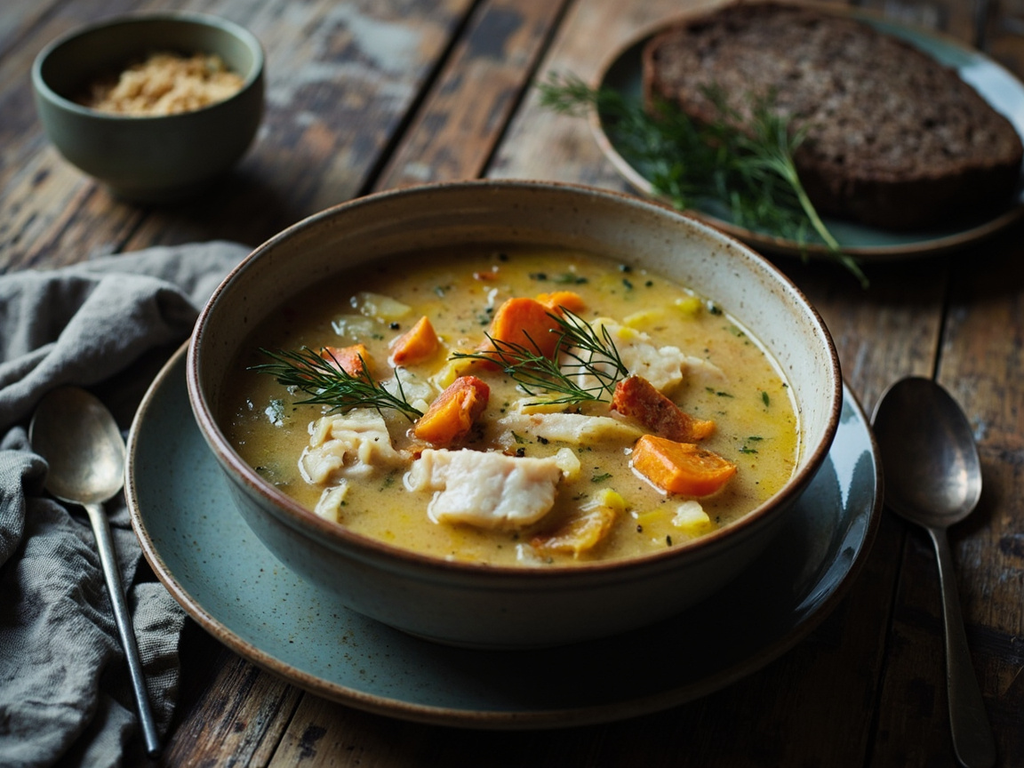
A smooth, milky sea velouté where white fish and root vegetables simmer in a creamy broth brightened with a touch of acidity. The quintessential family daily dish in coastal Norway.
At home, there were no useless feasts: the body is forged in sobriety, and I have always thought that a man who eats too much grows soft. At my table in Oslo, we simply served the fish from our fjords, in a light broth thickened with milk and roots from the garden. Taste it: it is modest, but it is honest, as all good Norwegian things should be. Take your whole-grain bread to mop up — and ask for nothing more, for endurance is born of moderation.
- •Fresh cod or haddock — a fine piece (protein, umami)
- •Milk and cream — generously (binder, smoothness)
- •Roots (carrot, parsnip, leek) — as from the garden (body, sweetness)
- •Vinegar or lemon juice — a dash (balancing acidity)
- •Butter, salt, pepper — to taste (seasoning)
Fiskesuppe, the Fish Soup of Middag in Oslo
A smooth, milky sea velouté where white fish and root vegetables simmer in a creamy broth brightened with a touch of acidity. The quintessential family daily dish in coastal Norway.
Why this dish? At Store Frøen and later at Polhøgda, Nansen ate frugally the classic Norwegian diet: fish, whole-grain bread, dairy. Fish soup, economical and nourishing, is the archetype of the bourgeois Norwegian *middag* of his time — sober, as he liked it.
At home, there were no useless feasts: the body is forged in sobriety, and I have always thought that a man who eats too much grows soft. At my table in Oslo, we simply served the fish from our fjords, in a light broth thickened with milk and roots from the garden. Taste it: it is modest, but it is honest, as all good Norwegian things should be. Take your whole-grain bread to mop up — and ask for nothing more, for endurance is born of moderation.
Ingredients (period version)
- Fresh cod or haddock — a fine piece (protein, umami)
- Milk and cream — generously (binder, smoothness)
- Roots (carrot, parsnip, leek) — as from the garden (body, sweetness)
- Vinegar or lemon juice — a dash (balancing acidity)
- Butter, salt, pepper — to taste (seasoning)
Ingredients
- Cod fillet — 400 g (protein)
- Whole milk — 500 ml (base)
- Heavy cream — 150 ml (creaminess)
- Carrots + 1 leek + 1 parsnip — 300 g total (vegetables)
- Butter — 30 g (light roux)
- Flour — 1 tbsp (thickener)
- White vinegar — 1 tsp (acidity)
- Salt, pepper, fresh dill — to taste (seasoning)
Method
- Finely chop the root vegetables and leek; sweat them in butter without browning.
- Sprinkle with flour, stir, then gradually add the milk.
- Simmer for 15 min until the vegetables are tender.
- Add the cream, then the fish cut into cubes; poach 4–5 min on low heat.
- Season with salt, pepper, and a dash of vinegar to brighten.
- Sprinkle with dill and serve piping hot with whole-grain bread.
How it was made : Traditional *fiskesuppe* was made with whole milk (cream being rarer for everyday), using the day's catch; bones and head were used for stock, and acidity often came from whey or vinegar, never lemon in modest households.
The contemporary twist : A spoonful of Norwegian lumpfish roe (northern caviar) placed in the center at serving, for an iodized touch and a beautiful color contrast.
Sources : Hanna Winsnes, *Lærebog i de forskjellige Grene af Huusholdningen* (1845) · Coastal Norwegian culinary tradition, late 19th century
Fridtjof Nansen · Charactorium