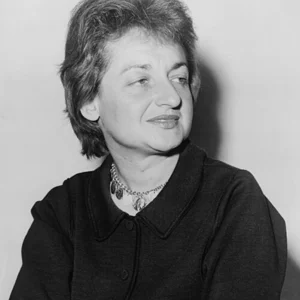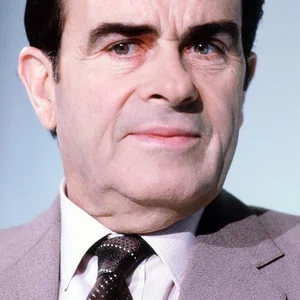

Secretary General of the French Communist Party from 1972 to 1994, Georges Marchais was one of the major figures of the French left during the Cold War. He embodied an orthodox communism, publicly supporting the Soviet intervention in Afghanistan in 1980.
Georges Marchais(1920 — 1997)
Georges Marchais
France
8 min read
Frequently asked questions
Famous Quotes
« The class struggle — I didn't invent it.»
« The overall record of real socialism is positive.»
Key Facts
- Born June 7, 1920 in Yvry-sur-Seine, died November 16, 1997
- Secretary General of the PCF from 1972 to 1994
- Presidential candidate in 1981, receiving 15.35% of the vote
- Publicly supported the Soviet intervention in Afghanistan in 1980
- Break with the Socialist Party over the Common Programme of the left in 1977
Works & Achievements
A programmatic work in which Marchais outlines the French path to socialism and justifies the union of the left. It marks the PCF's attempt to distance itself from authoritarian communism.
The founding document of the union of the left, co-signed with the Socialist Party. It represents the moment of greatest programmatic influence for the PCF since the Liberation.
A political program book published on the eve of the 1981 presidential election, in which Marchais sets out the PCF's proposals for transforming French society.
A collection of interviews and speeches in which Marchais explains his politics, including the breakdown of the Programme commun. His direct, plain-spoken style is on full display throughout.
A landmark speech in which the PCF officially renounces the concept of the dictatorship of the proletariat, seeking to modernize its image in the context of the union of the left.
For 22 years, Marchais led the PCF and shaped it into one of the most powerful communist parties in the Western world, before witnessing its gradual decline after 1981.
Anecdotes
During the 1981 presidential election, Georges Marchais took part in a memorable televised debate against Valéry Giscard d'Estaing. His populist wit and sharp comebacks earned him a reputation as a formidable orator, equally capable of galvanizing working-class crowds and unsettling his political opponents.
Questions about his past during the Occupation never stopped haunting him. Marchais claimed he had been forcibly conscripted to work in Germany; historians challenged this account, arguing he had gone voluntarily. The controversy illustrates the murky episodes that cast a shadow over his entire career.
Marchais was one of the first French political figures to make heavy use of television as a platform. His direct, sometimes aggressive style and his catchphrases — most famously his signature cry 'C'est scandaleux!' ('It's outrageous!') — left a lasting mark on the political language of the era.
In 1979, following the Soviet invasion of Afghanistan, Marchais declared from Moscow that he 'broadly' approved of the Soviet socialist record. The statement shocked a significant part of the French left and helped weaken the PCF's image among progressive voters.
As General Secretary for more than twenty years, Marchais transformed the PCF into a disciplined electoral machine while defending orthodox Marxism-Leninism. His break with the Common Programme in 1977 shattered left-wing unity and is widely cited as one of the key reasons for the Socialist Party's rise at the PCF's expense.
Primary Sources
We have determined that the Socialist Party has fundamentally altered the content of the Common Programme. Under these circumstances, the full responsibility for the failure of negotiations rests entirely with the Socialist Party.
We broadly endorse the record of actually existing socialism. The social gains achieved in socialist countries are considerable and deserve to be defended.
I stand before you on behalf of the workers, the women and men who want to put an end to capitalist society and build socialism in France, in freedom and democracy.
The party proposes to remove from its statutes the notion of the dictatorship of the proletariat, which is incompatible with the democratic path to socialism that we uphold for France.
The French Communist Party intends to defend the interests of workers by all democratic means. We reject any Cold War logic that divides the labour movement.
Key Places
Every autumn, this vast site in the northern suburbs of Paris hosted the Fête de l'Humanité, the unmissable gathering of the French left where Marchais would address enormous crowds.
Designed by Oscar Niemeyer and inaugurated in 1971, this iconic building in the 19th arrondissement of Paris served as the PCF's headquarters under Marchais's leadership.
Georges Marchais's birthplace, in the heartland of working-class France. His humble origins in this industrial town shaped his rhetoric on the condition of the working class.
Marchais never entered it as president, but he was a central player in the electoral battles that determined who would reside there. His 1981 result marked the beginning of the PCF's electoral decline.
Marchais traveled to Moscow several times to meet Soviet leaders. It was from the Soviet capital that he made his controversial 1979 statement on the Soviet invasion of Afghanistan.
Typical Objects

Every year in La Courneuve, Marchais would address hundreds of thousands of activists from the stage. The L'Humanité Festival platform was his natural theater, a symbol of working-class and communist culture.

The PCF's daily newspaper, L'Humanité served as both a propaganda tool and Marchais's main public platform. He used it to publish his speeches, political analyses, and policy positions.

At PCF headquarters — first on rue Le Peletier, then at place du Colonel Fabien — the phone was the key instrument for coordinating local cells. Marchais ran the party with an iron discipline through this network.

A powerful symbol of the working world that Marchais embodied, the blue work jacket represented his claimed closeness to the working class and the factory floors of France.

The PCF card, renewed each year in a solemn ceremony, was a cornerstone of activist identity. Marchais turned it into a symbol of belonging and loyalty to the movement.

The central theoretical reference of Marxism-Leninism, this work underpinned PCF ideology. Marchais cited it to legitimize his economic and social positions against opponents of capitalism.
School Curriculum
Vocabulary & Tags
Key Vocabulary
Daily Life
Morning
Marchais started his day early, reading L'Humanité and the national press to monitor media coverage of the PCF. He would meet with his closest collaborators at party headquarters on rue Le Peletier for the morning political briefing before moving on to a series of leadership meetings.
Afternoon
Afternoons were devoted to meetings of the Political Bureau or the Central Committee — the PCF's governing bodies where all strategic decisions were made. Marchais also received trade union delegations, local elected officials, and representatives of foreign organizations.
Evening
In the evenings, Marchais often attended public meetings and party rallies across France. During election campaigns, he moved from one televised debate to the next and gave press conferences, becoming one of the most recognizable faces on the French political scene.
Food
Coming from a working-class background, Marchais kept simple tastes: hearty traditional French home cooking. Working lunches at PCF headquarters served as much for informal discussion as for eating.
Clothing
Marchais wore the dark, understated suit typical of political leaders of his era, often with a red tie at major rallies to signal his communist allegiance. When visiting construction sites or factories, he would readily put on a work jacket to show solidarity with workers.
Housing
Marchais lived in Champigny-sur-Marne, a Val-de-Marne municipality long governed by Communist mayors and nicknamed the 'red city'. His choice to live in this working-class suburb was consistent with his image as a representative of the Parisian working class.
Historical Timeline
Period Vocabulary
Visual Style
Esthétique de l'affiche communiste française des années 70, entre graphisme soviétique, photographie documentaire en noir et blanc et meetings ouvriers filmés avec l'énergie du cinéma militant.
Sound Ambience
Un univers sonore industriel et militant, entre les usines de la banlieue ouvrière, les meetings politiques retentissants et le bourdonnement des permanences syndicales des années 1970.
Liens externes & ressources
Références
Œuvres
Le Défi démocratique
1973
Programme commun de gouvernement (PCF-PS)
1972
L'Espoir au présent
1980
Parlons franchement
1977
Rapport au XXIIe Congrès du PCF — abandon de la dictature du prolétariat
1976
Secrétariat général du PCF (1972-1994)
1972–1994