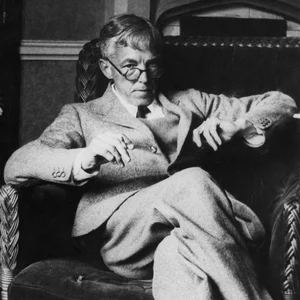

British mathematician, a leading figure in number theory and analysis in the early 20th century. He is famous for his collaboration with John Littlewood and for revealing to the world the self-taught Indian genius Srinivasa Ramanujan.
G.H. Hardy(1877 — 1947)
Godfrey Harold Hardy
Royaume-Uni
6 min read
Frequently asked questions
Famous Quotes
« A mathematician, like a painter or a poet, is a maker of patterns.»
« I have never done anything “useful”. No discovery of mine has made, or is likely to make, directly or indirectly, for good or ill, the least difference to the amenity of the world.»
Key Facts
- Born in 1877 in Cranleigh (United Kingdom), died in 1947 in Cambridge
- Formulated the Hardy-Weinberg law in 1908, a cornerstone of population genetics
- Began a collaboration in 1913 with the Indian mathematician Srinivasa Ramanujan
- Carried out a long and fruitful collaboration with John Littlewood in analytic number theory
- Published 'A Mathematician's Apology' in 1940, a reflection on the beauty of mathematics
Works & Achievements
Foundational textbook that introduced the rigour of modern analysis into British teaching. Reprinted many times, it shaped generations of students.
Population genetics principle explaining the stability of allele frequencies. An “accidental” discovery that became a cornerstone of biology.
A series of papers on prime numbers, the Riemann zeta function and the circle method. A collaboration legendary for its fruitfulness.
Hardy guided, published and won recognition for Ramanujan's discoveries, notably on integer partitions via the Hardy-Littlewood-Ramanujan circle method.
A reference work gathering and systematising the fundamental mathematical inequalities, still consulted today.
Famous essay defending the beauty of pure mathematics as an art. It has become a classic of popular science writing.
Number theory textbook that became a worldwide reference for university teaching.
Anecdotes
In 1913, Hardy received an astonishing letter from an unknown Indian clerk, Srinivasa Ramanujan, filled with extraordinary theorems. Suspicious, he nearly threw it away, but after discussing it with Littlewood that very evening, he concluded that only a true genius could have invented such formulas. He brought Ramanujan to Cambridge, changing the history of mathematics.
Hardy loved to tell the anecdote of taxicab number 1729. Visiting Ramanujan when he was ill, he remarked that the number of his taxi was rather dull. Ramanujan replied at once: “No, it is the smallest number expressible as the sum of two cubes in two different ways!” (1³+12³ and 9³+10³). Ever since, we speak of a “taxicab number.”
A staunch atheist, Hardy regarded God as his personal enemy. Before a dangerous sea voyage, he sent a postcard falsely announcing that he had solved the Riemann hypothesis: he was betting that God would not let him die and wrongly grant him the glory of that discovery.
Hardy hated mirrors so much that he would cover them with a cloth upon entering a hotel room. A keen cricket enthusiast, he judged the beauty of a mathematical proof as he would a perfect stroke, declaring that “there is no permanent place in the world for ugly mathematics.”
In his famous essay *A Mathematician's Apology* (1940), Hardy boasted that he had never done anything “useful” and that his work could never serve war. The irony of history: his celebrated Hardy-Weinberg law is today a cornerstone of population genetics.
Primary Sources
A mathematician, like a painter or a poet, is a maker of patterns. If his patterns are more permanent than theirs, it is because they are made with ideas.
These formulas had to be true, because if they were not, no one would have had the imagination to invent them.
It is easy to see that such a distribution will perpetuate itself unchanged after the second generation.
I owe to Ramanujan the one romantic incident in my life.
Key Places
Hardy's birthplace, where his father taught at a preparatory school. He received his earliest education there.
The heart of Hardy's intellectual life, where he studied and then taught, and where he welcomed Ramanujan. Home to the golden age of British pure mathematics.
Hardy held the Savilian Chair of Geometry here from 1919 to 1931, a period he considered happy and productive.
The prestigious school where Hardy completed his secondary education on a scholarship, before entering Cambridge.
The city where Hardy spent most of his career and where he died on 1 December 1947.
Typical Objects

The mathematician's everyday tool for writing out equations and proofs during seminars and collaborative work. Hardy developed his ideas on it with Littlewood.

Handwritten notebooks in which Ramanujan recorded thousands of formulas without proof, studied and circulated by Hardy. They remain a wellspring of inspiration for mathematicians.

A symbol of Hardy's all-consuming passion for cricket, a sport whose elegance he compared to that of mathematical proofs. He followed the scores devotedly.

Writing instruments for correspondence and the drafting of scholarly papers. Ramanujan's famous first letter was written by pen.

The black academic robe worn at ceremonies and while teaching in the colleges. A mark of belonging to the hushed world of Trinity College.

Hardy had an aversion to his own reflection and would systematically cover the mirrors in any room where he stayed. A telling detail of his eccentric character.
School Curriculum
Vocabulary & Tags
Key Vocabulary
Tags
Daily Life
Morning
Hardy started his day late and devoted it to his “four hours” of creative mathematics, which he considered the maximum possible for quality work. He would first read the cricket pages of the newspaper before tackling problems.
Afternoon
The afternoon was often reserved for cricket, his great passion, either by attending matches or following the scores. He also played “real tennis” and took long walks, regarding exercise as essential to the mind.
Evening
Evenings were spent in the Combination Room of Trinity College, in conversation with his colleagues, or writing letters. It was one evening that he decided, together with Littlewood, on the genius of Ramanujan.
Food
As a fellow of a Cambridge college, Hardy shared the formal meals at High Table, featuring classic British cuisine. A bachelor, he relied largely on the institution's communal catering.
Clothing
Hardy wore the plain, elegant attire of an Edwardian academic: tweed suits, shirts, and the black academic gown for ceremonies. He paid reasonable attention to his appearance despite his eccentricities.
Housing
He lived in the apartments (“rooms”) reserved for Fellows within the colleges of Cambridge and later Oxford. This bachelor, communal way of life was typical of British academics.
Historical Timeline
Period Vocabulary
Liens externes & ressources
Références
Œuvres
A Course of Pure Mathematics
1908
Loi de Hardy-Weinberg
1908
Travaux avec Littlewood sur la théorie des nombres
1911-1947
Édition des travaux de Ramanujan
1914-1920
Inequalities (avec Littlewood et Pólya)
1934
A Mathematician's Apology
1940
An Introduction to the Theory of Numbers (avec E.M. Wright)
1938