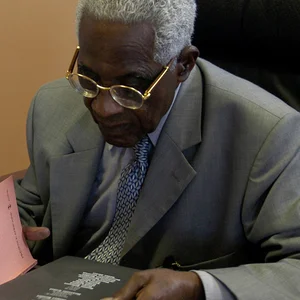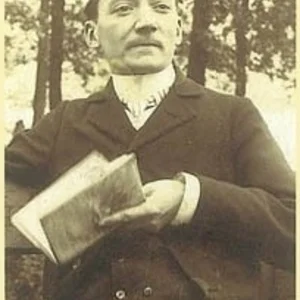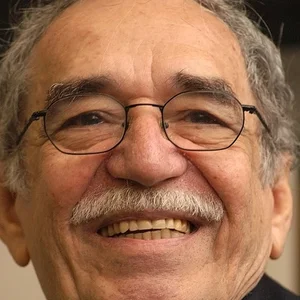

Colombian writer and journalist (1927-2014), a major figure of magical realism and of the Latin American literary “boom.” His novel “One Hundred Years of Solitude” (1967) earned him worldwide fame, and he received the Nobel Prize in Literature in 1982.
Gabriel García Márquez
Gabriel García Márquez
7 min read
Frequently asked questions
Famous Quotes
« Many years later, as he faced the firing squad, Colonel Aureliano Buendía was to remember that distant afternoon when his father took him to discover ice.»
« Life is not what one lived, but what one remembers and how one remembers it in order to tell it.»
Key Facts
- Born on 6 March 1927 in Aracataca (Colombia), a town that would inspire the mythical village of Macondo.
- Published “One Hundred Years of Solitude” in 1967, an emblematic novel of magical realism that sold millions of copies.
- Published “Chronicle of a Death Foretold” (1981) and then “Love in the Time of Cholera” (1985).
- Received the Nobel Prize in Literature in 1982.
- Died on 17 April 2014 in Mexico City.
Works & Achievements
His first novel, which introduces the village of Macondo and inaugurates his literary universe.
A short novel about an old colonel waiting in vain for his pension, praised for its restraint and humanity.
The saga of the Buendía family across seven generations, a masterpiece of magical realism and a landmark work of the Latin American "boom".
A novel about the solitude and decay of a dictator, written in a lush and experimental style.
A narrative in which the coming murder is known from the very first page, built like an investigation into honor and fate.
A great love story following a patient passion across half a century, set in a Caribbean city.
An address delivered upon receiving the Nobel Prize, a plea for a Latin America understood on its own terms.
The first volume of his memoirs, recounting his childhood and his beginnings as a writer and journalist.
Anecdotes
As a child, Gabriel — nicknamed "Gabito" — was raised by his grandparents in Aracataca, a village on Colombia's Caribbean coast. His grandmother would tell him stories of ghosts and wonders with unshakable seriousness, as if they were ordinary facts. It was from this way of recounting the incredible in a matter-of-fact tone that his "magical realism" would later be born.
To write "One Hundred Years of Solitude
García Márquez shut himself away in his Mexico City study for eighteen months. The family fell so deeply into debt that his wife Mercedes had to pawn the television and the hairdryer, and eventually even sell the car so he could keep writing.
When the manuscript was finally finished, the couple did not have enough money to mail the whole thing to the publisher in Buenos Aires. They could only send half the pages, and had to wait until they had more money to send the rest.
When he received the Nobel Prize in Literature in Stockholm in 1982, he turned down the traditional black tailcoat. He showed up dressed in a white "liqui liqui
the popular costume of the Colombian Caribbean, to stay true to his roots.
The name Macondo, the imaginary village of his novels, came to him from a banana plantation he used to glimpse as a child through the train window. He loved the sound of it long before he made it the heart of his literary universe.
Primary Sources
Many years later, as he faced the firing squad, Colonel Aureliano Buendía was to remember that distant afternoon when his father took him to discover ice.
Poets and beggars, musicians and prophets, warriors and scoundrels, all creatures of that unbridled reality, we have had to ask but little of imagination, for our crucial problem has been a lack of conventional means to render our lives believable.
My mother asked me to go with her to sell the house. She had come that very morning from the distant town where the family lived, and she had no idea how to find me.
On the day they were going to kill him, Santiago Nasar got up at five-thirty in the morning to wait for the boat the bishop was arriving on.
Key Places
The writer's native village in the Caribbean banana-growing region, where he was raised by his grandparents. It served as the model for the imaginary village of Macondo.
Capital where he completed part of his law studies and began his career in journalism. There he lived through the “Bogotazo” of 1948.
Colonial city on the Caribbean coast where he worked as a journalist and which inspired the setting of “Love in the Time of Cholera.”
City where he settled in 1961 and where he wrote “One Hundred Years of Solitude.” It remained his main residence until his death in 2014.
He lived here in the late 1950s as a press correspondent, during a period of great hardship, and wrote “No One Writes to the Colonel” there.
Swedish capital where he received the Nobel Prize in Literature in December 1982 and delivered his famous speech.
Typical Objects

A daily tool of the writer and journalist, on which he typed his articles and then his novels before the arrival of the computer. He wrote every morning with iron discipline.

A traditional white outfit from the Colombian and Venezuelan Caribbean, made up of a straight-collared jacket and matching trousers. García Márquez wore it to receive his Nobel Prize.

In “One Hundred Years of Solitude”, clouds of yellow butterflies follow the lovestruck Mauricio Babilonia. Having become the emblem of the work, they symbolize love and the wonder of magical realism.

Goldsmith's jewels that Colonel Aureliano Buendía makes tirelessly in the novel, melting them down to remake them endlessly. They embody solitude and futile repetition.

The hundreds of pages typed in Mexico City at the cost of heavy family debts. Lacking money for postage, it was first sent off in two halves to the Argentine publisher.

The yellow train that connected the plantations of the United Fruit Company to the coast, a striking image from the author's childhood in Aracataca. It inspired the arrival of modernity and misfortune in Macondo.
School Curriculum
Vocabulary & Tags
Key Vocabulary
Tags
Daily Life
Morning
A methodical writer, García Márquez devoted his mornings to writing, generally from nine in the morning until around two in the afternoon, without ever wavering. He worked in a quiet study, often after taking his children to school.
Afternoon
In the afternoon, he would reread and revise, receive friends, or answer his mail. A journalist by training, he stayed attentive to the political news of Latin America.
Evening
Evenings were given over to reading, to music — he loved Caribbean *vallenato* — and to conversations with his wife Mercedes and his circle of writer friends.
Food
Devoted to the cooking of his native Caribbean coast, he enjoyed dishes based on fish, rice, plantain, and tropical fruit. Colombian coffee accompanied his working days.
Clothing
Day to day, he gladly wore simple, light clothing suited to the hot climate. For grand occasions, he chose the white *liqui liqui* rather than Western dress.
Housing
As an adult, he lived mainly in a comfortable house in Mexico City, but his imagination remained anchored in his grandparents' house in Aracataca, a vast dwelling of wood and patios typical of the Caribbean.
Historical Timeline
Period Vocabulary
Liens externes & ressources
Références
Œuvres
Des feuilles dans la bourrasque
1955
Pas de lettre pour le colonel
1961
Cent ans de solitude
1967
L'Automne du patriarche
1975
Chronique d'une mort annoncée
1981
L'Amour aux temps du choléra
1985
Discours « La solitude de l'Amérique latine »
1982