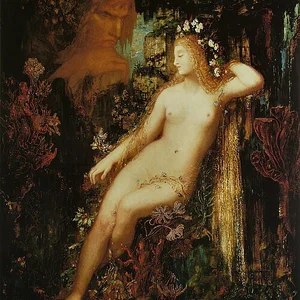

Galatea is a Nereid in Greek mythology, one of the fifty daughters of the sea god Nereus and the Oceanid Doris. She is famous for her love affair with the Sicilian shepherd Acis and for the advances of the Cyclops Polyphemus, who, out of jealousy, crushes Acis beneath a boulder.
Galatea
Galatea
6 min read
Frequently asked questions
Key Facts
- A Nereid, one of the fifty daughters of Nereus and Doris in Greek mythology
- Loved by the Cyclops Polyphemus, whose advances she rejects
- Lover of the Sicilian shepherd Acis, killed by the jealous Polyphemus who crushes him beneath a boulder
- Acis's blood is transformed into a Sicilian river, according to Ovid's account in the Metamorphoses (8 AD)
- Her myth has inspired many works of art, including Handel's 'Acis and Galatea' (1718)
Works & Achievements
A poem in which Polyphemus sings of his love for Galatea; the founding model of pastoral and bucolic poetry.
The most complete version of the myth, which passed the story down to all of Western culture.
A pioneering lyric work that stages the Cyclops's love for Galatea.
Satirical dialogues in which Galatea and her sister Doris debate Polyphemus's advances.
A fresco in the Villa Farnesina in Rome, a Renaissance masterpiece that fixed the image of Galatea upon the waves.
A Baroque oratorio that spread the myth throughout European music.
Anecdotes
Galatea belongs to the group of the Nereids, the fifty daughters of the old sea god Nereus. In Greek mythology, these sea nymphs escort sailors and dance around ships. Her name, which evokes the milky white of sea foam (from 'gala', meaning milk in Greek), emphasizes her connection to the calm waters of the Mediterranean.
Her most famous story takes place in Sicily, around Mount Etna. The Cyclops Polyphemus, a one-eyed giant, falls madly in love with her, but Galatea loves only the young shepherd Acis. Mad with jealousy, the Cyclops tears off a slab of rock and crushes Acis beneath it.
To avoid losing her beloved entirely, Galatea transforms the blood of Acis into a clear and lively Sicilian river, which bears the young man's name. This detail shows how the Greeks explained the origin of waterways through mythological tales.
The Roman poet Ovid recounts this legend in *The Metamorphoses*, in which Galatea herself tells the story of her grief to another Nereid. It is one of the main sources that has passed her story down to us.
Be careful not to confuse this Galatea with another figure of the same name: the ivory statue carved by Pygmalion and brought to life by Aphrodite. These are two distinct characters of Greek mythology who share the same name.
Primary Sources
Of Nereus and Doris of the lovely hair, daughter of Ocean, that perfect river, were born children full of charm among the goddesses... and lovely Galatea.
Acis was the son of Faunus and a nymph of the Symaethus; he was the joy of his father and mother, but even more so mine, for I alone had won his love.
O white Galatea, why do you reject the one who loves you? You are whiter than curdled milk to look upon, more tender than a lamb.
Galatea pelts your flock with apples, O Polyphemus, and calls you a clumsy lover and a goatherd.
Key Places
The main setting of the myth: it is on the Sicilian shore, at the foot of the Etna volcano, that Galatea loves Acis and flees the cyclops Polyphemus.
A waterway born from the blood of Acis, transformed by Galatea. The ancients identified a river at the foot of Mount Etna as the metamorphosed body of the shepherd.
Home of the fifty daughters of Nereus, where Galatea leads her life as a sea nymph, dancing and escorting sailors.
The mythical dwelling of the Old Man of the Sea, deep beneath the waters, where Galatea grew up among her Nereid sisters.
A Greek city in Sicily, homeland of the poet Theocritus, who sang of the cyclops's love for Galatea in his *Idylls*.
Typical Objects

Large sea shell used by the Nereids and sea deities as both instrument and ornament. Galatea is often associated with it in the iconography of the waves.

In ancient art, Galatea crosses the waves carried by a chariot or a team of dolphins and sea creatures. It is the attribute of the “Triumph of Galatea”.

The curved staff of the Sicilian shepherd loved by Galatea. It symbolizes the pastoral world set against the brutality of the cyclops.

A rustic pan flute made of reeds, which Polyphemus plays to sing his love to Galatea. Theocritus makes it the instrument of his laments.

A block of stone that the jealous cyclops hurls at Acis to crush him. It becomes the tragic instrument of the myth.

A light drape billowing in the wind, forming an arch above Galatea in depictions of her triumph. It evokes the foam and the motion of the waves.
School Curriculum
Vocabulary & Tags
Key Vocabulary
Daily Life
Morning
Like all the Nereids, Galatea leads an existence imagined by the poets to the rhythm of the sea. In the morning, she rises from the depths with her sisters to dance upon the waves and accompany the sunrise over the waters.
Afternoon
In the afternoon, the myth shows her on the Sicilian shore, secretly meeting the shepherd Acis in the shadow of the rocks. She flees the gaze of the cyclops Polyphemus, who keeps watch from the heights of Mount Etna.
Evening
In the evening, she listens from afar to the laments sung by Polyphemus, accompanied by his reed pipe. According to the stories, she sometimes mocks him by throwing apples at his flock.
Food
A divine figure, Galatea does not eat as humans do: the Greeks imagined the gods sustaining themselves on ambrosia and nectar. Her world nonetheless evokes the fruits of the sea and milk, to which her name refers.
Clothing
Ancient art depicts her clad in a light, flowing drapery, often half-naked, her veil billowing in the wind above her head. Her skin is described as white as milk or sea foam.
Housing
Her home is the underwater palace of her father Nereus, deep beneath the Mediterranean. But the myth anchors her above all on the coasts of Sicily, between the sea and the pastures at the foot of Mount Etna.
Historical Timeline
Period Vocabulary
Liens externes & ressources
Références
Œuvres
Idylle XI 'Le Cyclope' (Théocrite)
IIIe siècle av. J.-C.
Récit d'Acis et Galatée, Métamorphoses Livre XIII (Ovide)
vers 8 apr. J.-C.
Dithyrambe de Philoxène de Cythère
Ve-IVe siècle av. J.-C.
Dialogues marins (Lucien)
IIe siècle apr. J.-C.
Le Triomphe de Galatée (Raphaël)
1512
Acis and Galatea (Haendel)
1718