 flip
flipIrish Soda Bread
Irish Soda Bread
Why this dish? Soda bread was the daily bread of Irish homes in Boole's time: leavened without yeast, baked in half an hour, it keeps for a few days and travels easily — practical for a professor whose days were spent between his home in Blackrock and the college.
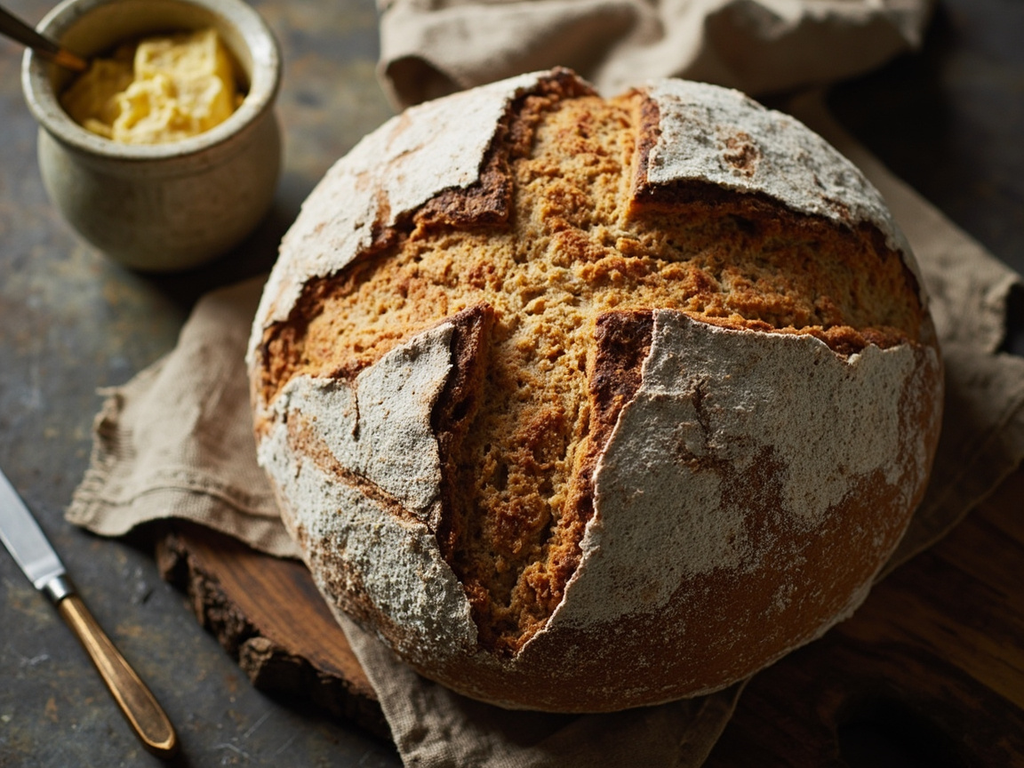
A dense, rustic loaf of wheat flour, raised with soda (bicarbonate) and buttermilk, marked with a deep cross. Tight crumb, thick crust, a slight tang: bread without kneading or waiting, to be broken still warm.
I am often asked how such a quick bread can be made, and I answer: by the grace of soda and buttermilk, which marry and make the dough rise without the help of any leaven. Mix quickly, do not knead — maltreated dough becomes heavy as a bad argument. Cut a cross into it with a knife, to let it breathe in the oven, and take it out golden after half an hour. This is the bread of our Cork neighbours, and it accompanies both the evening tea and the Sunday bacon.
- •Wheat flour — four cups (base)
- •Buttermilk — enough to bind (leavening and acidity)
- •Bread soda (bicarbonate) — a teaspoon (leavening agent)
- •Salt — a teaspoon (seasoning)
Irish Soda Bread
A dense, rustic loaf of wheat flour, raised with soda (bicarbonate) and buttermilk, marked with a deep cross. Tight crumb, thick crust, a slight tang: bread without kneading or waiting, to be broken still warm.
Why this dish? Soda bread was the daily bread of Irish homes in Boole's time: leavened without yeast, baked in half an hour, it keeps for a few days and travels easily — practical for a professor whose days were spent between his home in Blackrock and the college.
I am often asked how such a quick bread can be made, and I answer: by the grace of soda and buttermilk, which marry and make the dough rise without the help of any leaven. Mix quickly, do not knead — maltreated dough becomes heavy as a bad argument. Cut a cross into it with a knife, to let it breathe in the oven, and take it out golden after half an hour. This is the bread of our Cork neighbours, and it accompanies both the evening tea and the Sunday bacon.
Ingredients (period version)
- Wheat flour — four cups (base)
- Buttermilk — enough to bind (leavening and acidity)
- Bread soda (bicarbonate) — a teaspoon (leavening agent)
- Salt — a teaspoon (seasoning)
Ingredients
- Plain white flour (or half wholemeal) — 500 g (base)
- Buttermilk (cultured buttermilk) — 400 ml (leavening and acidity)
- Bicarbonate of soda — 1 level tsp (leavening agent)
- Fine salt — 1 tsp (seasoning)
Method
- Preheat the oven to 220°C.
- Mix the flour, bicarbonate, and salt in a large bowl.
- Pour in the buttermilk all at once and combine quickly by hand, just until a soft, sticky dough forms — do not knead.
- Shape into a round on a floured baking sheet, flatten slightly, and cut a deep cross into the top with a knife.
- Bake for 25–30 minutes: the bread is done when it sounds hollow when tapped on the bottom.
- Cool slightly on a wire rack before breaking open.
How it was made : Bicarbonate of soda ('bread soda') spread in kitchens from the 1840s and transformed Irish domestic breadmaking: no more need for yeast or a communal bread oven. Buttermilk, a by-product of butter churning, provided the acidity that reacts with the soda to leaven the dough. The scored cross, both practical (baking) and symbolic, is traditional.
The contemporary twist : Fold a handful of rolled oats into the dough and sprinkle some on the crust: a nod to Boole's signature oats, and a bit more texture.
Sources : Eliza Acton, Modern Cookery for Private Families, 1845 · Isabella Beeton, The Book of Household Management, 1861
George Boole · Charactorium