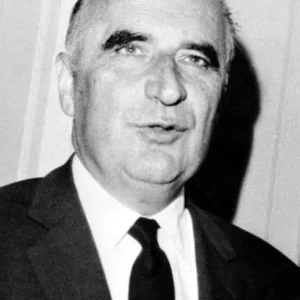

Georges Pompidou (1911-1974) was a French statesman, Prime Minister under de Gaulle from 1962 to 1968, then the second President of the Fifth Republic from 1969 until his death. A former literature teacher, he left his mark on France through his policy of industrial modernization and his support for contemporary arts.
Georges Pompidou(1911 — 1974)
Georges Pompidou
France
9 min read
Frequently asked questions
Famous Quotes
« Politics is the art of preventing people from getting involved in what concerns them.»
« There are three roads to failure: wine, women, and politics. I chose only the first two — they are less dangerous.»
Key Facts
- 1911: Born in Montboudif (Cantal)
- 1962-1968: Prime Minister under General de Gaulle, the longest-serving Prime Minister of the Fifth Republic
- June 1969: Elected President of the Republic following de Gaulle's resignation
- 1969-1974: Leads France until his death, pursuing a policy of industrial modernization
- 1974: Dies in office on April 2, from Waldenström's macroglobulinemia
Works & Achievements
Negotiated by Pompidou as Prime Minister at the height of May 68, these agreements granted a 35% increase in the minimum wage and expanded trade union rights. They brought an end to the largest general strike in French history.
Pompidou's landmark presidential initiative, this multidisciplinary cultural centre in Paris was designed to democratise access to contemporary art. Inaugurated in 1977, it is today one of the most visited museums in the world.
A personal literary work published before his presidency, this annotated selection of poems reflects his erudition as an agrégé professor. The book remains a testament to Pompidou's dual nature as both statesman and man of culture.
Under Pompidou, France pursued an ambitious policy of industrial and technological development, building 'national champions' in aeronautics (Airbus), nuclear energy, and computing. This vision drove the country's economic transformation.
An unfinished work published after his death, in which Pompidou shares his vision of politics and the Fifth Republic. An invaluable historical account of life behind the scenes of Gaullist power.
Pompidou drove an ambitious programme of motorway construction and major public works, including the Paris ring road (Boulevard Périphérique). This vision of an 'automobile France' came to define its era, though it has since attracted retrospective criticism.
Anecdotes
Georges Pompidou had a rare passion for poetry and modern art, unusual for a statesman. Together with his wife Claude, he personally built a collection of contemporary art that included works by Picasso and Rothko. When he became president, he had the Élysée decorated with pieces by living artists, breaking with classical tradition.
It was Pompidou himself who chose the controversial architectural design by Renzo Piano and Richard Rogers for the future Centre Beaubourg, even though most jury members and the public considered it too avant-garde. He defended the choice with conviction, declaring his desire to make Paris 'a city that embraces modernity.' He never saw the center inaugurated — he died two years before its opening in 1977.
During the events of May 1968, it was Pompidou, then Prime Minister, who negotiated directly with trade unions to reach the Grenelle Agreements, securing significant wage increases. His pragmatic handling of the crisis drew both criticism and praise, but demonstrated his ability to govern during turbulent times.
Pompidou had been suffering for several years from a serious blood disease, Waldenström's macroglobulinemia, which he carefully concealed from the public. His television appearances nonetheless revealed a visible physical transformation. He died in office on April 2, 1974, the first president of the Fifth Republic to pass away while serving.
A former literature teacher and holder of the agrégation, Pompidou published an 'Anthology of French Poetry' in 1961, a textbook that enjoyed great success. This deep literary culture set him apart from the image of a political technocrat, and he enjoyed quoting Baudelaire or Apollinaire in his official speeches.
Primary Sources
France must choose between the status quo and modernization. My government is resolutely committed to the path of industrial and social progress, without abandoning the values that define our national identity.
The government commits to raising the guaranteed minimum wage by 35%, with social partners agreeing to a gradual return to work across all affected sectors.
I want Paris to have a cultural center that is both a museum and a center for creation, where the visual arts would sit alongside music, cinema, and books. Something alive and warm.
De Gaulle taught me that in politics, form and substance are inseparable. A grand vision poorly expressed is a vision lost. I always sought to combine clarity of expression with rigor of action.
Culture is not a luxury dispensed by the State to its citizens: it is a vital necessity for a nation that intends to remain true to itself while opening up to the contemporary world.
Key Places
Georges Pompidou's birthplace in the Auvergne region, where he grew up in a family of schoolteachers. This rural setting instilled in him values of hard work and academic merit that would guide his entire career.
The official residence of the French President, where Pompidou carried out his duties from 1969 to 1974. He had contemporary artworks installed there, symbolically transforming the presidential space.
The national museum of modern art and cultural centre inaugurated in 1977, three years after the death of its initiator. This iconic building, with its exposed structure and colourful pipes, revolutionised museum architecture worldwide.
The official residence of the French Prime Minister, where Pompidou governed from 1962 to 1968. It was here that he negotiated the Grenelle Agreements in May 1968 and navigated a succession of political crises.
The lower house of the French Parliament, before which Pompidou defended his policies and survived several votes of no confidence. His eloquence and composure there earned him a reputation as a great parliamentary figure.
Typical Objects

A symbol of executive power under the Fifth Republic, the presidential telephone allowed Pompidou to govern in urgent situations. His aides noted that he would call people himself, at any hour, to make quick decisions.

Pompidou and his wife Claude were avid collectors of contemporary art. On his initiative, the Élysée Palace was redecorated with works by living artists, breaking with the tradition of academic paintings.

A book published by Pompidou in 1961, born of his passion for literature. This educational work reveals the man of letters behind the head of state and remains a key pedagogical reference.

Pompidou embodied the understated, bourgeois style of the republican president of the 1970s, a sharp contrast to de Gaulle's military kepi. His quiet elegance reflected his desire to modernize the image of the presidency.

The Delegation for Regional Planning and Development, close to Pompidou's heart, produced industrial and infrastructure blueprints. These files symbolize his vision of a modernized France, with developed regional cities and industrial zones.

Pompidou personally selected the Piano and Rogers design for this groundbreaking cultural center. The model of this 'inside-out' building with its colorful pipes illustrates his taste for architectural daring.
School Curriculum
Vocabulary & Tags
Key Vocabulary
Daily Life
Morning
Pompidou rose early and began his day by reading the national daily press — Le Monde, Le Figaro, L'Humanité — to take the pulse of public opinion. He would then hold a morning meeting with his close staff and the Secretary-General of the Élysée to set the day's priorities.
Afternoon
Presidential afternoons were structured around official audiences, interministerial councils, and the signing of regulatory texts. Pompidou paid particular attention to economic and industrial files, reviewing reports from DATAR and the Ministry of Finance.
Evening
Evenings at the Élysée alternated between state dinners with foreign heads of government and more intimate gatherings with intellectuals, artists, and writers whom Pompidou held in great affection. He found in these cultural exchanges a necessary counterpoint to the pressures of political life.
Food
Pompidou appreciated traditional French cuisine and wines from Auvergne, his home region. Official meals at the Élysée followed French gastronomic protocol, while in private he preferred a less formal table, in keeping with his rural origins.
Clothing
Pompidou embodied the understated style of the republican notable: dark suit (navy or grey), white shirt, club tie or one with subtle stripes. He avoided any ostentatious excess, seeking to project the image of an accessible, modern president — far removed from the Gaullist military cap.
Housing
The Pompidou couple officially resided at the Élysée Palace in Paris and at the Marcy residence in Orvilliers for weekends. They had installed their personal collection of modern art in both homes, transforming these official spaces into true showcases of French and international contemporary art.
Historical Timeline
Period Vocabulary
Visual Style
Le style visuel de l'ère Pompidou juxtapose le faste institutionnel de la Ve République — dorures de l'Élysée, cérémonies officielles — et la modernité audacieuse des années 1970, avec l'art contemporain s'invitant au cœur du pouvoir.
Sound Ambience
L'atmosphère sonore de la présidence Pompidou mêle l'effervescence feutrée des cabinets ministériels parisiens des années 1970 — machines à écrire, téléphones à cadran, réunions politiques — au bourdonnement de la capitale en pleine modernisation.
Liens externes & ressources
Références
Œuvres
Accords de Grenelle
27 mai 1968
Projet du Centre national d'art et de culture Georges-Pompidou
1969-1974
Anthologie de la poésie française
1961
Politique de modernisation industrielle (VIe Plan)
1971-1975
Mémoires — Pour rétablir une vérité
1982 (posthume)
Politique autoroutière et aménagement du territoire
1969-1974