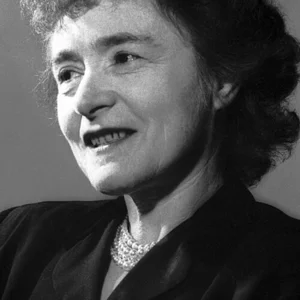

An American biochemist of Czech origin, Gerty Cori was the first woman to receive the Nobel Prize in Physiology or Medicine in 1947, which she shared with her husband Carl Cori. Her work on glycogen metabolism laid the foundations of modern biochemistry.
Gerty Cori(1896 — 1957)
Gerty Theresa Cori
États-Unis, Tchécoslovaquie, Cisleithanie
8 min read
Frequently asked questions
Key Facts
- 1896: born in Prague (Austro-Hungarian Empire)
- 1920: earned her medical doctorate in Prague, where she met Carl Cori
- 1929: described the Cori cycle, the mechanism by which glucose is converted into glycogen
- 1947: first woman to win the Nobel Prize in Physiology or Medicine
- 1957: died in St. Louis, Missouri, United States
Works & Achievements
Gerty and Carl Cori describe the mechanism by which muscle glycogen is broken down into lactic acid, carried by the blood to the liver, and then reconverted into glycogen. This fundamental cycle explains how the body regulates energy both at rest and during physical exertion.
Discovery of a key chemical intermediate in glycogen metabolism, named the "Cori ester" in their honor. This molecule lies at the heart of the chain of enzymatic reactions that allow the body to mobilize its sugar reserves.
Gerty Cori succeeded in obtaining phosphorylase in crystalline form — a technical feat that made it possible to study its structure and mechanism of action in precise detail. This breakthrough was decisive in understanding how the body releases energy stored in glycogen.
Scientific address delivered at the Nobel Academy in Stockholm, synthesizing twenty years of discoveries on glycogen metabolism and opening the way for biochemical study of hereditary metabolic diseases.
In her final years, Gerty Cori identified and classified several hereditary diseases caused by enzyme deficiencies in glycogen metabolism, thereby founding the medical biochemistry of storage diseases and foreshadowing modern medical genetics.
Anecdotes
When Gerty and Carl Cori were searching for their first jobs in the United States in the 1920s, academic institutions regularly discouraged them from working together, fearing that their marriage would undermine scientific objectivity. At Washington University in St. Louis, Gerty was hired as a mere research assistant at a salary several times lower than her husband's, despite having equivalent scientific abilities.
The Cori couple developed such a close and complementary working method that their colleagues nicknamed them “the Cori team.” Carl often planned experiments in broad strokes, but it was Gerty who carried out the most delicate procedures: she was the one who succeeded in crystallizing glycogen phosphorylase in 1943, a technical feat that astonished the international biochemical community.
When Gerty Cori learned in 1947 that she was to receive the Nobel Prize in Physiology or Medicine, she was already suffering from myelosclerosis, a rare bone marrow disease likely contracted through repeated radiation exposure during her early years of research. Yet she took the stage in Stockholm with dignity, becoming the first woman to receive this distinction in that category.
Despite the illness that was gradually weakening her body, Gerty Cori continued to work in her laboratory almost until her death in 1957. She wrote her final articles on glycogen storage diseases from her chair, deeply inspiring her students with her refusal to surrender to physical suffering.
Before entering the medical school in Prague, Gerty had to pass a proficiency examination in Latin and natural sciences — subjects she had not had the opportunity to study at her girls’ school. She prepared for the exam in just a few months, passed it brilliantly, and enrolled in the faculty where she met Carl Cori, her future husband and lifelong scientific partner.
Primary Sources
The present experiments show that lactic acid formed in the muscles during exercise is carried by the blood to the liver, where it is resynthesized into glycogen. This cycle between lactic acid and glycogen constitutes the main pathway by which carbohydrate is made available for muscular work.
Glucose-1-phosphoric acid has been isolated as an intermediate product in the enzymatic breakdown and synthesis of glycogen. The compound, formed through the action of phosphorylase on glycogen in the presence of inorganic phosphate, can be reconverted into glycogen by the same enzyme.
Muscle phosphorylase has been obtained in crystalline form. The crystals retain full enzymatic activity, catalyzing the reversible phosphorolysis of glycogen to glucose-1-phosphate. Two interconvertible forms of the enzyme, phosphorylase a and phosphorylase b, have been distinguished.
The elucidation of the enzymatic steps of glycogen degradation has opened a new approach to the study of inherited metabolic diseases. Several types of glycogen storage disease can now be explained as the result of a specific enzymatic deficiency, each type being associated with an accumulation of glycogen of normal or abnormal structure.
Six types of glycogen storage disease are now recognized, each characterized by a specific enzymatic defect. The recognition of these diseases as inborn errors of metabolism opens the possibility of a rational biochemical classification of hereditary diseases.
Key Places
Gerty Cori's birthplace, where she grew up in a cultivated Jewish family and studied medicine at the German University in Prague. It was here that she met Carl Cori, her future husband and lifelong scientific collaborator.
The Cori couple's first American position after emigrating in 1922, where Gerty worked as an assistant in the pathology department. It was here that they began their first joint research into carbohydrate metabolism.
The primary setting of Gerty Cori's scientific career from 1931 onward, where she made all her major discoveries about glycogen. She was not granted a tenured professorship until 1947, after receiving the Nobel Prize.
The city where Gerty Cori received the Nobel Prize in Physiology or Medicine on December 10, 1947, delivering a widely noted scientific lecture on enzymatic diseases of glycogen.
Liens externes & ressources
Références
Œuvres
Description du cycle de Cori
1929
Isolement du glucose-1-phosphate (ester de Cori)
1936
Cristallisation de la phosphorylase du glycogène
1943
Conférence Nobel : Glycogen Structure and Enzyme Deficiencies in Glycogen Storage Disease
1947
Classification des glycogénoses
1952-1957