 flip
flipPiadina sul testo — the everyday flatbread
Piadina sul testo — the everyday flatbread
Why this dish? The staple food of Romagna, which Zappi breaks every morning before climbing the scaffolding of an altarpiece. Kneaded in a flash, cooked on the *testo* of terracotta — the same Faenza clay that the town works for its famous majolica — it feeds the craftsman quickly and without a bread oven.
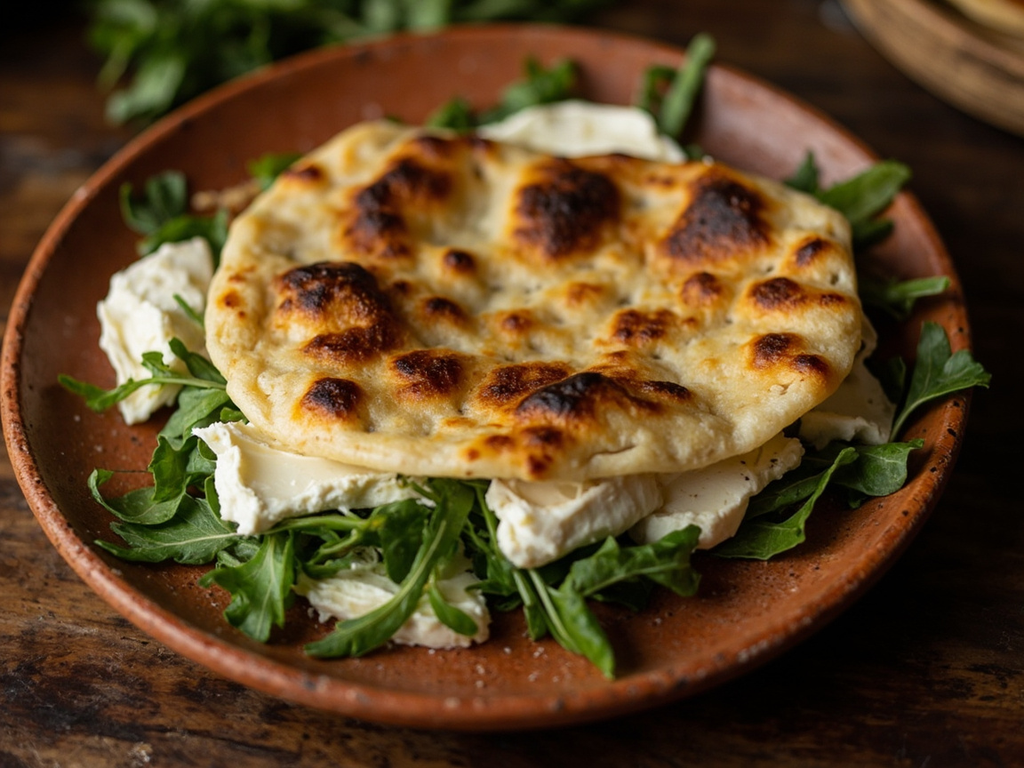
Flat, golden, and speckled by cooking, made from flour, lard, water, and salt. Eaten hot, folded over fresh cheese, garden herbs, or a slice of cured meat. The bread of the poor hand as well as the well-off painter.
Listen well: before my brushes touch the tempera, I must heat the *testo*, that good terracotta disk that Faenza's kilns know how to make better than anywhere else. I work the flour with a little lard and well water, roll it thin like a preparatory cartoon, and hop, on the hot stone it blisters and browns. Folded over a piece of squacquerone and three rocket leaves from the garden, it keeps my belly until vespers. Do not let it dry out: piadina is eaten hot, otherwise it sulks.
- •Wheat flour — a good bowlful (base)
- •Lard (strutto) — a walnut-sized piece (fat, softness)
- •Warm well water — as needed (binder)
- •Salt — a pinch (seasoning)
Piadina sul testo — the everyday flatbread
Flat, golden, and speckled by cooking, made from flour, lard, water, and salt. Eaten hot, folded over fresh cheese, garden herbs, or a slice of cured meat. The bread of the poor hand as well as the well-off painter.
Why this dish? The staple food of Romagna, which Zappi breaks every morning before climbing the scaffolding of an altarpiece. Kneaded in a flash, cooked on the *testo* of terracotta — the same Faenza clay that the town works for its famous majolica — it feeds the craftsman quickly and without a bread oven.
Listen well: before my brushes touch the tempera, I must heat the *testo*, that good terracotta disk that Faenza's kilns know how to make better than anywhere else. I work the flour with a little lard and well water, roll it thin like a preparatory cartoon, and hop, on the hot stone it blisters and browns. Folded over a piece of squacquerone and three rocket leaves from the garden, it keeps my belly until vespers. Do not let it dry out: piadina is eaten hot, otherwise it sulks.
Ingredients (period version)
- Wheat flour — a good bowlful (base)
- Lard (strutto) — a walnut-sized piece (fat, softness)
- Warm well water — as needed (binder)
- Salt — a pinch (seasoning)
Ingredients
- All-purpose flour (T55) — 300 g (base)
- Lard (or olive oil) — 50 g (fat)
- Warm water — about 130 ml (binder)
- Fine salt — 1 tsp (seasoning)
- Squacquerone or fresh cheese + rocket — for filling (companatico)
Method
- Mix flour and salt, add softened lard, then warm water little by little until a soft, non-sticky dough forms.
- Knead for 5 minutes, cover with a cloth and let rest for 30 minutes.
- Divide into 4 balls, roll each into a thin disk (3-4 mm).
- Heat a cast-iron skillet (or griddle) dry and very hot. Cook each flatbread for 2 minutes per side, pricking any blisters, until browned spots appear.
- Immediately fill with fresh cheese and rocket, fold in half, and eat hot.
How it was made : Before 1492, and long after, the piadina was cooked on the *testo*, a clay (later iron) disk placed on embers. No yeast: it is a peasant flatbread long mentioned in Romagna. Lard was the everyday cooking fat; olive oil, more expensive, was reserved.
The contemporary twist : Rolled tightly and sliced into bite-sized spirals for an aperitif, with a drizzle of sapa over the fresh cheese for a sweet-salty wink.
Sources : Pellegrino Artusi, La scienza in cucina e l'arte di mangiar bene (1891) — Romagna recipes · Romagnola oral tradition, piadina sul testo
Gian Paolo Zappi · Charactorium