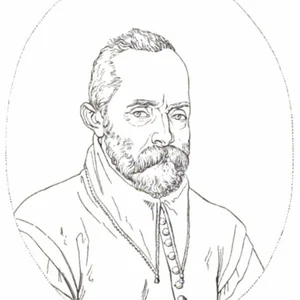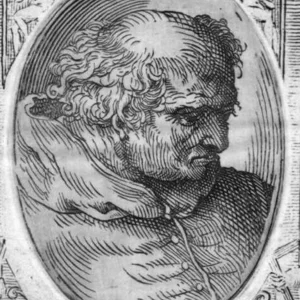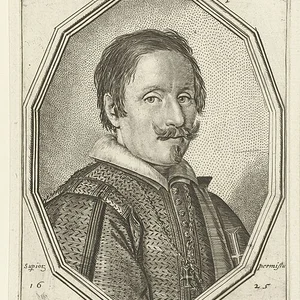

Italian painter and biographer (1566–1643), active in Rome. A rival of Caravaggio, he represents the late Mannerist current before adopting a moderate Baroque style. He is also known for his work on the lives of Roman painters.
Giovanni Baglione(1566 — 1643)
Giovanni Baglione
Italie
7 min read
Frequently asked questions
Key Facts
- Born in Rome around 1566, died in 1643
- Declared rival of Caravaggio, who mocked him in his letters, leading to a lawsuit in 1603
- Author of *Vite de' pittori, scultori et architetti* (1642), a major source on Roman art of his era
- Worked for several popes and received important commissions for Roman churches
- Gradually adopted Caravaggesque chiaroscuro while remaining attached to Mannerism
Works & Achievements
A painting conceived as a direct response to Caravaggio's *Amor Vincit Omnia*: a luminous celestial angel crushes a shadowy, carnal figure. The work, held at the Gemäldegalerie in Berlin, illustrates the debate between religious idealism and Caravaggesque realism.
A collection of biographies of artists who worked in Rome between 1572 and 1642, a landmark of the genre following Vasari. An irreplaceable historical source on Caravaggio, Annibale Carracci, and dozens of Roman artists, despite the author's personal biases.
A large decorative cycle painted for Pope Clement VIII in his official residence. These religious frescoes established Baglione as one of the papacy's official painters.
An altarpiece painted for the main Jesuit church in Rome, demonstrating Baglione's adaptation of Caravaggesque chiaroscuro within an orderly composition in keeping with the demands of the Counter-Reformation.
A painting showing how Baglione gradually absorbed the lessons of Caravaggesque realism into conventional religious iconography, without ever breaking with the idealism his patrons required.
Anecdotes
In 1603, Giovanni Baglione brought a lawsuit against Caravaggio before a Roman tribunal: his rival had mocked him in obscene and satirical sonnets circulating clandestinely through the city's workshops. The case is one of the rare artistic quarrels of the era to have been preserved directly in judicial records, and the testimonies gathered during the trial constitute a precious source on Roman artistic life at the beginning of the 17th century.
In response to Caravaggio's celebrated *Amor Vincit Omnia*, Baglione painted his own *Divine Love Overcoming Earthly Love*, in which a celestial angel crushes a carnal figure in the shadows. This pictorial duel illustrates the tension of the era between the raw realism of Caravaggism and an idealism more in keeping with the expectations of the Counter-Reformation Church.
Baglione was one of the very few contemporaries of Caravaggio to outlive him and write his biography. In his *Vite de' pittori* published in 1642, he draws an ambiguous portrait of his former enemy, acknowledging his genius while emphasizing his violent temperament and scandals — an essential source, despite the author's obvious subjectivity.
A member of the prestigious Accademia di San Luca in Rome, Baglione served as its president on two occasions. This institution trained and regulated Roman artists, and holding a leadership position there reflected an official recognition that his rival Caravaggio — a solitary and scandalous artist — never obtained.
Primary Sources
Michelagnelo da Caravaggio [...] fu persona satirica e superba, e tal volta rompeva con tutti i pittori di qualsivoglia bontà. [...] hebbe poco giudicio nel maneggio de' colori, nondimeno egli fu valenthuomo nella pittura.
Giovanni Baglione, painter [...] states that for about two or three months certain infamous and dishonest sonnets have been circulating in Rome against his reputation and his honor as a painter, and that he knows the author to be Michelangelo da Caravaggio.
Poiché la pittura è un'arte nobilissima, e le Vite de' Pittori eccellenti sono state scritte da molti, ho pensato di raccogliere in questo volume le vite di coloro che hanno operato in Roma dal Pontificato di Gregorio XIII sino a quello di Urbano VIII.
Eletto Principe dell'Accademia di San Luca il signor Giovanni Baglione pittore romano, con voti unanimi degli Accademici.
Key Places
The city where Baglione was born, lived, and died. Rome was at the time the artistic capital of the Christian West, sustained by papal and cardinalate commissions that drew the finest artists in Europe.
The official residence of the popes, whose halls Baglione decorated under the pontificate of Clement VIII in the late 1590s. These frescoes brought him official recognition and launched his career as a leading Roman painter.
The institution that regulated and trained Roman artists. Baglione was an active member and served as its president on two occasions, a testament to his standing in Rome's official artistic world.
The symbol of Catholic power, in the midst of reconstruction during the 16th and 17th centuries. Baglione moved within the orbit of the neighbouring papal building projects, at the heart of Counter-Reformation patronage.
Typical Objects

An oval wooden board on which the painter arranges and blends pigments ground in oil. Baglione's palette carried the characteristic colors of Roman Baroque painting: ochres, vermilion, lead white, and ivory black.

The oil painter's primary instrument, made from fine hairs bound to a wooden or bone handle. The quality of the brush determined the fineness of details, particularly for faces and drapery.

A large painting intended to adorn the back of a church altar. Baglione received numerous altarpiece commissions for Roman churches, which were the main source of income for painters of the Counter-Reformation.

Writing instruments used by Baglione to compose his *Vite de' pittori*, a biographical collection on Roman artists. Iron gall ink was the most common type used for manuscripts of the period.

An essential source of artificial light in the painter's studio, used for working in the evening or illuminating models. Mastery of artificial lighting effects was at the heart of the pictorial debate between Baglione and Caravaggio.

A legal document drawn up by a notary setting out the terms of a commission: subject, dimensions, materials, deadline, and price. Such contracts, common in Baroque Rome, formed the basis of the relationship between patrons and artists.
School Curriculum
Vocabulary & Tags
Key Vocabulary
Daily Life
Morning
Baglione rose early to make the most of the natural morning light, essential for oil painters. He prepared his colors by grinding pigments with linseed oil, then organized the posing session with his models or apprentices before setting to work on the large canvases in progress.
Afternoon
The afternoon was devoted to visits from patrons — cardinals, Roman nobles, church procurators — who inspected the progress of works or discussed new commissions. Baglione would sometimes attend the Accademia di San Luca for meetings among artists, where competitions, prizes, and the rules of the trade were debated.
Evening
In the evening, by lamplight, Baglione wrote notes on the artists he knew — a long-term undertaking that would eventually result in his *Vite* in 1642. He also frequented Rome's intellectual circles, where poets, scholars, and artists gathered under the patronage of cardinal-mecenates.
Food
Like any Roman of the established artist class, Baglione ate bread, vegetables (beans, artichokes), meat (lamb, chicken), and fish on the lean days prescribed by the Church. Wine diluted with water was the daily drink; meals followed the rhythm of the Catholic liturgical calendar, which was particularly strict in Rome.
Clothing
Baglione wore garments of wool cloth or silk depending on the occasion, sober and dark in the Roman fashion of the time. In the workshop, a leather apron protected his clothes from pigment and oil stains. At academic ceremonies, he dressed more formally, a mark of his status as a recognized artist.
Housing
Baglione lived and worked in a combined studio and dwelling (*bottega*) in the center of Rome, close to the main churches and cardinal residences. His workshop took in apprentices and assistants who prepared canvases, ground colors, and helped execute large commissions, following the traditional model inherited from the Renaissance.
Historical Timeline
Period Vocabulary
Liens externes & ressources
Références
Œuvres
Le vite de' pittori, scultori et architetti
1642
La Résurrection du Christ (pour l'église du Gesù)
1603