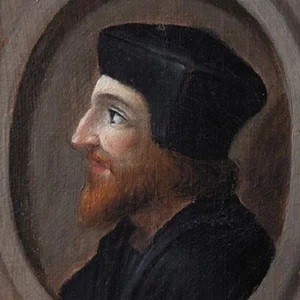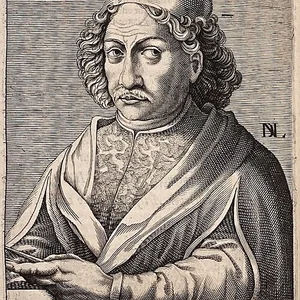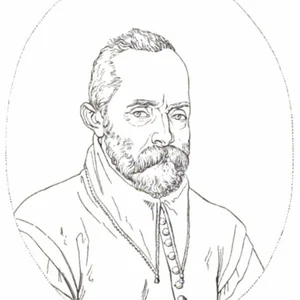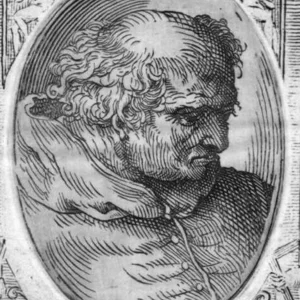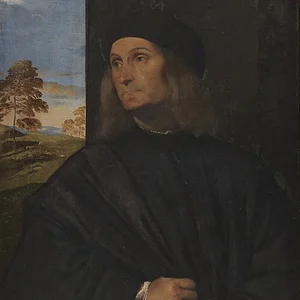

Giovanni Bellini was a major Venetian painter of the Italian Renaissance. Son of Jacopo and brother of Gentile Bellini, he revolutionized Venetian painting through his mastery of color, light, and atmosphere, paving the way for Giorgione and Titian.
Giovanni Bellini(1430 — 1516)
Giovanni Bellini
république de Venise
6 min read
Frequently asked questions
Key Facts
- Born around 1430 in Venice, into the Bellini family of artists
- Adopted and perfected oil painting, imported from Flanders, giving depth and luminosity to his works
- Painted numerous Madonnas and Child (sacre conversazioni) and altarpieces for Venetian churches
- Trained the future masters Giorgione and Titian in his workshop
- Studied by Albrecht Dürer during his stays in Venice, who considered him the finest painter in the city; died in Venice in 1516
Works & Achievements
An early work of great emotional intensity, marked by the influence of Mantegna.
A large *sacra conversazione* altarpiece that established a model for Venetian painting, with monumental painted architecture.
Madonna and Child surrounded by saints, painted for the Frari basilica, famous for blending real and painted architecture.
An official portrait of great dignity, a pinnacle of Venetian portraiture, now in the National Gallery in London.
A masterpiece of his maturity, where soft light and atmosphere unify the entire composition.
A painting famous for its meticulous, luminous treatment of landscape, heralding a new relationship with nature.
A late work painted for the Duke of Ferrara, later reworked by Titian; it reflects his openness to mythological subjects.
Anecdotes
Giovanni Bellini belonged to a true dynasty of painters: his father Jacopo Bellini ran one of the most important workshops in Venice, and his sketchbooks served as models for the entire family. His brother-in-law was none other than Andrea Mantegna, whose influence deeply marked his early works.
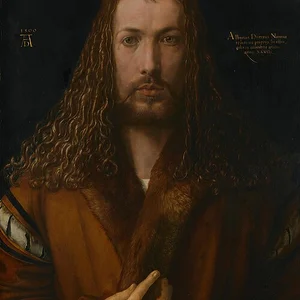
In 1506, the German painter Albrecht Dürer, while visiting Venice, wrote in a letter to his friend Willibald Pirckheimer that Bellini, though very old, was still “the best in painting” of the entire city. Dürer also recounts that the old master came to see him and asked, as a gift, for one of his brushes, curious about his skill.
Bellini had an exceptionally long career: he painted for more than sixty years and trained in his workshop two of the greatest geniuses of Venetian painting, Giorgione and Titian. He managed to keep his style evolving into old age, adopting the oil painting technique that had come from Flanders.
Appointed official painter of the Republic of Venice, he was tasked with restoring and renewing the great paintings in the Hall of the Great Council of the Doge's Palace. Sadly, these monumental works were destroyed in the fire of 1577.
In 1501, the poet and writer Pietro Bembo, who admired his art, observed that Bellini did not like having overly strict rules imposed on him in his commissions: he preferred, it was said, to “wander as he pleased” through his compositions, a sign of a creative freedom that was new for the time.
Primary Sources
He is very old, and he is still the best in painting.
Giovanni Bellini lived to the age of ninety and was held in great honour in his homeland, painting continuously until his death.
The master does not wish to be given too precise limits on what he must paint, being accustomed, he says, to always wandering as he pleases in his paintings.
Giovanni Bellini is entrusted with the task of working on the paintings of the Great Council hall in the ducal palace.
Key Places
Bellini's birthplace and the setting for his entire career, then a powerful maritime Republic and a great artistic centre. There he ran the most celebrated painting workshop.
It still houses the famous San Zaccaria Altarpiece (1505), a masterpiece of Bellini's maturity, still on view in its original location.
It holds the Frari Triptych (1488), painted by Bellini for the sacristy and remarkable for its painted architecture and its light.
As the Republic's official painter, Bellini worked here on the great paintings of the Hall of the Great Council, destroyed by the fire of 1577.
A neighbouring city where the sculptor Donatello taught and where Mantegna, Bellini's brother-in-law, worked; an artistic centre that influenced his early years.
Typical Objects

Large altar painting intended for churches, often a Virgin and Child surrounded by saints. Bellini painted magnificent ones, such as the San Zaccaria Altarpiece.

A poplar support coated with gesso (plaster) on which artists painted before canvas came into widespread use. The surface had to be carefully sanded and prepared.

Colours ground from minerals and earths, mixed with linseed oil. This Flemish technique, adopted by Bellini, allowed for unprecedented transparencies and gradations.

A collection of studies and models passed down within the workshop, inherited notably from his father Jacopo. It served as a repertory of figures and compositions.

Tools with fine or broad bristles that Bellini wielded with celebrated virtuosity. Dürer asked for one as a gift to understand his secret.

A woven support that gradually replaced the wooden panel in Venice, better suited to the lagoon's humid climate and to large formats.
School Curriculum
Vocabulary & Tags
Key Vocabulary
Daily Life
Morning
The master starts early in his workshop, in the natural light that best reveals colors. Apprentices and assistants grind pigments and prepare the panels and glues while he sketches out the day's compositions.
Afternoon
The afternoon is divided between painting the most delicate parts — the faces, the hands, the skies — which he reserves for himself, and receiving patrons: convents, religious brotherhoods, or wealthy patricians who have come to discuss an altarpiece or a portrait.
Evening
In the evening, as daylight fades, the painting work stops for lack of reliable light. This is the hour for the workshop's accounts, for studying drawings and models, and for conversations with the scholars and humanists of cultured Venice.
Food
The Venetian diet combines bread, the newly emerging polenta, vegetables, and the fish and seafood abundant in the lagoon. Wine accompanies meals, and spices brought from the East through the great maritime trade season the dishes of the wealthier classes.
Clothing
As a respected and notable craftsman, Bellini wears plain but fine clothing: a long robe or tunic of dark wool, sometimes lined with fur in winter. In the workshop, an apron protects his garments from paint stains.
Housing
He lives and works in a Venetian house-workshop, a brick building with pointed arched windows often overlooking a canal. The space combines family lodging, a store of materials, and a large workshop bustling with several collaborators.
Historical Timeline
Period Vocabulary
Liens externes & ressources
Références
Œuvres
Le Christ mort soutenu par deux anges (Pietà)
vers 1460
Triptyque des Frari
1488
Portrait du doge Leonardo Loredan
vers 1501
Retable de San Zaccaria
1505
Le Festin des dieux
1514