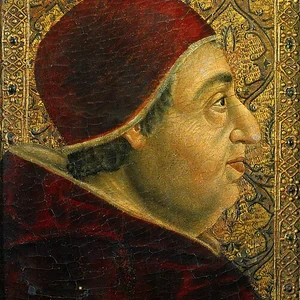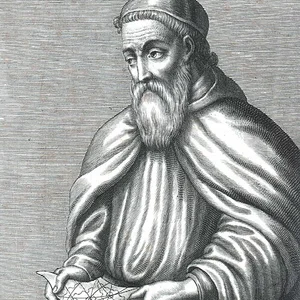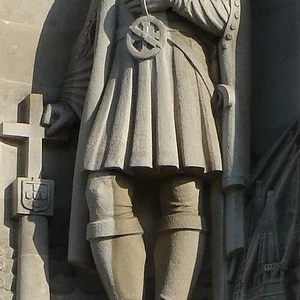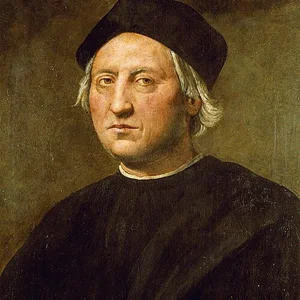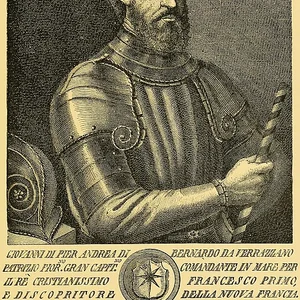

Florentine navigator and explorer in the service of France, he was the first European to explore the eastern coast of North America, from Florida to Canada, in 1524. He entered New York Bay and named many territories.
Giovanni da Verrazzano(1491 — 1528)
Giovanni da Verrazzano
République florentine
8 min read
Frequently asked questions
Key Facts
- 1524: explores the eastern coast of North America on behalf of King Francis I of France
- 1524: enters the bay of what will become New York, which he names 'New Angoulême'
- 1524: writes the letter to Francis I describing his discoveries, the first European account of the North American coast
- 1528: disappears during a third expedition to the Caribbean, likely killed by indigenous people in the Lesser Antilles
Works & Achievements
A detailed account of his voyage along the east coast of North America, addressed to the King of France. This document constitutes the first European description of many regions, including the future New York Bay, and remains a fundamental historical source.
The first documented European voyage to continuously explore the Atlantic seaboard of North America, from present-day North Carolina to Newfoundland, covering more than 5,000 kilometers of coastline and establishing the continuity of the continent.
A map drawn by his brother Girolamo based on Giovanni's surveys, representing for the first time the entire North American east coast. This map circulated throughout Europe and influenced cartography for several decades.
Verrazzano's second expedition, this time to South America to load brazilwood. This commercial voyage reflects his activities as a navigator in service of French economic interests.
Anecdotes
During his 1524 voyage, Verrazzano spotted from the deck of his ship a calm expanse of water through a thin sand isthmus in North Carolina. He believed he had discovered the Pacific Ocean, separated from the Atlantic by only a few kilometers of land. This misinterpretation, reproduced on maps for decades, revealed just how greatly Europeans underestimated the vastness of the American continent.
Upon entering the bay that would become New York, Verrazzano was captivated by the beauty of the site and the mildness of the climate. He named it “Angoulême,” in homage to the title held by Francis I before he became king. Five centuries later, the great suspension bridge connecting Brooklyn to Staten Island still bears his name: the Verrazzano-Narrows Bridge, inaugurated in 1964.
On the coast of what he called “Arcadia” — probably present-day Virginia — Verrazzano approached the shore and observed the Native Americans who awaited him with curiosity. He noted in his letter to Francis I their physical appearance, their fur clothing, and their customs, producing one of the first ethnographic descriptions of the inhabitants of the east coast of North America.
During his third voyage in 1528, Verrazzano went ashore alone on a beach in the Lesser Antilles to meet the local inhabitants. His brother Girolamo and the crew, remaining on the ship anchored offshore, watched helplessly as he was captured and killed by Caribs. Unable to approach because of the reefs, they had no choice but to sail away without him. This was the end of the life of one of the Renaissance's greatest explorers.
Francis I funded Verrazzano's expedition to find a northwest passage to the Indies, bypassing the zones reserved for Spain and Portugal under the Treaty of Tordesillas. Although Verrazzano never found that passage, he proved that the North American coastline formed a continuous barrier, pushing later explorers to search farther north — as Jacques Cartier would do starting in 1534.
Primary Sources
We found a very pleasant land, full of great trees, which we named Arcadia because of the beauty of its trees. The people are dark in complexion, in the same manner as the Ethiopians, with black and thick hair, not different from that of the Scythians. They are broad-faced, well-built in body, and well-proportioned in their limbs.
A map drawn by Giovanni's brother depicting the coastlines explored in 1524, naming the territories "Francesca" (in tribute to Francis I) and representing for the first time the continuity of the North American Atlantic seaboard.
Having left Spain, we sailed westward, and after covering some 1,200 leagues, we discovered a new land never seen by the ancients nor by the moderns, which we found to be very beautiful and good for all manner of fruits.
The king commissions Captain Verrazzano to explore the unknown lands lying beyond the seas, in order to find a passage to China and the Indies, for the glory of France and the enrichment of the kingdom.
Key Places
The likely birthplace of Giovanni da Verrazzano, who came from a noble Florentine family. The Castello di Verrazzano, in the Val di Greve, still stands today.
The Norman port from which Verrazzano set sail for his 1524 voyage aboard *La Dauphine*. Dieppe was at the time one of France's foremost centers of navigation and cartography.
The place where Verrazzano first made contact with the North American continent in 1524, before sailing northward along the coast. He named the territory "Francesca" in honor of Francis I.
Verrazzano entered this bay in April 1524 and named it "Angoulême." The first European to explore the site, his name is today carried by the famous Verrazzano-Narrows Bridge connecting Brooklyn to Staten Island.
The final stop of the 1524 voyage, where Verrazzano reached the shores of Newfoundland before returning to France. His exploration confirmed the continuity of the North American continent across thousands of kilometers.
The likely place of Verrazzano's death during his third voyage in 1528, where he was killed by the Caribs after going ashore alone to make contact.
Typical Objects

A brass measuring instrument used to calculate latitude by measuring the height of the sun or stars. Verrazzano used it daily to determine his ship's position during his 1524 voyage.

Essential for holding course on the open sea without visual landmarks. It allowed Verrazzano to navigate day and night, especially during the long Atlantic crossings.

A precision nautical chart showing coastlines, harbors, and wind directions. Verrazzano used existing ones to plan his route and drew new ones as his discoveries unfolded.

His main vessel during the 1524 expedition was La Dauphine, a sturdy 100-ton ship fitted out by Dieppe merchants. It was aboard this ship that he explored some 5,000 kilometers of American coastline.

Used to measure time on board and calculate the ship's speed with the log line. Verrazzano relied on it to estimate distances covered and record his observations in his logbook.

Verrazzano composed a long, detailed letter to Francis I describing the coastlines, peoples, and natural world he encountered. This document, preserved under the name Codex Cellere, is one of the earliest ethnographic accounts of North America.
School Curriculum
Vocabulary & Tags
Key Vocabulary
Daily Life
Morning
Verrazzano rose before dawn to observe the position of the stars and the sun using his astrolabe, in order to calculate the ship's latitude. He held council with his officers on the route to follow and checked the state of the sails, rigging, and provisions.
Afternoon
The afternoon was devoted to coastal navigation and cartography. Verrazzano made precise surveys of the coastline, noted depths and currents, and sometimes organized short expeditions ashore to meet local populations and observe the fauna and flora.
Evening
In the evening, Verrazzano wrote his observations in his logbook by the light of a lantern, describing the landscapes, the peoples encountered, and the day's events. He also kept navigation calculations to estimate the distance traveled using the hourglass and the log line.
Food
On board, sailors ate ship's biscuit (hard, dry flatbread), salted or smoked meat, dried fish, and legume soup. Fresh water, stored in barrels and often stagnant, was sometimes replaced by wine or vinegar. Stopovers allowed the crew to resupply with fresh water, fruit, and game.
Clothing
Verrazzano wore attire in the Florentine and French fashion of the early 16th century: a doublet with puffed sleeves, hose, a cape, and a wide-brimmed hat to shield himself from the sun at sea. On board, he wore more practical garments of wool or linen to withstand the wind and damp.
Housing
At sea, Verrazzano, as captain, had a private cabin at the stern of the ship, fitted with a hammock or narrow bunk, a chest for his instruments and charts, and a writing table. In port stopovers such as Dieppe or Madeira, he lodged with merchants or in sailors' inns.
Historical Timeline
Period Vocabulary
Liens externes & ressources
Références
Œuvres
Lettre à François Ier (Codex Cellere)
1524
Exploration de la côte est nord-américaine
1524
Mappemonde de Girolamo da Verrazzano
1529
Voyage au Brésil
1526