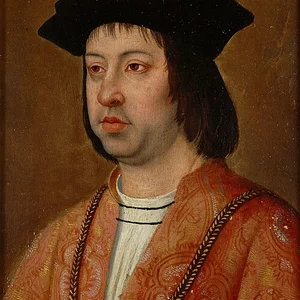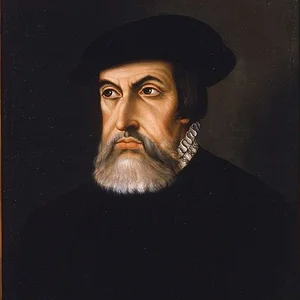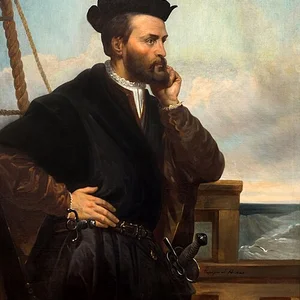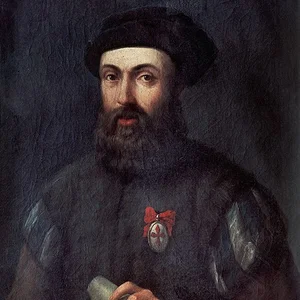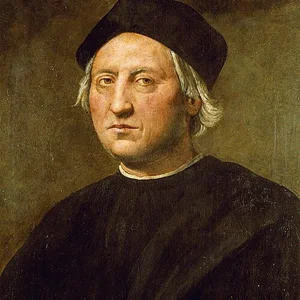

Italian navigator and explorer (1451–1506) who in 1492 completed a transatlantic voyage funded by the Catholic Monarchs of Spain. Although he was seeking a route to Asia, his expedition led to the European discovery of the American continent and marked the beginning of the colonization of the Americas.
Christopher Columbus(1451 — 1506)
Christopher Columbus
république de Gênes
7 min read
Frequently asked questions
Key Facts
- 1492: First transatlantic voyage aboard the Santa María, reaching the Caribbean
- 1492–1493: Discovery of several islands (Guanahani, Cuba, Hispaniola) which he believed to be part of Asia
- 1493–1504: Three further voyages across the Atlantic to explore the New World
- 1506: Death in Valladolid, Spain, without having understood that he had discovered a new continent
- His voyages marked the beginning of European colonization of the Americas and the end of the geographical Middle Ages
Works & Achievements
Crossing of the Atlantic with three ships (Santa María, Pinta, Niña) resulting in the European discovery of the Bahamas, Cuba, and Hispaniola. A founding event of modern history.
Expedition of 17 ships and 1,500 men to establish a permanent colony on Hispaniola. Discovery of Guadeloupe, Puerto Rico, and Jamaica.
Voyage during which Columbus reached the coasts of Venezuela, touching the South American continent for the first time. He was sent back to Spain in chains for mismanagement.
Final voyage exploring the coasts of Honduras, Nicaragua, Costa Rica, and Panama. Columbus was still searching for a passage to Asia.
A foundational document for the history of the Age of Discovery, known through the transcription made by Bartolomé de Las Casas. It describes day by day the crossing and the first encounters.
A compilation of biblical and prophetic texts through which Columbus sought to justify his voyages as a divine mission of Christianization.
Anecdotes
During his first voyage, Columbus's crew was on the verge of mutiny after weeks at sea without sighting land. Columbus reportedly kept a double logbook: one for himself with the actual distances traveled, and another underreporting the distances to reassure his anxious sailors.
On October 12, 1492, it was actually a sailor named Rodrigo de Triana who first spotted land from the crow's nest of the Pinta. Yet Columbus claimed the reward promised by the Catholic Monarchs to the first man to sight land, asserting he had seen a light the previous evening.
Columbus died in 1506 in Valladolid, convinced he had reached the coasts of Asia. He never knew that he had in fact landed on a continent unknown to Europeans. It was Amerigo Vespucci who would understand it was a 'New World', and it is his first name that gave the continent the name 'America'.
During his fourth voyage in 1504, stranded in Jamaica with a starving crew and natives refusing to resupply them, Columbus used his astronomical knowledge to predict a lunar eclipse. Impressed by this accurate prediction, the Taíno resumed providing supplies.
Columbus was sent back to Spain in chains in 1500 after his third voyage. The governor Francisco de Bobadilla, sent by the Catholic Monarchs, had arrested him for mismanagement of the colonies and brutal treatment of settlers and natives. Although quickly released, Columbus never recovered his titles as governor.
Primary Sources
At two hours after midnight the land appeared, from which we were about two leagues distant. We took in all the sails and lay to, waiting for daylight Friday, on which we arrived at a small island of the Lucayos.
I reached the Indies with the fleet which the most illustrious King and Queen our sovereigns gave me, and there I discovered a very great number of islands, peopled with inhabitants beyond number.
Your Highnesses appoint from this time forward the said Don Cristóbal Colón their Admiral in all those islands and mainlands which by his activity and industry shall be discovered or acquired in the said oceanic seas, for the duration of his life.
I have always read that the world, both land and water, was spherical. But I have now seen so much irregularity that I have come to hold another view of the world — not round, but shaped like a pear.
Key Places
Christopher Columbus's birthplace, a major merchant port on the Mediterranean where he discovered navigation and maritime trade from childhood.
Andalusian port from which Columbus's three ships departed on August 3, 1492, for his first transatlantic voyage.
Bahamian island where Columbus landed on October 12, 1492, marking first contact with the New World. He named it San Salvador.
Large Caribbean island where Columbus established the first permanent European settlement in the Americas, La Isabela, during his second voyage.
Franciscan friary near Palos where Columbus found support from the monks in championing his project before the Spanish court.
Castilian city where Christopher Columbus died on May 20, 1506, in relative disgrace, still convinced he had reached Asia.
Typical Objects
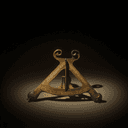
Astronomical instrument used to measure the altitude of stars and the sun to determine latitude at sea. Columbus used it during his Atlantic crossings.

Essential navigation instrument for maintaining a heading on the open sea. Columbus noted with concern the magnetic variations of the compass during his first voyage.

Fast and maneuverable lateen-rigged sailing ship, like the Niña and the Pinta. This type of Portuguese vessel was ideal for coastal exploration and long ocean crossings.

Used on board to measure time; a cabin boy had to turn it every half hour. It was the primary timekeeping instrument at sea.

Nautical chart detailing coastlines and ports, used by Mediterranean navigators. Columbus studied many such charts before conceiving his plan for a transatlantic crossing.

Daily record of navigation observations, distances traveled, and discoveries. Columbus's log, known through Las Casas's transcription, is a major historical document.

Banner bearing the arms of the Catholic Monarchs that Columbus planted on each newly discovered land to claim possession in the name of the Spanish crown.
School Curriculum
Vocabulary & Tags
Key Vocabulary
Tags
Époque
Daily Life
Morning
On board, the day begins at dawn with the changing of the watch. Columbus consults the compass and the estimated navigational position, then records his observations in the ship's log. The sailors recite morning prayers and receive their rations of hardtack and water.
Afternoon
The afternoon is devoted to observing the sky and sea to estimate the ship's position. Columbus uses the astrolabe to measure the height of the sun at noon. The sailors busy themselves with the maintenance of the sails, rigging, and hull, while the admiral studies his charts.
Evening
In the evening, Columbus observes the stars to verify the heading and records the distances traveled during the day. The crew sings religious hymns at sunset. The sailors sleep on the open deck or in cramped spaces beneath the forecastle, rotating in four-hour watch shifts.
Food
Food on board is frugal and monotonous: hardtack (galletas), salted meat or dried fish, dried legumes such as chickpeas and broad beans, cheese, garlic, and olive oil. Fresh water, stored in barrels, quickly turns stagnant; watered-down wine is also consumed.
Clothing
Columbus, as admiral, wears a doublet of velvet or fine cloth, fitted hose, and a cap. At sea, he dons a cloak to protect himself from the spray. The sailors wear simple canvas garments: a shirt, short breeches, and a wool cap.
Housing
At sea, Columbus has a cabin at the stern of the ship (the stern chamber), a small private space with a table for his charts and instruments. On land, in the colonies, the first settlements consist of wooden and thatched constructions, gradually replaced by stone buildings.
Historical Timeline
Period Vocabulary
Visual Style
Un style visuel maritime Renaissance mêlant les tons chauds des ports méditerranéens aux bleus profonds de l'Atlantique, avec des textures de parchemin et de bois vieilli évoquant les cartes et navires d'exploration du XVe siècle.
Sound Ambience
L'ambiance sonore d'une caravelle en pleine traversée atlantique : le craquement du bois, le vent dans les voiles, les ordres criés par l'équipage et le ressac des vagues, puis les sons tropicaux des îles caribéennes à l'arrivée.
Liens externes & ressources
Références
Œuvres
Premier voyage transatlantique
1492-1493
Deuxième voyage et colonisation
1493-1496
Troisième voyage : le continent
1498-1500
Quatrième voyage : l'Amérique centrale
1502-1504
Journal de bord du premier voyage
1492
Livre des Prophéties
1501-1505