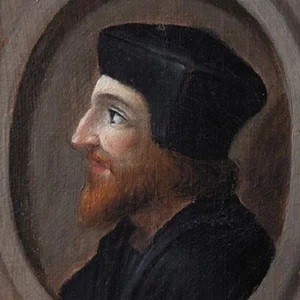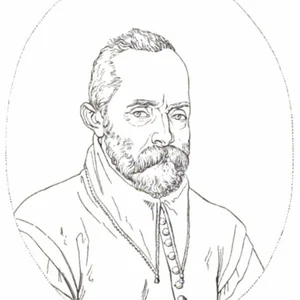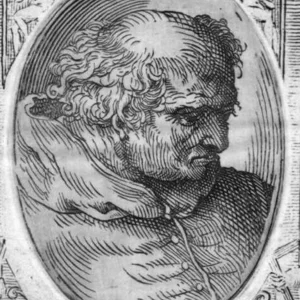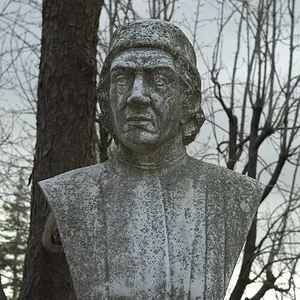

Italian Renaissance painter (c. 1435–1494), born in Urbino. He is best known as the father of Raphael, whose first master he was. His pictorial work reflects the influence of Melozzo da Forlì and the court of the Montefeltro.
Giovanni Santi
Giovanni Santi
Italie
8 min read
Frequently asked questions
Key Facts
- Born c. 1435 in Colbordolo, near Urbino
- Official painter at the court of Duke Federico da Montefeltro in Urbino
- Father of Raphael (born 1483), whom he introduced to painting
- Author of a rhyming chronicle in honour of Federico da Montefeltro
- Died in 1494, leaving his son Raphael an orphan at the age of 11
Works & Achievements
An epic poem in 23 cantos written in tribute to Duke Federico da Montefeltro. An exceptional literary source, it contains a list of the greatest artists of the age and reveals Giovanni Santi's humanist culture.
An altarpiece depicting the Virgin and Child surrounded by saints, now held at the Galleria Nazionale delle Marche in Urbino. The work reflects the influence of Melozzo da Forlì in its treatment of perspective and figures.
An altar painting commissioned for a church in Cagli, illustrating Santi's style — marked by gentle facial expressions and a luminous quality characteristic of the Quattrocento in the Marche region.
A typical Marian composition from Santi's workshop, of which several versions survive in museum collections. These works also served as teaching models for apprentices in the *bottega*, including the young Raphael.
A depiction of the duke and his heir, bearing witness to the role of official court painter held by Giovanni Santi in the service of the Montefeltro dynasty.
Anecdotes
Giovanni Santi is best known as the father and first teacher of Raphael, born on April 6, 1483, in Urbino. From his earliest years, young Raphael was learning the rudiments of painting in his father's *bottega*, holding a brush before he could even read fluently. It was in this family workshop that the greatest genius of the High Renaissance took his first artistic steps.
Giovanni Santi was not only a painter: he was also a poet, and wrote a long verse chronicle (the *Cronaca rimata*) in honor of Duke **Federico da Montefeltro**. In this text, he lists the greatest painters of his time and names **Leonardo da Vinci** and **Perugino** side by side as the two most talented artists in Italy. This literary testimony is today a valuable source for art history.
The court of Urbino, under the Montefeltro, was one of the most brilliant in Italy. Giovanni Santi worked there as official painter and enjoyed the patronage of Duke **Federico**, a passionate supporter of the arts and letters. This exceptional environment allowed Santi to mix with humanists, poets, and architects, and to provide his son Raphael with a cultural education that was rare for the time.
Giovanni Santi died in 1494, when Raphael was only eleven years old. This early loss forced the young boy to leave Urbino and train under **Perugino** in Perugia. Some historians argue that without this abrupt break, Raphael might have confined his ambitions to the local horizons of Urbino, and that his father's death paradoxically compelled him to surpass his inheritance.
Primary Sources
Giovanni Santi names among the most excellent painters of his time Leonardo da Vinci and Pietro Perugino, 'two young men equal in age and in excellence' — a unique literary testimony on the artistic hierarchy as perceived at the end of the Quattrocento.
Administrative documents attesting to commissions placed with Giovanni Santi by the Montefeltro for altarpieces and painted decorations in the churches and ducal properties in the vicinity of Urbino.
Giorgio Vasari devotes a biography to Giovanni Santi in which he describes his workshop in Urbino, his ties to the Montefeltro court, and the role he played in the early training of his son Raphael.
The record registers the birth of Raffaello di Giovanni Santi on 6 April 1483, confirming the direct line of descent and the Santi family's membership in the artisan middle class of Urbino.
Key Places
Court-city of the Montefeltro dukes, a leading intellectual and artistic center of the Quattrocento. This is where Giovanni Santi lived, worked, and trained his son Raphael in his *bottega*.
Ducal residence of the Montefeltro, an architectural masterpiece of the Italian Renaissance. Giovanni Santi carried out official commissions there and took part in the cultural life of the Montefeltro court.
A small town in the Marche region considered the birthplace of Giovanni Santi around 1435, in the territory of Urbino.
A small town in the Marche where Giovanni Santi carried out several religious commissions, including an altarpiece preserved in the church of San Domenico.
A coastal town in the Marche where Giovanni Santi received commissions and maintained professional ties with other workshops along the Adriatic coast.
Typical Objects

A fundamental tool of the Renaissance painter, crafted from sable hairs set into a quill tube. Giovanni Santi used brushes of varying sizes for highlights, flesh tones, and drapery.

The traditional support of Italian Quattrocento painting, made from poplar planks coated with several layers of gesso (a mixture of plaster and animal glue). This is the type of panel on which Giovanni Santi painted his altarpieces and Madonnas.

Colors were prepared by hand in the bottega from ground minerals mixed with a binding medium (oil or egg for tempera). Lapis lazuli, imported from Afghanistan, was worth its weight in gold and was reserved for the Virgin's mantle.

A full-scale drawing traced on thick paper, used to transfer a composition onto a panel or the fresh plaster of a fresco by pouncing. Giovanni Santi taught Raphael the art of the cartoon from his very first lessons.

At the court of Urbino, Giovanni Santi moved among the scholars and scribes of Duke Federico's celebrated library. Illustrated manuscripts served as iconographic and stylistic models for court painters.

A plucked string instrument ubiquitous at the Italian courts of the Renaissance. Giovanni Santi, himself a poet and man of culture, was immersed in an environment where music and the visual arts were intimately intertwined; Raphael would later paint lute-playing angels in his own works.
School Curriculum
Vocabulary & Tags
Key Vocabulary
Daily Life
Morning
Giovanni Santi began his day at dawn in his bottega in Urbino, where his apprentices were already grinding pigments and preparing egg tempera mixtures. He assigned tasks among his assistants, supervised the preparation of gesso-coated panels, and personally drew the first lines of the more important compositions. His young son Raphael would watch, ask questions, and practice on small scraps of wood.
Afternoon
The afternoon was devoted to painting proper: applying layer upon layer with extreme care, Giovanni Santi worked the dark grounds first before gradually lightening the flesh tones and drapery. He sometimes received patrons who came to inspect the progress of altarpieces, or visited the Palazzo Ducale to present his sketches to the duke's advisors.
Evening
In the evening, by candlelight, Giovanni Santi set down his brushes and picked up his poet's quill. He worked on the stanzas of his *Cronaca rimata*, searching for rhymes in hendecasyllables to celebrate the virtues of Duke Federico. The family gathered for the evening meal, and young Raphael listened to his father recite his verses — immersed as much in literary culture as in the world of painting.
Food
Like most prosperous Italian craftsmen of the Quattrocento, Giovanni Santi ate dark bread, legumes (broad beans, chickpeas), seasonal vegetables, cheeses, and cured meats. On feast days, he could afford poultry or fresh fish, washed down with wine from the Marche hills. His presence at court occasionally gave him access to ducal banquets, where culinary abundance reflected the prestige of the Montefeltro.
Clothing
In his workshop, Giovanni Santi wore a smock or dark leather apron to protect his clothes from paint splashes. Outside of work, he dressed as a respected craftsman: a coat of plain woolen cloth in muted colors (brown, slate blue) and a short cloak. During visits to court, he took greater care with his appearance, wearing finer fabrics to look worthy of his standing as ducal painter.
Housing
The Santi family lived in a house in Urbino, part of which was fitted out as a workshop on the ground floor to accommodate large panels and works in progress. Raphael's birthplace, preserved in Urbino and today converted into a museum, offers a faithful glimpse of the domestic and professional space of a fifteenth-century court painter.
Historical Timeline
Period Vocabulary
Liens externes & ressources
Références
Œuvres
Cronaca rimata (Chronique rimée de Federico da Montefeltro)
vers 1482-1494
Pala di Montefiorentino (Retable de Montefiorentino)
vers 1489
Vierge à l'Enfant avec saints
vers 1488
Portrait de Federico da Montefeltro et Guidobaldo
vers 1480