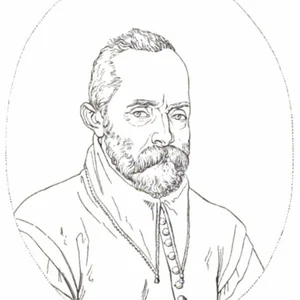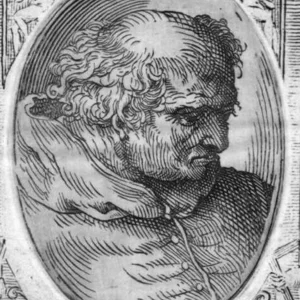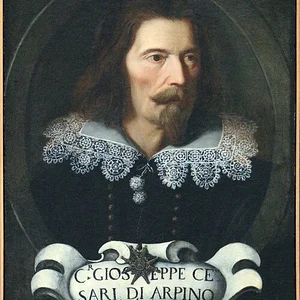

Italian Mannerist painter (1568–1640), Giuseppe Cesari was one of the most fashionable artists in Rome at the end of the sixteenth century. He worked for several popes and was the first master of the young Caravaggio. His frescoes adorn the Basilica of Saint John Lateran and the Capitoline Hill, among other sites.
Giuseppe Cesari(1568 — 1640)
Cavalier d'Arpino
États pontificaux, royaume de Naples
9 min read
Frequently asked questions
Key Facts
- Born in 1568 in Arpino (Lazio), died in 1640 in Rome
- Worked in Rome from adolescence, noticed by Pope Gregory XIII
- Ran the workshop where the young Caravaggio began his career around 1593
- Created the mosaics for the dome of Saint Peter's Basilica in Rome (1603–1612)
- Appointed Knight of the Order of Christ by Pope Clement VIII, hence his nickname
Works & Achievements
A monumental cycle depicting the apostles in the central nave, commissioned by Pope Clement VIII. This is the Cavalier d'Arpin's masterwork, in which he asserts his elegant Mannerist style at the heart of Catholic Christendom.
A vast fresco cycle illustrating legendary episodes from ancient Rome, a titanic undertaking pursued over forty years. This long-term project testifies to the Cavalier d'Arpin's central role in the official decoration of Rome.
Among the young Cesari's earliest major commissions, these frescoes in the chapel adjacent to the Scala Sancta immediately earned him a considerable reputation among Rome's ecclesiastical authorities.
A mythological painting depicting the Greek hero freeing the princess from the sea monster, revealing the Cavalier d'Arpin's decorative virtuosity in the secular subjects so prized by aristocratic collectors.
A mythological composition of great Mannerist grace, depicting the goddess of the hunt gazing upon the sleeping shepherd. This work perfectly illustrates the refined aesthetic that Cesari set against the brutal naturalism of Caravaggio.
A religious painting on a theme much favored in the Counter-Reformation context, in which the Cavalier d'Arpin displays his gifts as a colorist and his mastery of elegant figural movement amid the rising Baroque style.
Anecdotes
Around 1593, the young Caravaggio entered the workshop of the Cavaliere d'Arpino as an apprentice. Overwhelmed with prestigious commissions, Cesari assigned him primarily the painting of flowers and fruit — tasks considered minor. No one suspected at the time that this humble assistant would go on to revolutionize European painting and one day eclipse his own master.
In 1607, Cardinal Scipione Borghese, nephew of Pope Paul V, had the Cavaliere d'Arpino arrested on the pretext of tax fraud. His paintings and drawings were confiscated and absorbed into the Borghese collection. This spectacular seizure explains why the Galleria Borghese holds one of the most important collections of his works today.
Pope Clement VIII was so impressed by Giuseppe Cesari's talent that he bestowed upon him the honorary title of Knight of the Golden Spur, an exceptionally rare distinction granted to only a handful of outstanding artists. From that point on, the painter signed his works 'Cavaliere d'Arpino' — the name by which he would be remembered by posterity.
At barely fifteen years old, the young Giuseppe Cesari secured his first commissions at the Vatican, impressing the papal court with an artistic maturity extraordinary for his age. This precocity immediately opened the doors of the pontifical workshops to him and ensured a meteoric rise.
By a twist of fate, the Cavaliere d'Arpino — who had reigned as absolute master of Roman painting in the 1590s — was ultimately eclipsed by his own former apprentice. Caravaggio, whom he had deemed fit only to paint still lifes, would go on to radically transform Western art with his striking realism and dramatic use of light.
Primary Sources
Michelangelo da Caravaggio stette a lavorare da Giuseppe d'Arpino per qualche mesi, dove si occupò di dipingere fiori e frutti così bene imitati che da allora in poi quella maniera è molto cresciuta.
Giuseppe Cesari d'Arpino era tenuto il primo pittore di Roma, e lavorava per i pontefici con grande onore e ricompensa, essendo favorito da Clemente VIII che lo creò cavaliere.
Michelangelo [Caravaggio] si pose a lavorare nella bottega di Giuseppe Cesari detto il Cavalier d'Arpino, allora in grande riputazione, dipingendo fiori e frutte ; ma presto si separò per seguire la sua propria maniera fondata sul naturale.
Der Ritter Joseph von Arpin war zu seiner Zeit einer der berühmtesten Maler Roms und hatte viele Schüler, unter welchen auch der berüchtigte Caravaggio gezählt wurde.
Key Places
A small town in southern Latium where Giuseppe Cesari was born in 1568, which gave him his famous nickname 'Cavalier d'Arpin'. He maintained family ties there throughout his life.
Rome was the stage for the Cavalier d'Arpin's entire career. He ran a thriving workshop there with many apprentices, including the young Caravaggio, and died in the city in 1640 after sixty years of intense creative output.
The "mother of all churches" houses the Cavalier d'Arpin's monumental frescoes depicting the apostles in the central nave, painted between 1599 and 1605 on the commission of Clement VIII. It remains his most prestigious commission.
The Cavalier d'Arpin spent several decades working in the Hall of the Horatii and Curiatii in this palace, illustrating founding episodes of ancient Roman history in a fresco cycle that remained unfinished at his death.
From adolescence, Giuseppe Cesari worked in the Vatican Loggie under the guidance of experienced masters. These early papal commissions launched his career and earned him the direct patronage of successive popes.
Typical Objects

Made from marten or polecat hair bound to wooden handles, brushes were the essential tools of the Mannerist painter. The Cavaliere d'Arpino owned varied sets for the fine details of faces as well as the large surfaces of frescoes.

A large drawing on heavy paper at the final scale of the work, used to refine a composition before transferring it to the wall by pouncing. The Cavaliere d'Arpino produced highly elaborate cartoons for his large papal frescoes, testaments to his mastery of draughtsmanship.

The Mannerist palette included costly pigments such as lapis lazuli (ultramarine blue, imported from Afghanistan), vermilion (bright red), and ochre earths. These precious raw materials determined the quality and price of an artistic commission.

A wooden structure erected against the walls and ceilings of basilicas, allowing the painter to work at height on still-fresh plaster. The Cavaliere d'Arpino spent years on scaffolding to execute his great frescoes at the Lateran and on the Capitoline Hill.

Following his ennoblement by Clement VIII, Cesari wore the dress of a Roman gentleman: a dark velvet doublet, starched ruff, sword at his side, and cloak. This attire reflected his exceptional social standing as an ennobled painter — a rare distinction for the era.

An official document from the papal chancery formalising a major artistic commission, specifying the subject, format, deadline, and payment. The Cavaliere d'Arpino received several of these precious parchments throughout his career in the service of Clement VIII and his successors.
School Curriculum
Vocabulary & Tags
Key Vocabulary
Tags
Daily Life
Morning
The Cavalier d'Arpin began his day at dawn with morning prayers, a devout practice essential for an artist working primarily for the glory of the Church. He would then make his way to his workshop to oversee his many apprentices, review the previous day's work, and assign tasks before tackling the most delicate parts of the compositions himself.
Afternoon
The afternoon was devoted to painting proper, often on scaffolding in basilicas or palaces. On fresco sites, one had to paint 'al fresco' — that is, on wet plaster applied that morning before it dried — an intense physical constraint demanding absolute speed and precision. In the studio, he worked more freely on his easel compositions.
Evening
In the evenings, the Cavalier d'Arpin frequented the salons of cardinals and Roman nobles, a world to which his title opened the doors. These social engagements were not mere pleasure: it was there that relationships with patrons were forged, contracts negotiated, and an artist's reputation built. He sometimes took part in sessions of the Accademia di San Luca, where painters and men of letters debated art and Antiquity.
Food
The table of an ennobled painter like Cesari reflected his elevated status: white bread, roasted meats, fish during Lent, fresh vegetables from the Roman market (artichokes, broad beans, squash), and wines from Latium. The fasting days imposed by the Church — numerous in the sixteenth century — set the rhythm of every Roman's diet, even the wealthiest, with meals based on fish and legumes.
Clothing
After his ennoblement, Giuseppe Cesari wore the attire of a Roman gentleman: a dark velvet doublet, a starched ruff at the collar, silk stockings, and for formal occasions, a cloak and sword — the mark of knightly rank. In the studio, he naturally wore work clothes protected by a leather apron to avoid soiling his outfits when handling pigments.
Housing
The Cavalier d'Arpin resided in a well-appointed bourgeois house in Rome, spacious enough to accommodate both his private apartments and his workshop. There he kept his collections of preparatory drawings, precious pigments, tools, and works in progress. His social standing required him to maintain a house befitting a knight, with servants and refined décor.
Historical Timeline
Period Vocabulary
Liens externes & ressources
Références
Œuvres
Fresques de la Basilique Saint-Jean-de-Latran
1599-1605
Diane et Endymion
vers 1602