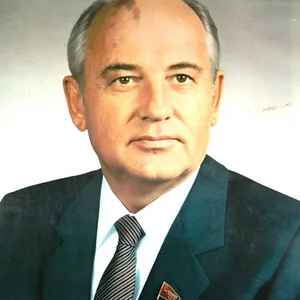

Last General Secretary of the Soviet Union (1985–1991), Gorbachev initiated sweeping reforms with Perestroika and Glasnost, transforming the USSR before its dissolution in 1991. His actions marked the end of the Cold War and the restructuring of the Soviet bloc.
Gorbachev(1931 — 2022)
Gorbachev
Union soviétique, Russie
6 min read
Frequently asked questions
Famous Quotes
« Perestroika is an absolute necessity.»
« We cannot continue to live as before.»
Key Facts
- 1985: Becomes General Secretary of the Communist Party and launches Perestroika (economic and political restructuring)
- 1986: Introduces Glasnost (openness), allowing greater freedom of expression
- 1989: End of Soviet dominance in Eastern Europe and fall of the Berlin Wall
- 1991: Dissolution of the USSR on December 26, end of his term as President of the USSR
- 1990: Awarded the Nobel Peace Prize for his contribution to ending the Cold War
Works & Achievements
Vast programme of economic and political reforms aimed at modernising the USSR. Perestroika introduced elements of a market economy and decentralised planning.
Policy of openness and freedom of expression that put an end to Soviet censorship. It allowed public criticism of the regime and freed the press.
First nuclear disarmament agreement to eliminate an entire category of missiles. It marked a decisive turning point in the end of the arms race.
Decision to withdraw Soviet troops from Afghanistan after nine years of war. This withdrawal, completed in February 1989, brought an end to a costly and unpopular conflict.
Work in which Gorbachev sets out his vision of the necessary reforms. Translated into many languages, it became an international bestseller.
Gorbachev accepted the reunification of Germany within NATO in exchange for security guarantees. This decision transformed the geopolitical map of Europe.
Anecdotes
In 1985, during his first official visit to Great Britain, Margaret Thatcher said of Gorbachev: "This is a man one can do business with." This phrase became famous and marked a turning point in East-West relations.
At the Reykjavik summit in October 1986, Gorbachev and Reagan came close to agreeing on the total elimination of nuclear weapons. Negotiations failed over the American space defense program (SDI), but the summit paved the way for the INF Treaty of 1987.
Following the Chernobyl disaster in April 1986, Gorbachev was initially criticized for the Soviet authorities' early silence. The event convinced him of the absolute necessity of Glasnost and transparency in state governance.
On December 25, 1991, Gorbachev announced his resignation on Soviet television in a sober twelve-minute address. That same evening, the red flag was lowered from the Kremlin for the last time, replaced by the Russian tricolor.
Gorbachev received the Nobel Peace Prize in 1990 for his role in ending the Cold War. Paradoxically, he was at that time sharply criticized in his own country, where many blamed him for the economic collapse and the loss of Soviet power.
Primary Sources
We need democracy like we need air. If we do not understand this, if we do not find the means to put democratization into practice, our policy of Perestroika will be doomed to failure.
The use of force or the threat of force can no longer be instruments of foreign policy. The principle of freedom of choice is mandatory. Failure to respect this principle constitutes a violation of international law.
I am terminating my activities as President of the USSR. I am making this decision on account of the situation that has developed with the formation of the Commonwealth of Independent States. Fate had it that when I came to lead the state, it was already clear that something was wrong in this country.
Perestroika is not a change of scenery. It is a bold and revolutionary attempt to develop socialist society in a coherent and comprehensive manner, giving it the most modern forms of organization.
Both parties agree to eliminate their ground-launched ballistic and cruise missiles with a range between 500 and 5,500 kilometers, within a period of three years.
Key Places
Seat of Soviet power where Gorbachev served from 1985 to 1991. It was from his office that he delivered his resignation speech.
Site of the historic 1986 summit between Gorbachev and Reagan. Although it did not result in an agreement, the summit revived the disarmament process.
Gorbachev's birthplace in southern Russia, where he was born in 1931. His rural childhood shaped his understanding of the hardships faced by the Soviet people.
Symbol of the East-West divide. The fall of the Wall in 1989, made possible by the Soviet non-intervention decided by Gorbachev, was celebrated here.
Presidential dacha where Gorbachev was placed under house arrest during the attempted coup of August 1991. He spent three days there, cut off from the outside world.
Typical Objects

Direct communication line between Moscow and Washington. Gorbachev used it frequently in his exchanges with Reagan and then Bush to defuse tensions.

Strategic map of the USSR's allied countries. Under Gorbachev, this map gradually shrank as Eastern European countries broke free.

Official files of the CPSU's political bureau. Gorbachev used them to propose his major Perestroika and Glasnost reforms.

Official newspaper of the Communist Party. Under Glasnost, the Soviet press began publishing critical articles, something previously unthinkable.

Symbolic instrument of Gorbachev's diplomacy. Gorbachev signed historic disarmament agreements with American presidents.

Red star badge worn by Party members. Gorbachev was the last leader to wear this badge as head of the USSR.
School Curriculum
Vocabulary & Tags
Key Vocabulary
Daily Life
Morning
Gorbachev started his days early at the Kremlin, going through intelligence reports and diplomatic dispatches. He typically held a morning meeting with his closest advisors to set the priorities for the day.
Afternoon
Afternoons were devoted to Politburo sessions, meetings with leaders of the Soviet republics, or diplomatic receptions. Gorbachev also spent time preparing his speeches and monitoring the progress of economic reforms.
Evening
In the evenings, Gorbachev would spend time with his wife Raisa, with whom he maintained a very close and unusual relationship for a Soviet leader. They often discussed politics and culture. He read late into the night, particularly works of philosophy and history.
Food
Gorbachev's diet was relatively simple, true to his peasant roots from the North Caucasus. He enjoyed traditional Russian dishes such as borscht and pirozhki. Unlike several of his predecessors, he was known for his sobriety regarding alcohol and even led an anti-alcohol campaign in 1985.
Clothing
Gorbachev wore the classic dark suit of Soviet leaders, but with a more modern and Western cut than his predecessors. When traveling abroad, his polished dress style stood in sharp contrast to the austere image of former Kremlin leaders. His famous birthmark on his forehead became a distinctive mark recognized around the world.
Housing
Gorbachev resided in an official apartment at the Kremlin and had a state dacha in Foros, Crimea, for vacations. These residences, though comfortable by Soviet standards, remained more modest than those of some of his predecessors such as Brezhnev.
Historical Timeline
Period Vocabulary
Visual Style
Style visuel mêlant le réalisme soviétique tardif et le photojournalisme des années 1980, entre monumentalisme du Kremlin et vent de changement, dans des tons gris, rouges sombres et dorés.
Sound Ambience
Ambiance sonore de la fin de l'ère soviétique, mêlant les cloches du Kremlin, les murmures des couloirs diplomatiques et les bruits de la presse internationale couvrant les réformes historiques.
Liens externes & ressources
Références
Œuvres
Perestroïka (restructuration)
1985-1991
Glasnost (transparence)
1986-1991
Traité FNI (Forces Nucléaires Intermédiaires)
1987
Retrait d'Afghanistan
1988-1989
Perestroïka : Vues neuves sur notre pays et le monde (livre)
1987
Accords de réunification allemande
1990