
Argentine Marxist revolutionary (1928–1967) and iconic figure of 20th-century guerrilla warfare. A key player in the Cuban Revolution alongside Fidel Castro, he went on to lead revolutionary movements in Africa and Latin America before his death in Bolivia.
Che Guevara(1928 — 1967)
Che Guevara
Cuba, Argentine
7 min read
Frequently asked questions
Famous Quotes
« A revolutionary must be driven by feelings of love and intense hatred»
« The revolution is not an apple that falls when it is ripe; you have to make it fall»
Key Facts
- 1956: Takes part in the Granma landing alongside Fidel Castro, marking the start of the Cuban Revolution
- 1959: Victory of the Cuban Revolution; Che becomes Minister of Industry in Cuba
- 1965: Resigns his position in Cuba to lead a guerrilla campaign in equatorial Africa, then in Bolivia
- 1967: Captured and executed on October 8 in Bolivia, becoming an icon of revolutionary rebellion
- Major influence on Latin American and international revolutionary movements
Works & Achievements
A personal journal of his formative journey across Latin America, which became a classic of travel literature and a testimony on the continent's inequalities.
A theoretical and practical manual on rural guerrilla warfare, which became a reference for revolutionary movements in the Third World.
A major essay on his vision of socialism and the creation of the 'new man', grounded in revolutionary consciousness rather than material incentives alone.
Che's final diary, a daily chronicle of the Bolivian guerrilla campaign that ends with his capture and execution.
As a government official, he supported this massive campaign which reduced illiteracy in Cuba from 23% to under 4% in a single year.
Active participation in the redistribution of agricultural land in Cuba, ending large latifundist estates in favor of peasant farmers.
Anecdotes
Ernesto Guevara suffered from severe asthma since childhood, which never prevented him from leading exhausting military expeditions through the jungle. He always carried his inhaler during guerrilla campaigns, and his fellow combatants testified that he regularly suffered from nocturnal attacks.
In 1952, the young Ernesto embarked with his friend Alberto Granado on a motorcycle journey across South America on an old Norton 500 nicknamed "La Poderosa" (the Mighty One). This eight-month odyssey, spent in close contact with the poverty of indigenous and working-class populations, profoundly transformed his worldview and forged his political consciousness.
Che Guevara was a passionate and compulsive reader. Even in the midst of guerrilla warfare in the Sierra Maestra, he carried books in his backpack and organized literacy classes for peasants and illiterate fighters between battles.
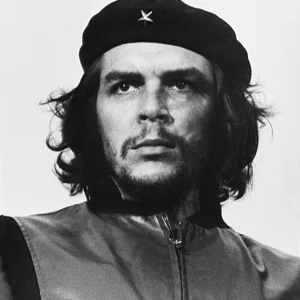
The famous photograph of Che, "Guerrillero Heroico", taken by Alberto Korda on March 5, 1960 during a funeral ceremony in Havana, has become one of the most reproduced images in the world. Korda never collected any royalties, believing the image belonged to the people.
After the victory of the Cuban Revolution, Guevara was appointed president of the National Bank of Cuba in 1959. He signed banknotes simply as "Che", which shocked traditional financial circles but became a symbol of rupture with the old order.
Primary Sources
I feel my nostrils dilate, savoring the acrid smell of gunpowder and blood. I feel my ribs like a raging animal and I sense within me the will to kill, ready to be unleashed.
Other lands of the world call for the contribution of my modest efforts. I can do what is denied to you because of your responsibility at the head of Cuba, and the hour of parting has come.
We want to build socialism. We have declared that we are supporters of those who fight for the liberation of peoples, everywhere in the world. We condemn all forms of exploitation of man by man.
Let me say, at the risk of seeming ridiculous, that the true revolutionary is guided by great feelings of love. It is impossible to think of an authentic revolutionary without this quality.
The morale of the troop is low and physical condition deteriorates day by day. The peasants are not joining us and the situation is becoming critical.
Key Places
Mountain range in eastern Cuba where Che and the Cuban revolutionaries waged their guerrilla campaign against Batista's regime from 1956 to 1959.
City where Che won a decisive battle in December 1958, forcing the fall of Batista's regime. His mausoleum stands there.
Cuban capital where Guevara served as Minister of Industry and president of the National Bank after the revolution.
Small Bolivian village where Che was captured and executed on October 9, 1967, now a place of pilgrimage.
Birthplace of Ernesto Guevara, where he was born on June 14, 1928, into an Argentine middle-class family.
City where Guevara met Fidel Castro in 1955 and trained with the future revolutionaries before the landing in Cuba.
Typical Objects

The Che's emblematic headwear adorned with a commander's star, which became the worldwide symbol of rebellion and revolution.

Che regularly smoked cigars, a habit he picked up in Cuba that became an integral part of his iconic image.

An indispensable item he carried at all times, even in the midst of guerrilla warfare, to manage his chronic asthma attacks.

A weapon he frequently used during the guerrilla campaign in the Sierra Maestra, emblematic of the fighter he had become.

Che kept a detailed journal of his campaigns and always carried works of philosophy, economics, and literature.

An essential tool for communication and propaganda during guerrilla campaigns, most notably Radio Rebelde, founded in the Sierra Maestra.

Guevara documented his travels and campaigns. His photographs now constitute an important historical source.
School Curriculum
Vocabulary & Tags
Key Vocabulary
Tags
Daily Life
Morning
In the Sierra Maestra, Che would rise at dawn, often after a night marked by asthma attacks. He started the day with a maté, a drink inherited from his native Argentina, then studied maps and planned the column's movements with his officers.
Afternoon
Afternoons were devoted to jungle marches, training new recruits, and making contact with local peasants. Che also provided medical care to fighters and villagers, drawing on his training as a physician.
Evening
Evenings at camp were dedicated to reading and writing in his journal. He organized literacy sessions for illiterate guerrillas and held strategic meetings by the light of a lamp or campfire.
Food
Food in the guerrilla was sparse and irregular: rice, black beans, hunted meat when available, tropical fruits picked along the way. Cuban coffee and Argentine maté were his drinks of choice. Periods of scarcity were frequent in Bolivia.
Clothing
Che wore the typical guerrilla uniform: olive green fatigues, worn combat boots, a cartridge belt, and his iconic black beret adorned with a star. As a minister in Havana, he often kept his military attire as a rejection of bourgeois conventions.
Housing
During the guerrilla campaign, he slept on the ground in hammocks or under makeshift jungle shelters. In Havana after the revolution, he lived in modest quarters, refusing privileges. His office at the Ministry of Industry sometimes served as a bedroom during long working nights.
Historical Timeline
Period Vocabulary
Visual Style
Un style visuel inspiré de la photographie en noir et blanc à fort contraste des années 1960, évoquant le photojournalisme révolutionnaire et l'esthétique des affiches de propagande cubaines, avec des touches de vert jungle et de rouge révolutionnaire.
Sound Ambience
L'ambiance sonore de la jungle tropicale cubaine et bolivienne, mêlant les bruits de la nature luxuriante aux sons discrets d'un campement de guérilleros — feu de camp, radio clandestine et conversations à voix basse.
Liens externes & ressources
Références
Œuvres
Diarios de motocicleta (Voyage à motocyclette)
1952 (publié en 1993)
La Guerre de guérilla
1960
Le Socialisme et l'Homme à Cuba
1965
Journal de Bolivie
1966-1967 (publié en 1968)
Campagne nationale d'alphabétisation à Cuba
1961
Réforme agraire cubaine
1959