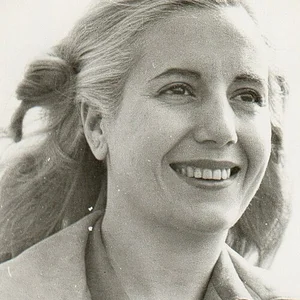

Eva Perón, wife of Argentine president Juan Perón, became one of the most influential political figures in Latin America. A symbol of the descamisados (shirtless ones), she fought for workers' and women's rights, notably securing women's suffrage in Argentina in 1947.
Eva Perón(1919 — 1952)
Eva Perón
Argentine
8 min read
Frequently asked questions
Famous Quotes
« I prefer to be known as Evita rather than Eva Perón, because Evita is the name the humble people gave me.»
« I only ask that those who know the suffering of the people always stand by their side.»
Key Facts
- Born in 1919 in Los Toldos into a modest family, she left the province for Buenos Aires at 15 to pursue an acting career
- She met Juan Perón in 1944 at a charity gala and became his companion, then married him in 1945
- In 1947, she secured the passage of a law granting Argentine women the right to vote
- She founded the Eva Perón Foundation in 1948, which funded schools, hospitals, and social housing for the most destitute
- She died of cancer at just 33 years old in 1952, causing immense national mourning in Argentina
Works & Achievements
Eva was the primary architect of the law granting Argentine women the right to vote. She conducted two years of intense lobbying in Congress, permanently transforming the Argentine political landscape.
Social foundation managing thousands of schools, hospitals, and shelters for single women and children. It redistributed resources directly to the poorest by bypassing traditional bureaucracy, reaching millions of Argentines.
Feminine branch of the Peronist movement founded and personally led by Eva. This party mobilized newly enfranchised women voters and secured a massive female electoral base for Peronism in the 1951 elections.
An autobiographical and ideological work describing her vision of Peronism, the condition of women, and social justice. Made compulsory in Argentine schools, it served as a major instrument of Peronist propaganda.
Diplomatic tour of Europe (Spain, Italy, France, Portugal, Switzerland) aimed at improving the international image of Peronist Argentina. She met with Franco, Pope Pius XII, and various European heads of state.
Manuscript written by Eva shortly before her death, more radical than 'La razón de mi vida', calling for social revolution. Suppressed by orthodox Peronists, it was not published until 1987.
Anecdotes
Eva Perón was born María Eva Duarte on May 7, 1919, in Los Toldos, the illegitimate daughter of an estanciero. This humble and stigmatized origin profoundly shaped her personality: throughout her life, she fought class prejudice with an intensity that her supporters attributed to her own experience of poverty and social exclusion.
At 15, Eva left her province for Buenos Aires with the ambition of becoming an actress. She started in minor theater productions and radio serials, gradually gaining recognition. It was at a charity gala for victims of an earthquake in January 1944 that she met Colonel Juan Perón — an encounter that would change the course of her life and Argentine history.
October 17, 1945, is a mythic date in Peronist history: when Perón was imprisoned by his military rivals, thousands of workers (the descamisados, 'shirtless ones') converged on the Plaza de Mayo in Buenos Aires. Eva played an essential role in mobilizing this popular support. Perón was released, and the event became the Peronist national holiday.
During her 1947 European tour (the 'Rainbow Tour'), Eva received a triumphant welcome in Spain, where Franco awarded her the Grand Cross of Isabella the Catholic. She also met Pope Pius XII in Rome. However, in France and England the reception was cooler, as some governments looked unfavorably upon Argentina's ties to the Axis during the war.
Diagnosed with cervical cancer in 1952, Eva Perón long refused to acknowledge the severity of her illness. When she died on July 26, 1952, at just 33 years old, the national mourning lasted weeks. Her embalmed body, prepared by Dr. Pedro Ara, then had a remarkable odyssey: seized by the military junta in 1955, it was hidden in Europe for seventeen years before being returned to Perón in 1971.
Primary Sources
I prefer to be Evita, rather than the wife of the President, if this 'Evita' serves to make the nickname a bridge of love between the shirtless ones and Perón.
Mi decisión definitiva e irrevocable es y será la que considere corresponde a los intereses del general Perón y a los de la Patria, y esto lo resolveré yo misma, según mi conciencia.
Argentine women have won the right to citizenship. We are equal before the law. Equal before the Homeland. But we are not equal in action.
Quiero vivir eternamente con Perón y con mi pueblo. Ésta es mi absoluta voluntad y éste es mi deseo más profundo.
Key Places
Eva Duarte's birthplace, in the Argentine pampas. Her illegitimate birth in this poor village forged her identification with the working classes.
The iconic square facing the Casa Rosada where Eva delivered her great speeches to the descamisados. October 17, 1945 marked the birth of Peronism as a mass movement.
Headquarters of the social foundation created in 1948, which managed hospitals, schools, homes for young women, and the distribution of aid. It embodied the social arm of the Peronist government.
Buenos Aires' grand opera house where Eva attended official performances as Primera Dama, a symbol of her spectacular social ascent.
The affluent neighborhood of Buenos Aires home to the famous cemetery where Eva is ultimately interred. The historical irony is that the woman of the people rests in the cemetery of the Argentine aristocracy.
Typical Objects

A visual symbol of Eva Perón, her severe bun and bleached hair became an iconic signature. This austere yet elegant hairstyle contrasted with her humble origins and asserted her public authority.

Before becoming First Lady, Eva was a radio actress. Radio remained her preferred tool for speaking directly to the Argentine people, with an emotional and populist oratorical style.

Autobiography published in 1951, a true founding text of female Peronism. Distributed to every Argentine school, it was made compulsory on the school curriculum during the Perón years.

The Foundation distributed thousands of packages containing toys, clothing and food to poor families. These distributions symbolised the direct bond between Eva and the descamisados.

During her 1947 European tour, Eva wore gowns by leading Parisian couturiers, drawing admiration and criticism in equal measure. Her taste for elegance was interpreted as a symbolic act of revenge against her origins.

At official ceremonies and parades, Eva frequently received crowns of white flowers from the crowd. White flowers became a symbol of the virginal and sacrificial image cultivated by Peronism.
School Curriculum
Vocabulary & Tags
Key Vocabulary
Tags
Daily Life
Morning
Eva rose early, often before dawn, and immediately began receiving trade union delegations or representatives of working-class communities at the Ministry of Labor. She was known to work up to eighteen hours a day, refusing to abide by official schedules. Her mornings were dominated by audiences with the 'descamisados' who came seeking help and support.
Afternoon
Afternoons were devoted to managing the Eva Perón Foundation: meetings with hospital and school directors, overseeing the distribution of food parcels and toys. Eva personally intervened in many individual cases, writing handwritten notes to unlock aid. She also received ambassadors and participated in official ceremonies alongside Perón.
Evening
Official evenings included diplomatic receptions, performances at the Teatro Colón, or charity galas. Eva still worked late into the night, reading files or preparing her radio addresses. At the presidential residence in Olivos, she would spend a few moments with her loved ones and her dogs, of whom she was very fond.
Food
Eva ate little and simply, more out of lack of time than any taste for asceticism. She preferred traditional Argentine creole cuisine: locro (a corn and meat stew), empanadas, and dulce de leche. Her collaborators reported that she frequently skipped meals, absorbed by her work.
Clothing
Eva maintained an impeccable and polished appearance, a symbol of her social revenge over her modest origins. She wore strict-cut suits in dark colors during her working days, and gowns from renowned fashion houses (Paquin, Dior during her European tour) for official ceremonies. Her platinum blonde chignon, tight and austere, was her visual signature recognized throughout the country.
Housing
Eva and Juan Perón resided at the presidential residence in Olivos, in the northern suburbs of Buenos Aires, and also occupied apartments at the Casa Rosada for official working days. The Olivos residence was comfortable but relatively modest for a head of state. Contrary to the image her detractors projected onto her, Eva did not surround herself with ostentatious luxury in her daily life.
Historical Timeline
Period Vocabulary
Visual Style
Le style visuel d'Eva Perón mêle l'élégance Art Déco des années 1940, l'iconographie politique péroniste aux tons rouge et or, et une esthétique quasi-religieuse qui transforma la Primera Dama en figure mythique de l'Argentine populaire.
Sound Ambience
L'univers sonore d'Eva Perón est celui des grandes foules péronistes sur la Plaza de Mayo, des discours radiophoniques enflammés et de la Buenos Aires ouvrière des années 1940-1950, portée par le tango et l'effervescence politique.
Liens externes & ressources
Références
Œuvres
Suffrage féminin en Argentine (Loi 13.010)
1947
Fundación Eva Perón
1948
Partido Peronista Femenino
1949
La razón de mi vida (autobiographie)
1951
Gira del Arco Iris (tournée européenne)
1947
Mi mensaje (œuvre posthume)
1952 (publié 1987)