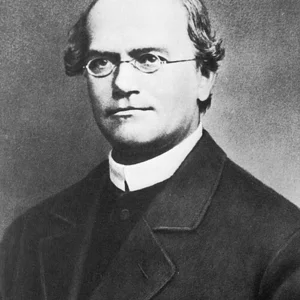

Moravian monk and naturalist (1822–1884), Gregor Mendel is the founder of modern genetics. Through his experiments with pea plants, he discovered the fundamental laws of heredity that govern the transmission of traits from one generation to the next.
Frequently asked questions
Key Facts
- 1843: Enters the Augustinian monastery in Brno (Moravia)
- 1866: Publication of his results on plant hybridization, including the discovery of the three laws of heredity
- 1868: Becomes abbot of the Brno monastery
- 1875–1884: His work is forgotten before being rediscovered in 1900 by three independent botanists
- 1884: Dies in Brno without seeing his discoveries recognized
Works & Achievements
The founding article of genetics, in which Mendel presents his two laws of heredity (segregation and independent assortment) based on eight years of experiments on peas. It would remain ignored for thirty-five years.
Eight years of experimental work involving 29,000 pea plants: Mendel carefully crossed pure varieties across seven traits and statistically analyzed the results over three generations.
The second scientific article published by Mendel, devoted to hawkweed (Hieracium) hybrids. The results, atypical due to the asexual reproduction characteristic of this genus, did not confirm his laws and discouraged him from continuing.
A series of letters exchanged with the eminent Swiss botanist, in which Mendel defends his conclusions and attempts to obtain scientific recognition that would never come during his lifetime.
Anecdotes
Mendel failed twice the certification exam to become a teacher of natural sciences, particularly in botany and zoology. Paradoxically, it was precisely in these fields that he would go on to revolutionize world science just a few years later.
For eight years, from 1856 to 1863, Mendel cultivated and analyzed more than 29,000 pea plants in the garden of his monastery in Brno. He kept meticulous records of each generation, counting and classifying tens of thousands of seeds by hand.
Mendel presented his findings in 1865 before the Natural History Society of Brno. The audience remained silent, asking no questions. His paper, published in 1866, was almost never cited for thirty-five years and remained in near-total obscurity until its rediscovery in 1900.
Charles Darwin, a contemporary of Mendel, was also searching for the mechanisms of heredity. He owned in his library a journal where Mendel's article could have been referenced, but the two scientists never crossed paths intellectually. Their posthumous encounter, through the neo-Darwinian synthesis of the 20th century, would transform biology.
Having become abbot of the Augustinian monastery of Saint Thomas in 1868, Mendel abandoned his scientific research to devote himself to administration. He spent his final years fighting against taxes imposed on religious institutions, an administrative burden he deeply resented.
Primary Sources
Die Erbsen, welche ich für die Versuche benutzte, stammten aus dem Klostergarten... Die Merkmale, welche ich an den Bastarden beobachtet habe, lassen sich in zwei Gruppen einteilen: in jene, welche in der Kreuzung vollständig oder fast unverändert erscheinen, und in jene, welche in dem Bastard zurücktreten.
I know that the result I have obtained will not easily be accepted... but I am convinced that it is only a matter of time before it is recognized as a work of considerable importance.
Das Verhältnis von 3:1, in welchem die Verteilung der dominierenden und rezessiven Merkmale in den Pflanzen der zweiten Generation stattfindet, weist auf ein Verhältnis von 1:2:1 hin.
Die Bastarde von Hieracium verhalten sich in der Fortpflanzung anders als die Pisum-Bastarde, was eine vollständige Erklärung durch die bisherigen Regeln erschwert.
Key Places
The heart of Mendel's life and work: it was in the garden of this Augustinian monastery that he cultivated his thousands of pea plants and carried out all of his foundational experiments.
Mendel studied there from 1851 to 1853, focusing on physics, mathematics, and natural sciences, acquiring the quantitative rigor that would come to characterize his approach to genetics.
A village in Austrian Silesia where Mendel was born in 1822, into a farming family that cultivated the land and practiced fruit tree growing, introducing him from an early age to the observation of plants.
It was in this hall that Mendel presented his discoveries in February and March 1865, before an audience of local scientists who did not grasp the significance of what they were hearing.
Typical Objects

Mendel kept extremely precise handwritten records in which he noted the traits of each pea plant generation by generation, with numerical data that allowed him to establish his mathematical ratios.

The cultivated pea was the central tool of Mendel's discoveries: its seven pairs of clearly distinct traits (color, shape, size…) provided ideal material for analyzing heredity.

To control crossings, Mendel used a fine brush to manually transfer pollen from one flower to another, ensuring the purity of hybridizations.

An indispensable instrument for examining pea flowers, seeds, and pods, the magnifying glass allowed him to precisely distinguish the hereditary traits under study.

Mendel conducted his experiments as a member of a religious order: his black habit was the daily garment in which he walked through the monastery garden to tend to his crops.

After his experiments on peas, Mendel attempted to study heredity in bees and installed beehives in the monastery garden, without managing to achieve results as clear-cut.
School Curriculum
Vocabulary & Tags
Key Vocabulary
Tags
Époque
Daily Life
Morning
Mendel rose at dawn to attend the morning office with the Augustinian community. After breakfast taken together in the refectory, he put on his gardening clothes over his habit and made his way to the monastery garden to inspect his pea plants, noting the condition of the seedlings before the heat of the day set in.
Afternoon
Afternoons were devoted to meticulous observations: counting seeds, performing artificial pollinations with a brush, and labeling hybridized plants. Mendel also taught physics and natural sciences at the Brno gymnasium, where he was appreciated by his students for his hands-on teaching style and quiet humor.
Evening
In the evening, after vespers and the communal dinner, Mendel would retire to his cell or to the monastery library to compile his data in his notebooks, carry out his statistical calculations, and write up his notes. He also corresponded by letter with botanists and learned societies across Central Europe.
Food
Mendel followed the modest diet of the monastic community: bread, vegetables from the garden, soups, legumes, and cheese made up the everyday fare. On feast days, the meal was supplemented with meat or fish. His contemporaries described him as a man of good appetite who put on weight as he grew older.
Clothing
Mendel wore the black habit of the Augustinian order, with a scapular and a leather belt. In the garden, he rolled up his sleeves and sometimes wore a canvas apron to protect his robe from soil and plants. Once he became abbot, he occasionally donned the liturgical vestments of his office.
Housing
Mendel lived in a cell at the Saint Thomas Monastery in Brno, simply and modestly furnished in accordance with the religious rule: a bed, a desk, a bookcase. His research notebooks and collections of botanical specimens gradually took over the available space. After his election as abbot in 1868, he had slightly more spacious quarters in the main monastery building.
Historical Timeline
Period Vocabulary
Visual Style
Style réaliste Biedermeier, tons chauds et verts sourds, lumière naturelle douce sur le jardin monastique morave, esthétique d'illustration botanique scientifique du XIXe siècle.
Sound Ambience
Le jardin silencieux du monastère de Brno, rythmé par les cloches des heures canoniales, le bourdonnement des abeilles et le bruissement des plants de pois, tandis que Mendel note ses observations.
Liens externes & ressources
Références
Œuvres
Versuche über Pflanzenhybriden (Expériences sur les hybrides de plantes)
1866
Expériences d'hybridation sur les pois (1856-1863)
1856–1863
Über einige aus künstlicher Befruchtung gewonnenen Hieracium-Bastarde
1869
Correspondance avec Carl von Nägeli (1866-1873)
1866–1873