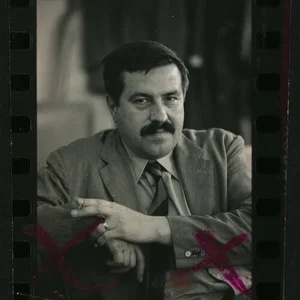

German writer, a major figure of post-war literature. His novel *The Tin Drum* (1959) examines the memory of Nazism through the eyes of a child who refuses to grow up. Nobel Prize in Literature in 1999.
Günter Grass(1953 — ?)
Günter Grass
5 min read
Frequently asked questions
Key Facts
- Born in 1927 in Danzig (today Gdańsk, Poland)
- Publishes *The Tin Drum* (Die Blechtrommel) in 1959, the first volume of the Danzig Trilogy
- Receives the Nobel Prize in Literature in 1999
- Reveals in 2006, in his autobiography *Peeling the Onion*, that he had been enlisted in the Waffen-SS as a teenager
- Died in 2015 in Lübeck
Works & Achievements
A foundational novel of postwar German literature, in which a child who refuses to grow up watches the rise and fall of Nazism. The first volume of the “Danzig Trilogy.”
A short tale about a teenager in Danzig during the war, the second volume of the trilogy.
A sweeping panorama spanning Nazism and the postwar years, which closes the “Danzig Trilogy.”
An exuberant novel that revisits history through myth and cooking, blending folktale with a meditation on the relationship between men and women.
An ambitious novel about German reunification that sparked heated critical debate.
An autobiography in which Grass looks back on his youth and reveals his conscription into the Waffen-SS.
Anecdotes
Before becoming a writer, Günter Grass had trained as a stonemason and sculptor at the fine arts academies of Düsseldorf and then Berlin. All his life, he himself drew and engraved the illustrations for his books: the pen and the pencil went together.
The hero of *The Tin Drum*, Oskar Matzerath, decides at the age of three to stop growing and deliberately throws himself down the cellar stairs to halt his growth. With his tin drum and his glass-shattering scream, he becomes the grating witness of Nazi Germany seen from below.
Grass wrote most of *The Tin Drum* in Paris, between 1956 and 1959, while living modestly off odd jobs. The book, as soon as it appeared, caused a scandal in Germany for its boldness and crudeness, before becoming a worldwide classic.
In 2006, in his autobiography *Peeling the Onion*, Grass revealed that at the age of seventeen, in 1944, he had been enlisted in the Waffen-SS. This belated confession, coming from a moral figure who had spent his life urging his compatriots to face their past, sparked an enormous controversy.
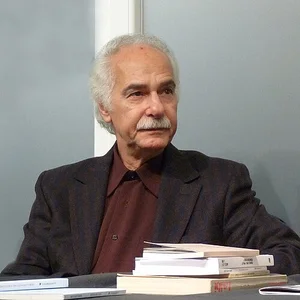
Recognizable by his mustache and his pipe, Grass was also an engaged citizen: he campaigned for the Social Democratic chancellor Willy Brandt and never hesitated to weigh in on his country's public debates.
Primary Sources
Granted: I am an inmate of a mental hospital; my keeper is watching me, he never lets me out of his sight.
To tell a story is to breathe against the current of passing time. In it, Grass defends fiction as an act of resistance against forgetting.
What, at seventeen, seemed to me an ordinary stint of military service bore — as I would learn much later — the insignia of the Waffen-SS.
Why have I stayed silent, silent far too long, about what is plain to see?
Key Places
Grass's birthplace, then a free city with a German majority, today Polish. The central setting of his “Danzig Trilogy.”
Grass studied sculpture and engraving here at the Academy of Fine Arts after the war.
He continued his artistic training at Berlin's Hochschule für bildende Künste in the 1950s.
It was in Paris, between 1956 and 1959, that Grass wrote the bulk of *The Tin Drum*.
Grass spent his final decades near Lübeck, in the village of Behlendorf, and died in Lübeck in 2015.
Here he received the Nobel Prize in Literature in December 1999.
Typical Objects

The emblematic object of little Oskar, who pounds on it to protest against the adult world. It became a literary symbol of refusal and of the memory of Nazism.

The everyday working tool of the 20th-century writer, on which Grass typed his novels after drafting them by hand.

Burins, chisels, and points that Grass, trained in the fine arts, used to sculpt and engrave. He designed the covers and illustrations of his own books.

An accessory that became a signature of Grass's public persona, featured in countless portraits of the writer.

Grass never separated writing from drawing: he accompanied his manuscripts with ink and charcoal sketches.
School Curriculum
Vocabulary & Tags
Key Vocabulary
Daily Life
Morning
Grass devoted his mornings to writing — first with a pen, then a typewriter — in his studio. He liked to work with regularity, like a craftsman at his workbench.
Afternoon
The afternoon was often given over to the other side of his art: sculpture, drawing, engraving, and watercolor, which fed into his books.
Evening
In the evening, he read, welcomed friends and fellow writers, and gladly took part in the political and literary debates of his time, pipe in hand.
Food
A lover of good food, Grass enjoyed the home cooking of Northern Germany and Poland — Baltic fish, soups, slow-cooked stews. Food, in fact, occupies a major place in his work, notably in *The Flounder*.
Clothing
He is pictured in the understated dress of an artist — jacket and sweater — with the air of a 20th-century intellectual, recognizable by his drooping mustache and his pipe.
Housing
He lived for many years in a country house in Behlendorf, near Lübeck, between his writer's desk and his artist's studio, surrounded by his graphic works.
Historical Timeline
Period Vocabulary
Liens externes & ressources
Références
Œuvres
Le Tambour (Die Blechtrommel)
1959
Le Chat et la Souris (Katz und Maus)
1961
Les Années de chien (Hundejahre)
1963
Le Turbot (Der Butt)
1977
Toute une histoire (Ein weites Feld)
1995
Pelures d'oignon (Beim Häuten der Zwiebel)
2006