
The Kiss, Vienna Secession, Art Nouveau
Gustave Klimt(1862 — 1918)
Gustave Klimt
empire d'Autriche, Autriche-Hongrie
7 min read
Frequently asked questions
Key Facts
- Gustave Klimt naît à Vienne en 1862 et devient l'un des peintres les plus représentatifs de l'Art nouveau autrichien.
- En 1897, il fonde la Sécession viennoise, un mouvement artistique cherchant à s'affranchir des académismes officiels.
- Entre 1907 et 1908, il peint Le Baiser, œuvre emblématique de sa « période dorée » caractérisée par l'usage abondant de feuilles d'or.
- Ses peintures murales pour l'Université de Vienne (1900-1907) provoquent un scandale pour leur représentation symbolique et sensuelle du corps humain.
- Il meurt en 1918 à Vienne, laissant une œuvre majeure qui influencera durablement l'art du XXe siècle, notamment l'expressionnisme autrichien.
Works & Achievements
Mural decoration for the imperial theater, which earned him official recognition and the Golden Cross of Franz Joseph. These academic frescoes contrast sharply with his future style.
An immense 34-meter frieze adorning the Secession pavilion during an exhibition dedicated to Beethoven. It illustrates the Ode to Joy and embodies the ideal of total art (Gesamtkunstwerk).
Three panels commissioned by the University of Vienna, rejected for obscenity and reclaimed by Klimt. Burned by the Nazis in 1945, they are known only through photographs.
Portrait of a femme fatale in gold and black, depicting Judith holding the head of Holofernes. The first major work of the golden period, it symbolizes the emancipated and dangerous woman.
Klimt's absolute masterpiece, combining gold leaf, geometric and floral motifs in a representation of universal love. Purchased immediately by the Austrian state, it is one of the most reproduced paintings in the world.
Portrait of a wealthy Viennese Jewish patron, entirely covered in gold leaf. Confiscated by the Nazis, restituted to the family in 2006, it is now in New York — its story inspired the film Woman in Gold.
A swirling composition depicting women at different stages of life, typical of his late period in which geometric ornaments give way to more fluid and psychological forms.
Anecdotes
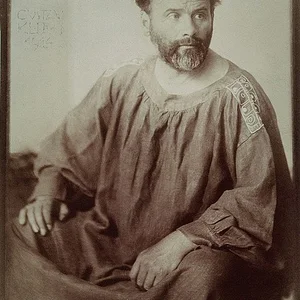
Klimt was known for working in a long blue monk's robe with nothing underneath, which he sewed himself. He claimed that this outfit gave him complete freedom of movement and mind during his painting sessions.
In 1897, Klimt co-founded the Vienna Secession with a group of artists who rejected academic rules. Their motto, engraved on the pediment of their building, was: "To every age its art, to art its freedom." This break marked a cultural revolution in Vienna.
His three paintings commissioned by the University of Vienna — Philosophy, Medicine, and Jurisprudence — were so scandalous that the professors themselves asked the State not to exhibit them. Klimt repaid the advances he had received and reclaimed his canvases, refusing any censorship.
The Kiss (1907–1908) was purchased by the Austrian State at its very exhibition, before the paint had even dried. It is one of the few works by Klimt never sold to a private collector, and it is today the most visited painting in the Belvedere in Vienna.
Klimt never wrote a manifesto or gave interviews about his art. He would say: "If you want to know something about me, look carefully at my paintings." He remained deeply secretive about his private life, although he had numerous relationships and several unacknowledged children.
Primary Sources
I am not an official artist. I refuse to carry out commissions that force me to betray my vision. Give me back my paintings.
Our association recognizes no distinction between 'high' art and 'decorative' art. We want Vienna to reclaim its place among the great artistic capitals of Europe.
To every age its art, to art its freedom. We invite artists of all disciplines to reject the artificial boundaries between the arts.
Gustav would spend hours watching women in his studio, letting them move freely before beginning to sketch. He said that movement was the soul of the body.
Key Places
Klimt's main studio from 1892, where he received numerous women as models and produced his major works. Klimt also kept a garden there with cats.
Inaugurated in 1898, this iconic landmark of Viennese modernism — nicknamed the 'golden cabbage' — hosted the Secession exhibitions and today houses the Beethoven Frieze.
Klimt spent every summer on the shores of this lake with Emilie Flöge and her family. He painted the majority of his landscapes there, seeking calm away from the bustle of Vienna.
This imperial museum holds the largest collection of Klimt's works in the world, including The Kiss and Judith I. It is the essential destination for discovering his work.
Klimt contributed to the decoration of the spandrels of this imperial museum (1890–1891), an official commission that earned him the Golden Cross and launched his career.
Typical Objects

Klimt used genuine gold leaf (24-carat gold) to enhance his canvases, a technique inherited from Byzantine mosaic art. This precious material gives his works their characteristic luminosity.

Klimt himself made long blue robes with no collar or buttons to paint in. This garment, inspired by Japanese clothing, symbolized his rejection of bourgeois conventions.

He filled dozens of sketchbooks with line drawings, particularly of female nudes. He is credited with more than 4,000 drawings, which bear witness to his meticulous observation of the human body.

For his geometric ornaments and spiral motifs, Klimt used very fine brushes, similar to those of the Japanese calligraphers he admired.

The journal of the Vienna Secession, to which Klimt contributed regularly, was itself an art object — square format, refined typography, original illustrations — a symbol of the Gesamtkunstwerk project.

Klimt collected photographs of women and Japanese woodblock prints (ukiyo-e), which he drew upon to compose his poses and decorative motifs.
School Curriculum
Vocabulary & Tags
Key Vocabulary
Daily Life
Morning
Klimt rose early, around five or six in the morning, and went directly to his studio on Josefstädter Straße. He slipped on his long blue work robe and began painting before breakfast, making the most of the morning light.
Afternoon
In the afternoon, he received his models — often women he allowed to move freely around the studio while he observed and sketched them. He could fill several pages of his sketchbook before deciding to paint. He also enjoyed tending to his cats and his garden.
Evening
In the evening, Klimt frequented Viennese cafés (Café Central, Café Landtmann) where he met with intellectuals and artists of the Secession. He often dined at the homes of bourgeois patrons or with Emilie Flöge, his lifelong companion, but always returned home alone.
Food
Klimt was a great lover of traditional Viennese cuisine: Tafelspitz (boiled beef), Gulasch, Apfelstrudel. He regularly had breakfast at a café with a Melange (Viennese café au lait) and Kipferl (crescent rolls). He was not particularly abstemious, enjoying Austrian white wine.
Clothing
Outside his studio, Klimt dressed modestly but carefully, without bourgeois ostentation. He often wore a dark coat and a hat. When painting, he wore only his blue kaftan-robe, which he made himself, with nothing underneath — a deliberate eccentricity.
Housing
Klimt lived in a functional apartment in Vienna, separate from his studio. His home was austere, contrasting sharply with the visual richness of his works. His true spiritual living space was his studio, cluttered with canvases, sketchbooks, and Oriental decorative objects, surrounded by a wild garden.
Historical Timeline
Period Vocabulary
Visual Style
Un style Art Nouveau symboliste dominé par les feuilles d'or, les motifs géométriques byzantins et japonais, opposant des fonds ornementaux abstraits à des visages et des mains traités avec un réalisme saisissant.
Sound Ambience
Un mélange de raffinement bourgeois viennois et de silence studieux d'atelier : musique de chambre, frôlement de soie, grattement de fusain et bruissement de feuilles d'or dans un studio baigné de lumière.
Liens externes & ressources
Références
Œuvres
Frise Beethoven
1902
Philosophie, Médecine, Jurisprudence (triptyque universitaire)
1900-1907
Judith I
1901
La Vierge
1913