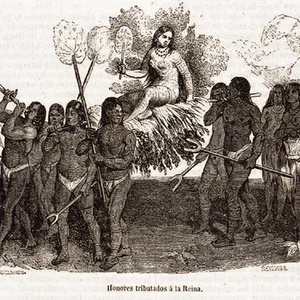

Taíno queen and poet of Hispaniola (c. 1474–1503), Anacaona was renowned for her areítos — ceremonial songs and poems passed down through oral tradition. A fierce resister of Spanish colonization, she was captured and executed by Nicolás de Ovando.
Anacaona(1474 — 1503)
Anacaona
7 min read
Frequently asked questions
Key Facts
- c. 1474: born into the Taíno people of Hispaniola (present-day Haiti/Dominican Republic)
- Before 1492: recognized as a master composer of areítos (ceremonial poetic songs passed down orally through Taíno tradition)
- 1492–1498: encounters and complex relations with Spanish colonists, including Christopher Columbus
- 1503: captured at a banquet set as a trap by Governor Nicolás de Ovando; executed by hanging
- Legacy: an iconic figure of Indigenous resistance, celebrated especially in Haiti as a national symbol
Works & Achievements
A body of ceremonial songs and oral poems composed by Anacaona for the great festivals of Xaragua. These areítos, passed down orally, narrated Taíno history and cosmogony and were admired even by Spanish chroniclers.
After the death of her brother Bohechío, Anacaona ruled alone over one of the most powerful and populous chiefdoms in Hispaniola, maintaining the social and cultural cohesion of her people in the face of growing colonial pressure.
Anacaona conducted several negotiations with Spanish representatives, seeking to preserve her people's autonomy through dialogue. Her solemn reception of Columbus's envoys in 1496 is one of the earliest documented examples of intercultural diplomacy in the Caribbean.
An oral composition of lamentation and celebration dedicated to her husband Caonabó, who died in Spanish captivity. This funeral song is cited by Bartolomé de las Casas as a testament to her poetic genius and to the collective memory of the Taíno people.
Anecdotes
During Christopher Columbus's second voyage in 1496, Anacaona organized a grand celebration at Xaragua in honor of the Spanish. She brought together more than three hundred women who danced and sang areítos in ceremonial dress. Bartolomé de las Casas recorded that the visitors were astonished by the elegance and sophistication of these festivities.
Anacaona was renowned throughout the island for her areítos — poetic songs passed down orally during Taíno ceremonies. These compositions told the history of the people, honored ancestors, and celebrated heroes. Spanish chroniclers noted that she was considered the most gifted composer of her time among the Taíno.
After the capture and death in captivity of her husband Caonabó (around 1496), followed by the death of her brother Bohechío (around 1498), Anacaona alone took the helm of the powerful chiefdom of Xaragua. She ruled with authority over a region spanning the western part of Hispaniola, becoming one of the few female chiefs recognized as such by the Spanish themselves.
In 1503, Governor Nicolás de Ovando organized a banquet to which he invited Anacaona and the leading Taíno chiefs under the pretense of negotiations. It was a trap: the Spanish surrounded and massacred the assembled caciques. Anacaona was spared in the moment, but was arrested, summarily tried, and hanged in Santo Domingo — becoming a symbol of Indigenous resistance to colonization.
According to the accounts of Bartolomé de las Casas, Anacaona refused until the very end to submit to Spanish colonial authority. When offered the chance to save her life by agreeing to become Ovando's mistress, she reportedly refused outright, choosing death over humiliation. This defiance earned her a heroic place in Haitian historical memory.
Primary Sources
Anacaona was a woman of singular wisdom and authority, very gracious in her speech and in her areítos, which are her songs and dances.
Queen Anacaona received the Spanish with magnificence, having her women dance and sing in great numbers, and offered gifts of great richness.
Anacaona was the principal lady of the province of Jaragua, a woman of great intelligence and ability, who composed songs among the indigenous people known as areítos.
The governor ordered Queen Anacaona arrested and had her hanged, pretending to do her honor.
Key Places
A powerful Taíno chiefdom covering western Hispaniola, over which Anacaona became ruler after the death of her brother Bohechío. It was here that she organized the great areíto ceremonies, and where the massacre ordered by Ovando took place in 1503.
The chiefdom ruled by Caonabó, Anacaona's husband. It was from Maguana that Caonabó led the armed resistance against the Spanish before being captured, forcing Anacaona to take on a leading political role on her own.
A city founded by the Spanish in 1496, the first European colonial capital in the Americas. It was in Santo Domingo that Anacaona was summarily tried and executed by hanging in 1503, on the orders of Governor Ovando.
A large Caribbean island, the heart of the Taíno world and the first territory to be permanently colonized by Spain. Anacaona was born, lived, and died here, and her story stands as one of the island's most tragic founding chapters.
Typical Objects

Ceremonial seat carved from wood or stone, reserved for Taíno caciques and chiefs. As cacique of Xaragua, Anacaona sat on a duho during ceremonies and audiences with the Spanish.

Religious idol or effigy representing Taíno ancestral spirits, crafted from wood, stone, or cotton. Anacaona venerated them as part of the rituals that accompanied her areítos and important governance decisions.

Musical instruments used to accompany areítos, the ritual and poetic songs of which Anacaona was the foremost composer. Gourd maracas and wooden drums kept the rhythm of her ceremonial performances.

Disc-shaped ornament made from an alloy of gold, copper, and silver, worn by Taíno caciques as a symbol of prestige and spiritual authority. Anacaona likely wore one during official ceremonies and when receiving the Spanish.

Woven cotton resting net, a Taíno invention later adopted by European sailors. Within the domestic space of the bohíos, hammocks structured the daily life and rest of Anacaona and her court.

Earthenware griddle used to cook casabe, a flatbread made from cassava flour and a staple food of the Taíno people. The preparation and sharing of casabe played a central role in the banquets over which Anacaona presided.
School Curriculum
Vocabulary & Tags
Key Vocabulary
Tags
Daily Life
Morning
Anacaona began her day with spiritual rituals dedicated to the zemís, ancestral spirits she honored in her role as cacique. She then received counsel from her advisors (nitaínos) on the affairs of the chiefdom of Xaragua, settling disputes and making political decisions.
Afternoon
Afternoons were often devoted to preparing ceremonies or composing new areítos, in collaboration with the court's singers and dancers. She also oversaw the management of collective resources: organizing cassava cultivation, redistributing food supplies, and preparing ceremonial feasts.
Evening
Evenings brought the community together around the fire for grand areíto ceremonies, where Anacaona presided and sometimes sang her own compositions. These gatherings were at once religious, political, and artistic, reinforcing the collective identity of the Taíno people of Xaragua.
Food
The Taíno diet was based primarily on casabe (cassava flatbread), corn, sweet potato, beans, and tropical fruits (pineapple, guava, papaya). Anacaona and her court also ate fish, crabs, and iguanas. During major celebrations, communal feasts brought together hundreds of people.
Clothing
As cacique, Anacaona wore distinctive ornaments: a guanín (gold disk) around her neck, colorful feather adornments, and shell bracelets. Like most adult Taínos, she wore the nagua, a woven cotton skirt, leaving the torso largely bare and decorated with body paint in red (achiote) and black (jagua).
Housing
Anacaona lived in a caney, a large round dwelling reserved for Taíno chiefs, far more spacious than ordinary bohíos. Built from wood and palm leaves, it was richly decorated with hanging zemís and guanins. The caney served as residence, council chamber, and ceremonial space all at once.
Historical Timeline
Period Vocabulary
Visual Style
Esthétique taïno des Antilles : peintures corporelles géométriques, ornements en or et plumes, palette dominée par les rouges ocres, les verts tropicaux et le turquoise des Caraïbes.
Sound Ambience
Ambiance sonore d'une cérémonie taïno à Xaragua : percussions rituelles, chant choral féminin des areítos, oiseaux tropicaux et vagues des Caraïbes en toile de fond.
Liens externes & ressources
Références
Œuvres
Areítos de Xaragua
vers 1490-1503
Gouvernement du caciquat de Xaragua
vers 1498-1503
Diplomatie avec les Espagnols
1496-1503
Areíto en hommage à Caonabó
vers 1496